
Do students know basic legal vocabulary? Differences by gender and education in Spain and Latin America
DOI:
https://doi.org/10.24310/isl.19.2.2024.20987Keywords:
legal competence, lexical availability, legal lexiconAbstract
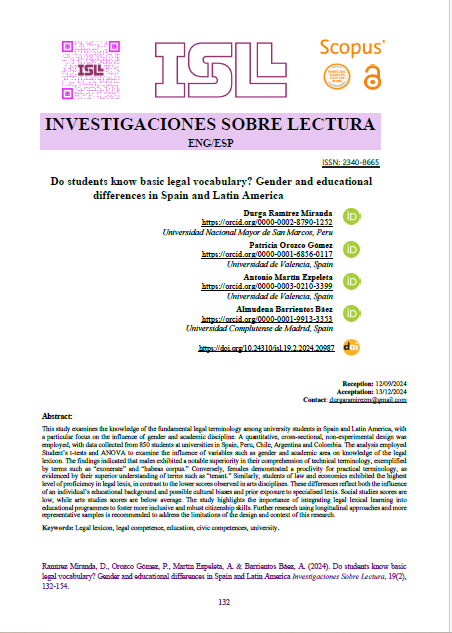
This study examines the knowledge of the fundamental legal terminology among university students in Spain and Latin America, with
a particular focus on the influence of gender and academic discipline. A quantitative, cross sectional, non experimental des ign was
employed, with data collected from 850 students at universities in Spain, Peru, Chile, Argentina and Colombia. The analysis employed
Student s t tests and ANOVA to examine the influence of variables such as gender and academic area on knowledge of the legal
lexicon. The findings indicated that males exhibited a notable superiority in their comprehension of technical terminology, exemplified
by terms such as exonerate and habeas corpus. Conversely, females demonstrated a proclivity for practical terminology, as
evidenced by their superior understanding of terms such as tenant. Similarly, students of law and economics exhibited the highest
level of proficiency in legal lexis, in contras t to the lower scores observed in arts disciplines. These differences reflect both the influence
of an individual s educational background and possible cultural biases and prior exposure to specialised lexis. Social studies scores are
low, while arts studi es scores are below average. The study highlights the importance of integrating legal lexical learning into
educational programmes to foster more inclusive and robust citizenship skills. Further research using longitudinal approaches and more
representativ e samples is recommended to address the limitations of the design and context of this research.
Downloads
Metrics
References
Arbó Marro, C., & Miguel Romera, E. (2020). De ley. Manual de español jurídico. Edinumen. https://www.redalyc.org/pdf/921/92152423014.pdf
Adams, A. y Andreis, A.M. (2012). Espacialidad e intersubjetividad en la constitución de la ciudadanía: el papel de la escuela. En Educar para la participación ciudadana en la enseñanza de las Ciencias Sociales (vol. I, pp. 101-108). Díada Editora.
Aguirre-Beltrán, B. (2001). El español para la comunicación profesional. Enfoque y orientaciones didácticas. En Español para Fines Específicos. Actas del I Congreso Internacional de Español para Fines Específicos (pp. 33-43). Ministerio de Educación, Cultura y Deporte.
Alam, M. S., y Asmawi, A. (2023). Chat GPT in Constructivist Language Pedagogy: Exploring Its Potential and Challenges in Legal Vocabulary Acquisition. Applied Research on English Language, 12(4), 131-148. DOI: 10.22108/are.2024.139708.2188
Bastidas-García, E. M. (2016). Las colocaciones en el español jurídico y su tratamiento en el aula de español para extranjeros [Tesis doctoral. Universitat de València]. http://hdl.handle.net/10550/58170
Beaty, R. E., Silvia, P. J., Nusbaum, E. C., Jauk, E., y Benedek, M. (2014). The roles of associative and executive processes in creative cognition. Memory & Cognition, 42(7), 1186-1197. https://doi.org/10.3758/s13421-014-0428-8
Calahorro-Merina, E.M. (2015). La enseñanza de Español para Fines Específicos. El español jurídico [Tesis doctoral. Universidad de Málaga]. http://hdl.handle.net/10630/13546
Campos Pardillos, M. Á., & Calvo Ferrer, J. R. (2023). La enseñanza/aprendizaje del léxico jurídico: dificultades y especificidad de un componente difuso. En Realidades y desafíos de la tecnología aplicada a la traducción e interpretación (pp. 179-190). Peter Lang.
Carranza Alcántar, M. del R. (2016). El uso de las TIC en la enseñanza y el aprendizaje del Derecho. Revista Educ@rnos, 15, 151-167. https://revistaeducarnos.com/wp-content/uploads/2016/10/articulo-maria-del-rocio.pdf
Cervantes-Ayala, P.A. (2020). Aproximaciones hacia una política educativa para la alfabetización jurídica. Revista de Investigación en Derecho, Criminología y Consultoría Jurídica, 14(27), 203-225.
Chamorro Guerrero, A. (2020). El enfoque léxico en la enseñanza del español jurídico. En La enseñanza del español con fines específicos (pp. 139-156). En Ediciones Académicas. https://1library.co/article/el-enfoque-l%C3%A9xico-la-ense%C3%B1anza-del-espa%C3%B1ol-jur%C3%ADdico.z3d917w9
Cownie, F., Bradney, A., & Jones, E. (Eds.). (2025). Elgar Concise Encyclopedia of Legal Education. Edward Elgar Publishing. https://www.e-elgar.com/shop/usd/elgar-concise-encyclopedia-of-legal-education-9781035302925.html
De Alba-Fernández, N., García-Pérez, F.F y Santisteban-Fernández, A. (2012). Educar para la participación ciudadana en la enseñanza de las ciencias sociales. Díada Editora.
Del Valle Cacela, V. (2020). Algunas observaciones sobre las colocaciones en el lenguaje jurídico español. Lublin Studies in Modern Languages and Literature, 44(2), 1-12. https://journals.umcs.pl/lsmll/article/view/10455
González Hernández, E., & Hernando García-Cervigón, A. (2020). Nuevas herramientas de enseñanza del lenguaje jurídico: elaboración de un glosario jurídico audiovisual. En Actas del Congreso Internacional Nodos del Conocimiento 2020. https://2020.nodos.org/ponencia/nuevas-herramientas-de-ensenanza-del-lenguaje-juridico-elaboracion-de-un-glosario-juridico-audiovisual/
Gutiérrez, M. (2021). El español jurídico: aproximación didáctica integradora a partir de una perspectiva discursiva. En Actas del Congreso Internacional de Español para Fines Específicos (pp. 85-102). Instituto Cervantes. https://cvc.cervantes.es/ensenanza/biblioteca_ele/publicaciones_centros/PDF/viena_2021/05_gutierrez.pdf
International Bar Association & Law Schools Global League. (2020). Blueprint for Global Legal Education. IE Law School. https://www.ie.edu/law-school/knowledge-exchange/blueprint-global-legal-education/
Instituto Cervantes (2008). Diccionario de términos clave en ELE. https://cvc.cervantes.es/Ensenanza/biblioteca_ele/diccio_ele/default.htm
Jiménez-Pérez, E. P., Cerezo-Guzmán, M. V., García-Guirao, P., Gutiérrez-Fresneda, R. (2025). Validación de herramienta de competencia legal. (En prensa).
Jiménez-Pérez, E. P. (2023). Critical Thinking VS Critical Competence: Critical Reading. Investigaciones Sobre Lectura, 18(1), 1-26. https://doi.org/10.24310/isl.vi18.15839
Macià, E. (2016). Didáctica de la traducción de la terminología jurídica en textos especializados. [Tesis doctoral, Universidad de Vic]. https://repositori.uvic.cat/bitstream/handle/10854/4613/tesdoc_a2016_macias_elena_didactica_traduccion.pdf
Nation, I. S. P. (2001). Learning Vocabulary in Another Language. Cambridge University Press.
Organización de las Naciones Unidas (ONU). (2015). Transformar nuestro mundo: La Agenda 2030 para el Desarrollo Sostenible. https://www.un.org/sustainabledevelopment/es/
Ortiz-Sánchez, M. y Pérez-Pino, V. (2004). Léxico jurídico para estudiantes. Tecnos.
Real Decreto 157/2022, de 1 de marzo, por el que se establecen la ordenación y las enseñanzas mínimas de la Educación Primaria.
Real Decreto 217/2022, de 29 de marzo, por el que se establece la ordenación y las enseñanzas mínimas de la Educación Secundaria Obligatoria.
Recomendaciones del Consejo, de 22 de mayo de 2018, relativa a las competencias clave para el aprendizaje permanente. Diario Oficial de la Unión Europea C189.
Rodríguez Tapia, S. (2023). Percepción, terminología e interlocutores del discurso jurídico en el grado de especialización textual. Círculo de Lingüística Aplicada a la Comunicación, 94, 137-152. https://doi.org/10.5209/clac.70744
Sanz i Vilar, E., & Sevilla-Vallejo, S. (2020). El español jurídico: propuesta de intervención en el aula de español con fines específicos. Revista de Lenguas para Fines Específicos, 27(1), 113-139. https://ojsspdc.ulpgc.es/ojs/index.php/LFE/article/view/1354
Schmitt, N. (2000). Vocabulary in Language Teaching. Cambridge University Press.
Downloads
Published
How to Cite
Issue
Section
License
Copyright (c) 2024 Durga Edelmira Ramírez Miranda, Patricia Orozco Gómez, Antonio León Martín Ezpeleta, Almudena Barrientos-Báez

This work is licensed under a Creative Commons Attribution-NonCommercial-ShareAlike 4.0 International License.
All contents published in Investigaciones sobre Lectura are protected under the Creative Commons Attribution-NonCommercial-ShareAlike 4.0 International (CC BY-NC-SA 4.0) license. All about this license is available in the following link: <http://creativecommons.org/licenses/by-nc-sa/4.0>
Users can copy, use, redistribute, share and exhibit publicly as long as:
- The original source and authorship of the material are cited (Journal, Publisher and URL of the work).
- It is not used for comercial purposes.
- The existence of the license and its especifications are mentioned.
There are two sets of authors’ rights: moral and property rights. Moral rights are perpetual prerogatives, unrenounceable, not-transferable, unalienable, imprescriptible and inembargable. According to authors’ rights legislation, Investigaciones sobre Lectura recognizes and respects authors moral rights, as well as the ownership of property rights, which will be transferred to University of Malaga in open access. The property rights are referred to the benefits that are gained by the use or the dissemination of works. Investigaciones sobre Lectura is published in an open access form and it is exclusively licenced by any means for doing or authorising distribution, dissemination, reproduction, , adaptation, translation or arrangement of works.
Authors are responsable for obtaining the necessary permission to use copyrighted images.



31.png)