
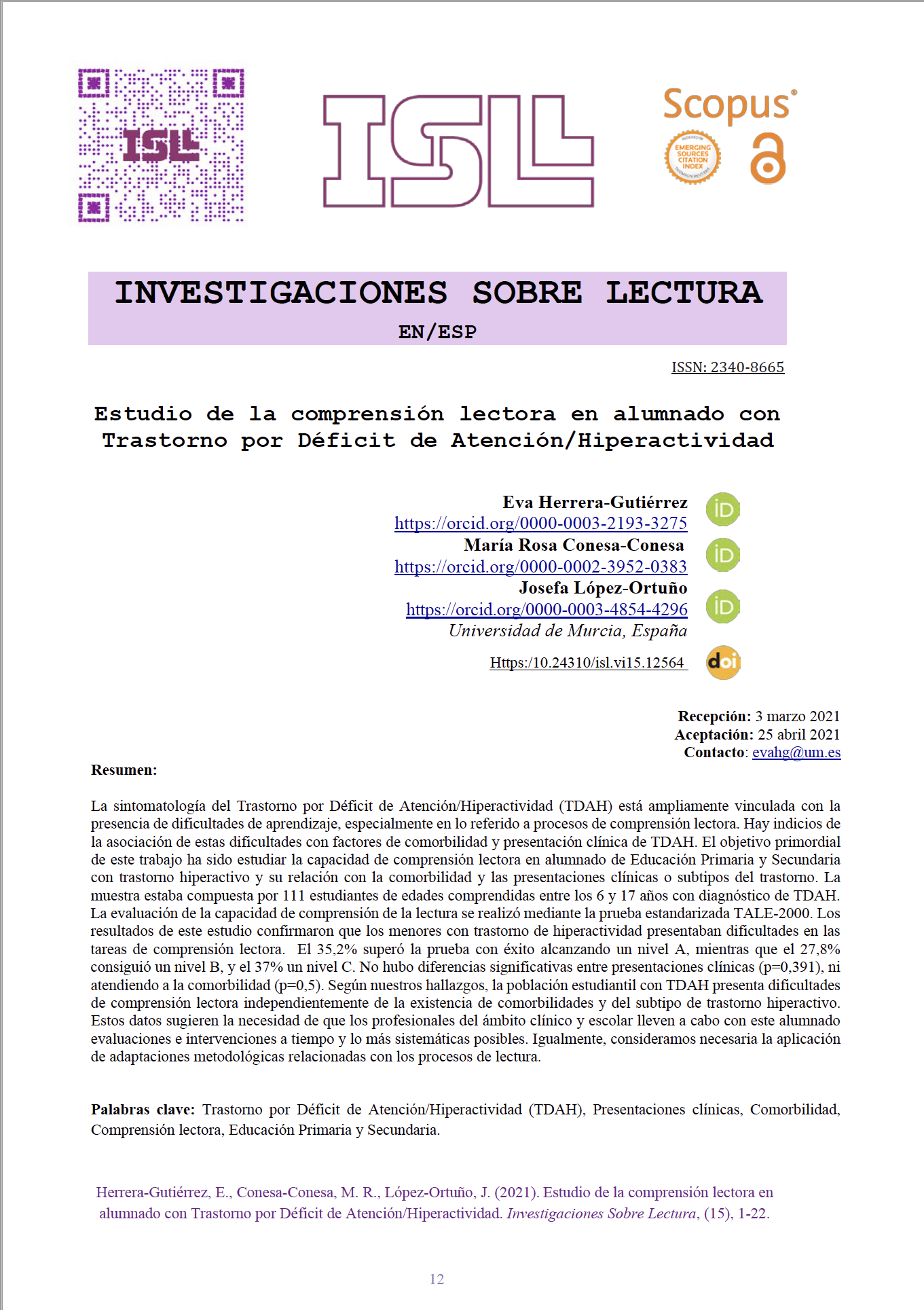
Estudio de la comprensión lectora en alumnado con Trastorno por Déficit de Atención/Hiperactividad
Study of Reading Comprehension in Students with ADHD
DOI:
https://doi.org/10.24310/isl.vi15.12564Keywords:
Attention Deficit / Hyperactivity Disorder (ADHD), Clinical Presentations, Comorbidity, Reading Comprehension, Primary and Secondary EducationAbstract
The symptoms of Attention Deficit / Hyperactivity Disorder (ADHD) are widely linked to the presence of learning difficulties, especially regarding reading comprehension processes. There is evidence between these difficulties with comorbidity factors and clinical presentation of ADHD. The main objective of this work has been to study the reading comprehension capacity in Primary and Secondary Education students with hyperactive disorder and its relationship with comorbidity and clinical presentations or subtypes of the disorder. The sample consisted of 111 students across ages 6 to 17 diagnosed with ADHD. The assessment of reading comprehension capacity was carried out using the TALE-2000 standardized test. The results of this study confirmed that children with hyperactivity disorder had difficulties in reading comprehension tasks. 35.2% successfully passed the test reaching a level A, while 27.8% achieved a level B, and 37% a level C. There were no significant differences between clinical presentations (p = 0.391). nor considering comorbidity (p = 0.5). According to these findings, the student population with ADHD presents reading comprehension difficulties regardless of the existence of comorbidities and the subtype of hyperactive disorder. These data suggest the need for clinical and school professionals to carry out evaluations and interventions with these students on time and as systematic as possible. Likewise, it should be considered to apply methodological adaptations related to reading processes.
Downloads
Metrics
References
Aguilera, S., Mosquera, A. y Blanco, M. (2014). Trastornos de Aprendizaje y TDAH. Diagnóstico y Tratamiento. Pediatría Integral, XVIII(9), 655-659.
American Psyquiatric Association (2013). Diagnostic and Statistical Manual of Mental Disorders (5th edition). DSM-5. Washington, DC: Author.
Artigas-Pallarés, J. (2009). Modelos cognitivos en el trastorno por dèficit de atención/hiperactividad. Revista de Neurología, 49(11), 587-593.
Baddeley, A.D., & Hitch, G.J. (2000). Development of working memory: should the Pascual-Leone and the Baddeley and Hitch models be merged? Journal of Experimental Child Psychology, 77(2), 128-137. doi: 10.1006/jecp.2000.2592
Baddeley, A.D., & Logie, R.H. (1999). Working memory: The multiple-component model. In A. Miyake & P. Shah (Eds.), Models of working memory: Mechanisms of active maintenance and executive control (pp. 28-61). Cambridge: Cambridge University Press.
Barkley, R.A. (2005). ADHD and the nature of self-control. New York: Guilford Press.
Barkley, R.A. (2013). Distinguishing sluggish cognitive tempo from ADHD in children and adolescents: Executive functioning, impairment, and comorbidity. Journal of Clinical Child & Adolescent Psychology, 42(2), 161-173. doi: 10. 1080/15374416.2012.734259
Canet-Juric, L., Urquijo, S., Richard’s, M.M. y Burin, D. (2009). Predictores cognitivos de niveles de comprensión lectora mediante análisis discriminante. International Journal of Psychological Research, 2(2), 99-111.
Cardo, E., Ros-Cervera, G., Eirís-Puñal, J., Escofet-Soteras, C., Fernández-Jaén, A., Mulas, F., ... Grupo de Trabajo de TDAH de la Sociedad Española de Neurología Pediátrica. (2017). Estado actual del enfoque del trastorno por déficit de atención/hiperactividad en neuropediatría. Revista Neurología, 64(Supl. 1), S105-S109. doi: 10.33588/rn.64S01.2017033
Cardona-Tangarife, M.A. y Varela-Cifuentes, V. (2017). Desempeño lector en niños con diagnóstico de TDAH (Trastorno de Déficit de Atención con Hiperactividad). Psicogente, 20(37), 99-118. doi: 10.17081/psico.20.37.2421
Castrillón, E.M., Morillo, S. y Restrepo, L.A. (2020). Diseño y aplicación de estrategias metacognitivas para mejorar la comprensión lectora en estudiantes de secundaria. Ciencias Sociales y Educación, 9(17), 203-231. doi: 10.22395/csye.v9n17a10
Conesa-Conesa, M.R., Herrera-Gutiérrez, E. y López-Ortuño, J. (2020). TDAH, problemas de lectoescritura y Teoría del Déficit Múltiple. En A. Díez Mediavilla y R. Gutiérrez Fresneda (Coords.), Lectura y dificultades lectoras en el siglo XXI (pp. 560-574). Barcelona: Octaedro.
Cromley, J.G., Snyder-Hogan, L.E., & Luciw-Dubas, U.A. (2010). Cognitive activities in complex science text and diagrams. Contemporary Educational Psychology, 35(1), 59–74. doi: 10.1016/j.cedpsych.2009.10.002
Cuetos, F. (2014). Psicología de la lectura (7ª ed.). Madrid: Wolters Kluwer.
Daucourt, M.C., Erbeli, F. Little, C.W., Haughbrook, R., & Hart, S.A. (2020). Meta-Analytical Review of the Genetic and Environmental Correlations between Reading and Attention-Deficit/Hyperactivity Disorder Symptoms and Reading and Math. Scientific Studies of Reading, 24(2), 23-56. doi: 10.1080/10888438.2019.1631827.
De La Hoz Vásquez, M.G. y Rodríguez-Hernández, M.I. (2018). Relación de los movimientos oculares sacádicos y la comprensión lectora con el déficit de atención e hiperactividad (TDAH). Inclusión & Desarrollo, 6(1), 137-149. doi : 10.26620/uniminuto.inclusion.6.1.2019.137-149
Demagistri, M.S, Richards, M.M. y Canet-Juric, L. (2014). Incidencia del Funcionamiento Ejecutivo en el Rendimiento en Comprensión Lectora en Adolescentes. Electronic Journal of Research in Educational Psychology, 12(2), 343-370. doi: 10.14204/ejrep.33.13146
Diamond, A. (2013). Executive functions. Annual Review of Psychology, 64, 135-168. doi: 10.1146/annurev-psych-113011-143750
Ericsson, K.A., & Kintsch, W. (2000). Shortcomings of generic retrieval structures with slots of the type that Gobet (1993) proposed and modelled. British Journal of Psychology, 91, 571-590.
Fernández, M.I., Miranda, A., García, R. y Colomer, C. (2011). Diferencias entre sujetos con TDAH con y sin dificultades en comprensión lectora: los procesos de la compresión lectora. International Journal of Developmental and Educational Psychology, 3(1), 277-286.
Fernández-Jaén, A., Fernández-Mayoralas, D.M., Fernández-Perrone, A.L, Jiménez, A., Albert, J., López-Martín, S., ... López-Arribas, S. (2018). Neurodesarrollo y fenocopias del trastorno por déficit de atención/ hiperactividad: diagnóstico diferencial. Revista de Neurología, 66(Suppl. 1), S103-S107.
Friedman, L.M., Rapport, M.D., Raiker, J.S., Orban, S.A., & Eckrich, K.S. (2017). Reading Comprehension in Boys with ADHD: The Mediating Roles of Working Memory and Orthographic Conversion. Journal of Abnormal Child Psychology, 45(2), 273-287. doi: 10.1007/s10802-016-0171-7
Ghelani, K., Sidhu, R., Jain, U., & Tannock, R. (2004). Reading comprehension and reading related abilities in adolescents with reading disabilities and attention-deficit/hyperactivity disorder. Dislexia, 10(4), 364-384. doi: 10.1002/dys.285
Gutiérrez-Martínez, F. y Ramos, M. (2014). La memoria operativa como capacidad predictora del rendimiento escolar. Estudio de adaptación de una medida de memoria operativa para niños y adolescentes. Psicología Educativa, 20, 1-10. doi: 10.1016/j.pse.2014.05.001
Herrera-Gutiérrez, E., López-Ortuño, J., Conesa Conesa, M.R. y Giménez Palacios, J.A. (2016). La comprensión lectora en estudiantes con Trastorno por Déficit de Atención/Hiperactividad de Educación Primaria. En J.L. Castejón (Coord.), Psicología y Educación: Presente y Futuro (pp. 1690-1698). Madrid: ACIPE.
Hidalgo, M.I. y Sánchez, L. (2014). Trastorno por Déficit de Atención e Hiperactividad: Manifestaciones clínicas y evolución. Diagnóstico desde la evidencia científica. Pediatría Integral, XVIII(9), 609-623.
Injoque-Ricle, I., Barreyro, J.P., Calero, A. y Burin, D.I. (2012). Memoria de Trabajo y vocabulario: Un modelo de interacción entre los componentes del modelo de Baddeley y el sistema de información verbal cristalizada. Cuadernos de Neuropsicología, 6(1), 33-45. doi: 10.7714/cnps/6.1.202
Lara, E.M. y Salazar, E.A. (2019). Competencia lectora de los estudiantes que ingresan a la Secundaria en la Unidad Educativa Fiscomisional Sagrado Corazón. Revista Científica Hallazgos21, 4(3), 240-249.
Larson, K., Russ, S.A., Kahn, R.S., & Halfon, N. (2011). Patterns of comorbidity, functioning, and service use for US children with ADHD, 2007. Pediatrics, 127(3), 462-470. doi: 10.1542/peds.2010-0165
López Ortuño, J. (2015). Estudio descriptivo del Trastorno por Déficit de Atención con Hiperactividad (TDAH): perfil psicoeducativo y comorbilidad en los diferentes subtipos. Tesis Doctoral. Murcia: Universidad de Murcia.
Martín, R. (2016). Comorbilidad entre el trastorno por déficit de atención e hiperactividad y la dislexia en adolescentes: las funciones ejecutivas como endofenotipo. Tesis Doctoral. La Laguna: Universidad de la Laguna.
Miranda, A., Fernández, M.A., García, R., Roselló, B. y Colomer, C. (2011). Habilidades lingüísticas y ejecutivas en el Trastorno por Déficit de Atención (TDAH) y en las Dificultades de Comprensión Lectora (DCL). Psicothema, 23(4), 688-694.
Montesdeoca Arteaga, D.V., Gómez-Parra, M.E. y Espejo Mohedano, R. (2020). Estrategias de enseñanza de la comprensión lectora aplicadas y percibidas: un estudio con docentes y estudiantes de cuarto grado de educación básica de Manabí-Ecuador. Investigaciones Sobre Lectura, 14, 165-180. doi: 10.37132/isl.v0i14.321
Norris, D. (2017). Short-Term Memory and Long-Term Memory are Still Different. Psychological Bulletin, 143(9), 992-1009. doi: 10.1037/bul0000108
Pascual-Gómez, I. y Carril-Martínez, I. (2017). Relación entre la comprensión lectora, la ortografía y el rendimiento: un estudio en Educación Primaria. Ocnos, 16(1), 7-17. doi: 10.18239/ocnos_2017.16.1.1167
Peng, P., Sha, T., & Li, B. (2013). The deficit profile of working memory, inhibition, and updating in Chinese children with reading difficulties. Learning and Individual Differences, 25, 111-117. doi: 10.1016/j.lindif.2013.01.012
Pimperton, H., & Nation, K. (2010). Suppressing irrelevant information from working memory: Evidence for domain-specific deficits in poor comprehenders. Journal of Memory and Language, 62(4), 380-391. doi: 10.1016/j.jml.2010.02.005
Piñeiro-Dieguez, B., Balanzá-Martínez, V., García-García, P., Soler-López, B., & CAT Study Group (2016). Psychiatric Comorbidity at the Time of Diagnosis in Adults With ADHD: The CAT Study. Journal of Attentional Disorders, 20(12), 1066-1075. doi: 10.1177/1087054713518240
Tamm, L., Epstein, J.N., Denton, C.A., Vaughn, A.J., Peugh, J., & Willcutt, E.G. (2014). Reaction time variability associated with reading skills in poor readers with ADHD. Journal of the International Neuropsychological Society, 20(3), 292–301. doi: 10.1017/s1355617713001495
Toro, J., Cervera, M. y Urío, C. (2000). EMLE Escalas Magallanes de Lectura y Escritura. TALE-2000: Manual de referencia. Bizcaia: ALBOR-COHS.
Van Dijk, T.A. (2006). Discourse, context and cognition. Discourse Studies, 8(1), 159-177.
Viramontes, E., Amparán, A. y Núñez, L.D. (2019). Comprensión lectora y el rendimiento académico en Educación Primaria. Investigaciones Sobre Lectura, 12, 65-82. doi: 10.37132/isl.v0i12.264.
Willcutt, E.G., & Pennington, B.F. (2000). Comorbidity of Reading Disability and Attention-Deficit/Hyperactivity Disorder: Differences by Gender and Subtype. Journal of Learning Disabilities, 33(2), 179-191. doi: 10.1177/00222194000330
Downloads
Published
How to Cite
Issue
Section
License
All contents published in Investigaciones sobre Lectura are protected under the Creative Commons Attribution-NonCommercial-ShareAlike 4.0 International (CC BY-NC-SA 4.0) license. All about this license is available in the following link: <http://creativecommons.org/licenses/by-nc-sa/4.0>
Users can copy, use, redistribute, share and exhibit publicly as long as:
- The original source and authorship of the material are cited (Journal, Publisher and URL of the work).
- It is not used for comercial purposes.
- The existence of the license and its especifications are mentioned.
There are two sets of authors’ rights: moral and property rights. Moral rights are perpetual prerogatives, unrenounceable, not-transferable, unalienable, imprescriptible and inembargable. According to authors’ rights legislation, Investigaciones sobre Lectura recognizes and respects authors moral rights, as well as the ownership of property rights, which will be transferred to University of Malaga in open access. The property rights are referred to the benefits that are gained by the use or the dissemination of works. Investigaciones sobre Lectura is published in an open access form and it is exclusively licenced by any means for doing or authorising distribution, dissemination, reproduction, , adaptation, translation or arrangement of works.
Authors are responsable for obtaining the necessary permission to use copyrighted images.




31.png)