
Satisfaction and Organizational Culture in Clinical Learning Environments for Nursing Students: An Integrative Review
DOI:
https://doi.org/10.24310/rep.10.2.2025.22068Keywords:
External practices, Nursing, Mentoring, Literature review, University teachingAbstract
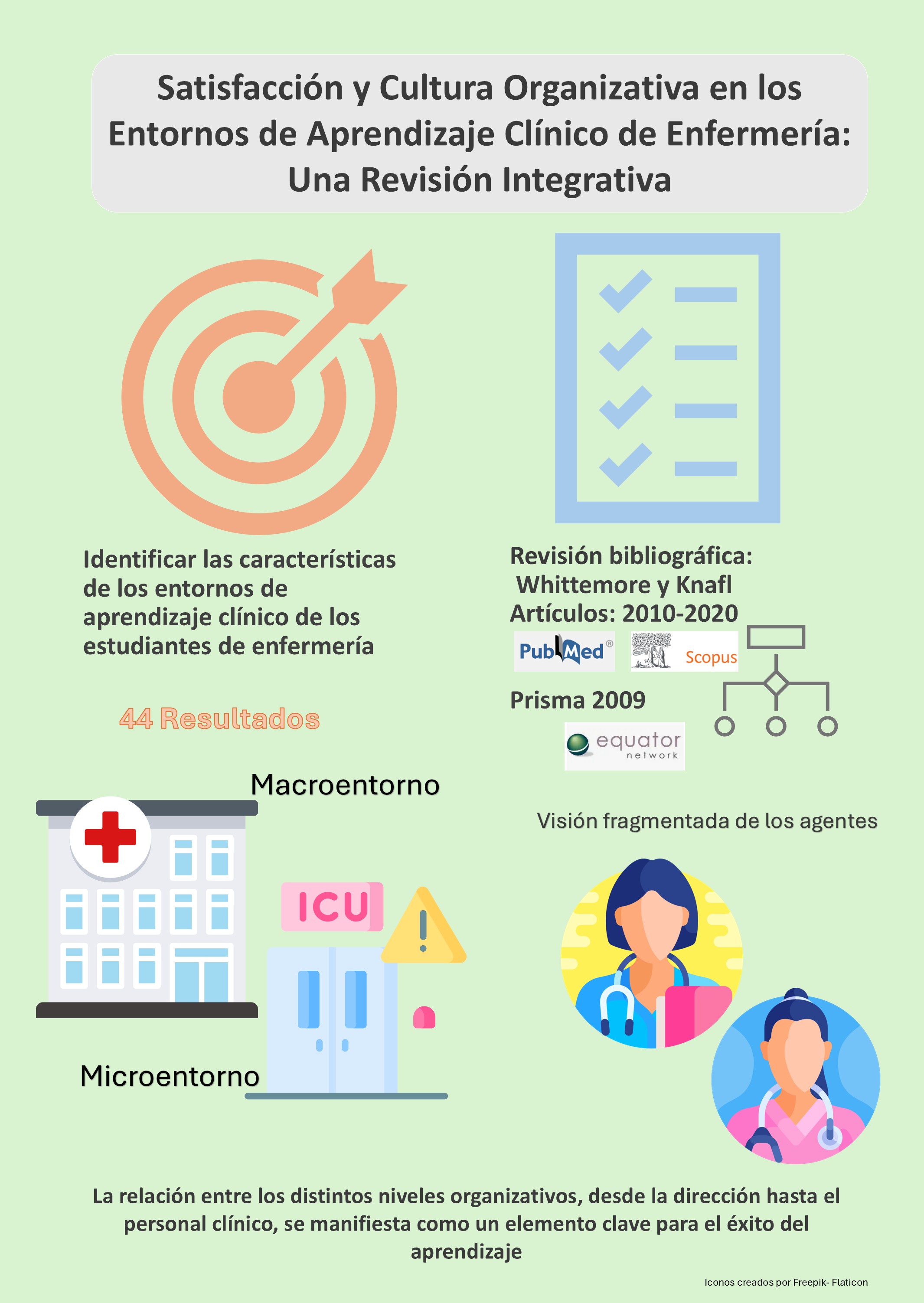
The study aims to identify the characteristics of clinical learning environments for nursing students. The method consists of a literature review based on the Whittemore and Knafl model. Articles published between 2010 and 2020 that analysed clinical nursing learning environments using validated tools and/or studied the satisfaction of those involved in learning were included. Forty-four studies were selected. Aspects of the clinical learning environment were identified, both at the institutional level (macroenvironment) and at the unit level (microenvironment), as well as the agents involved in the learning process. Among the results, we found that there is a fragmented view of the environments, as the studies focus on isolated aspects of the context or its agents. After analysis, it was observed that the relationship between the different organisational levels, from management to clinical staff, is a key element for successful learning, as it facilitates a collaborative culture that enhances teaching and the integration of students into the clinical environment.
Downloads
References
Alves, E., & Cogo, A. (2014). Nursing students’ perception of learning process in a hospital setting. Gaúcha Enferm, 35(1), 102–109. https://doi.org/10.1590/1983-1447.2014.01.42870
Arkan, B., Ordin, Y., & Yilmaz, D. (2018). Undergraduate nursing students’ experience related to their clinical learning environment and factors affecting to their clinical learning process. Nurse Education in Practice, 29, 127–132. https://doi.org/10.1016/j.nepr.2017.12.005
Beal, J. A., & Riley, J. M. (2019). Best organizational practices that foster scholarly nursing practice in Magnet® hospitals. Journal of Professional Nursing, 35(3), 187–194. https://doi.org/10.1016/j.profnurs.2019.01.001
Bisholt, B., Ohlsson, U., Engström, A. K., Johansson, A. S., & Gustafsson, M. (2014). Nursing students’ assessment of the learning environment in different clinical settings. Nurse Education in Practice, 14(3), 304–310. https://doi.org/10.1016/j.nepr.2013.11.005
Bourgeois, S., Drayton, N., & Brown, A. M. (2011). An innovative model of supportive clinical teaching and learning for undergraduate nursing students: The cluster model. Nurse Education in Practice, 11(2), 114–118. https://doi.org/10.1016/j.nepr.2010.11.005
Chan, A., Tang, F., Choi, K. C., Liu, T., & Taylor-Piliae, R. E. (2018). Clinical learning experiences of nursing students using an innovative clinical partnership model: A non-randomized controlled trial. Nurse Education Today, 68, 121–127. https://doi.org/10.1016/j.nedt.2018.06.001
Chuan, O. L., & Barnett, T. (2012). Student, tutor and staff nurse perceptions of the clinical learning environment. Nurse Education in Practice, 12(4), 192–197. https://doi.org/10.1016/j.nepr.2012.01.003
Congdon, G., Baker, T., & Cheesman, A. (2013). Enhancing the strategic management of practice learning through the introduction of the role of Learning Environment Manager. Nurse Education in Practice, 13(2), 137–141. https://doi.org/10.1016/j.nepr.2012.08.005
Díaz, C. (2018). Qualitative research and thematic content analysis. Intellectual orientation of Universum journal. Revista General de Información y Documentación, 28(1), 119–142. https://doi.org/10.5209/RGID.60813
Dimitriadou, M., Papastavrou, E., Efstathiou, G., & Theodorou, M. (2015). Baccalaureate nursing students’ perceptions of learning and supervision in the clinical environment. Nursing and Health Sciences, 17, 236–242. https://doi.org/10.1111/nhs.12174
D’Souza, M. S., Karkada, S. N., Parahoo, K., & Venkatesaperumal, R. (2015). Perception of and satisfaction with the clinical learning environment among nursing students. Nurse Education Today, 35(6), 833–840. https://doi.org/10.1016/j.nedt.2015.02.005
Engström, M., Löfmark, A., Ugland Vae, K. J., & Mårtensson, G. (2017). Nursing students’ perceptions of using the Clinical Education Assessment tool AssCE and their overall perceptions of the clinical learning environment - A cross-sectional correlational study. Nurse Education Today, 51, 63–67. https://doi.org/10.1016/j.nedt.2017.01.009
European Parliament and the Council of the European Union. (2013). Directive 2013/55/EU of the European Parliament and of the Council of 20 November 2013 amending Directive 2005/36/EC on the recognition of professional qualifications and Regulation. Official Journal of the European Union, 354, 132–170.
Flott, E. A., & Linden, L. (2016). The clinical learning environment in nursing education: a concept analysis. Journal of Advanced Nursing, 72(3), 501–513. https://doi.org/10.1111/jan.12861
Günay, U., & Kılınç, G. (2018). The transfer of theoretical knowledge to clinical practice by nursing students and the difficulties they experience: A qualitative study. Nurse Education Today, 65, 81–86. https://doi.org/10.1016/j.nedt.2018.02.031
Gurková, E., Žiaková, K., Cibríková, S., Magurová, D., Hudáková, A., & Mrosková, S. (2016). Factors influencing the effectiveness of clinical learning environment in nursing education. Central European Journal of Nursing and Midwifery, 7(3), 470–475. https://doi.org/10.15452/CEJNM.2016.07.0017
Hegenbarth, M., Rawe, S., Murray, L., Arnaert, A., & Chambers-Evans, J. (2015). Establishing and maintaining the clinical learning environment for nursing students: A qualitative study. Nurse Education Today, 35(2), 304–309. https://doi.org/10.1016/j.nedt.2014.10.002
Henderson, A., Cooke, M., Creedy, D., & Walker, R. (2012). Nursing students’ perceptions of learning in practice environments: A review. Nurse Education Today, 32(3), 299–302. https://doi.org/10.1016/j.nedt.2011.03.010
Henriksen, N., Normann, H. K., & Skaalvik, M. W. (2012). Development and testing of the Norwegian version of the Clinical Learning Environment, Supervision and Nurse Teacher (CLES+T) evaluation scale. International Journal of Nursing Education Scholarship, 9. https://doi.org/10.1515/1548-923X.2239
Hooven, K. (2014). Evaluation of Instruments Developed to Measure the Clinical Learning Environment. Nurse Educator, 39(6), 316–320. https://doi.org/10.1097/NNE.0000000000000076
Hooven, K. (2015). Nursing Students’ Qualitative Experiences in the Medical – Surgical Clinical Learning Environment: A Cross-Cultural Integrative Review. Journal of Nursing Education, 54(8), 421–429. https://doi.org/10.3928/01484834-20150717-01
Hooven, K. (2017). Development and testing of the collaboration in the clinical learning environment tool. Journal of Nursing Measurement, 25(2), 353–369. https://doi.org/10.1891/1061-3749.25.2.353
Jamshidi, N., Molazem, Z., Sharif, F., Torabizadeh, C., & Kalyani, M. N. (2016). The Challenges of Nursing Students in the Clinical Learning Environment: A Qualitative Study. The Scientific World Journal, 2016, 1–7. https://doi.org/10.1155/2016/1846178
Kaldal, M. H., Kristiansen, J., & Uhrenfeldt, L. (2018). Nursing students experienced personal inadequacy, vulnerability and transformation during their patient care encounter: A qualitative meta-synthesis. Nurse Education Today, 64, 99–107. https://doi.org/10.1016/j.nedt.2018.02.008
Kamphinda, S., & Chilemba, E. B. (2019). Clinical supervision and support: Perspectives of undergraduate nursing students on their clinical learning environment in Malawi. Curationis, 42(1), 1–10. https://doi.org/10.4102/curationis.v42i1.1812
Koontz, A. M., Mallory, J. L., Burns, J. A., & Chapman, S. (2010). Staff nurses and students: the good, the bad, and the ugly. Medsurg Nursing : Official Journal of the Academy of Medical-Surgical Nurses, 19(4), 240–245.
Korhonen, H., Tuomikoski, A., Oikarainen, A., Kääriäinen, M., Elo, S., Kyngäs, H., Liikanen, E., & Mikkonen, K. (2019). Culturally and linguistically diverse healthcare students’ experiences of the clinical learning environment and mentoring: A qualitative study. Nurse Education in Practice, 41, 1–7. https://doi.org/10.1016/j.nepr.2019.102637
Liljedahl, M., Björck, E., Kalén, S., Ponzer, S., & Laksov, K. B. (2016). To belong or not to belong: nursing students’ interactions with clinical learning environments – an observational study. BMC Medical Education, 16, 197–207. https://doi.org/10.1186/s12909-016-0721-2
Lovecchio, C. P., DiMattio, M. J. K., & Hudacek, S. (2012). Clinical liaison nurse model in a community hospital: A unique academic-practice partnership that strengthens clinical nursing education. Journal of Nursing Education, 51(11), 609–615. https://doi.org/10.3928/01484834-20121005-02
Lovecchio, C. P., Di Mattio, M. J. K., & Hudacek, S. (2015). Predictors of undergraduate nursing student satisfaction with clinical learning environment: A secondary analysis. Nursing Education Perspectives, 36(4), 252–254. https://doi.org/10.5480/13-1266
Mamaghani, E. A., Rahmani, A., Hassankhani, H., Zamanzadeh, V., Campbell, S., Fast, O., & Irajpour, A. (2018). Experiences of Iranian Nursing Students Regarding Their Clinical Learning Environment. Asian Nursing Research, 12(3), 216–222. https://doi.org/10.1016/j.anr.2018.08.005
Mikkonen, K., Merilainen, M., & Tomietto, M. (2020). Empirical model of clinical learning environment and mentoring of culturally and linguistically diverse nursing students. Journal of Clinical Nursing, 29, 653–661. https://doi.org/10.1111/jocn.15112
Murray, T. A., Crain, C., Meyer, G. A., McDonough, M. E., & Schweiss, D. M. (2010). Building bridges: An innovative academic-service partnership. Nursing Outlook, 58(5), 252–260. https://doi.org/10.1016/j.outlook.2010.07.004
Nepal, B., Taketomi, K., Ito, Y. M., Kohanawa, M., Kawabata, H., Tanaka, M., & Otaki, J. (2016). Nepalese undergraduate nursing students’ perceptions of the clinical learning environment, supervision and nurse teachers: A questionnaire survey. Nurse Education Today, 39, 181–188. https://doi.org/10.1016/j.nedt.2016.01.006
Newton, J. M., Jolly, B. C., Ockerby, C. M., & Cross, W. M. (2010). Clinical Learning Environment Inventory: factor analysis. Journal of Advanced Nursing, 66(6), 1371–1381. https://doi.org/10.1111/j.1365-2648.2010.05303.x
O’Mara, L., Mcdonald, J., Gillespie, M., Brown, H., & Miles, L. (2014). Challenging clinical learning environments: Experiences of undergraduate nursing students. Nurse Education in Practice, 14(2), 208–213. https://doi.org/10.1016/j.nepr.2013.08.012
Ouzzani, M., Hammady, H., Fedorowicz, Z., & Elmagarmid, A. (2016). Rayyan - a web and mobile app for systematic reviews. Systematic Reviews. https://doi.org/10.1186/s13643-016-0384-4
Page, M. J., McKenzie, J. E., Bossuyt, P. M., Boutron, I., Hoffmann, T. C., Mulrow, C. D., Shamseer, L., Tetzlaff, J. M., Akl, E. A., Brennan, S. E., Chou, R., Glanville, J., Grimshaw, J. M., Hróbjartsson, A., Lalu, M. M., Li, T., Loder, E. W., Mayo-Wilson, E., McDonald, S., … Moher, D. (2021). The PRISMA 2020 statement: An updated guideline for reporting systematic reviews. Systematic Reviews, 89, 1–11. https://doi.org/10.1016/j.ijsu.2021.105906
Papathanasiou, I. V, Tsaras, K., & Sarafis, P. (2014). Views and perceptions of nursing students on their clinical learning environment: Teaching and learning. Nurse Education Today, 34, 57–60. https://doi.org/10.1016/j.nedt.2013.02.007
Phuma-Ngaiyaye, E., Bvumbwe, T., & Chipeta, M. C. (2017). Using preceptors to improve nursing students’ clinical learning outcomes: A Malawian students’ perspective. International Journal of Nursing Sciences, 4(2), 164–168. https://doi.org/10.1016/j.ijnss.2017.03.001
Pitkänen, S., Kääriäinen, M., Oikarainen, A., Tuomikoski, A., & Elo, S. (2018). Healthcare students’ evaluation of the clinical learning environment and supervision – a cross-sectional study. Nurse Education Today, 62, 143–149. https://doi.org/10.1016/j.nedt.2018.01.005
Rhodes, M. L., Meyers, C. C., & Underhill, M. L. (2012). Evaluation Outcomes of a Dedicated Education Unit in a Baccalaureate Nursing Program. Journal of Professional Nursing, 28(4), 223–230. https://doi.org/10.1016/j.profnurs.2011.11.019
Saarikoski, M., Isoaho, H., Warne, T., & Leino-kilpi, H. (2008). The nurse teacher in clinical practice : Developing the new sub-dimension to the clinical learning environment and supervision (CLES) scale. International Journal of Nursing Studies, 45(8), 1233–1237. https://doi.org/10.1016/j.ijnurstu.2007.07.009
Serçekus, P., & Baskale, H. (2016). Nursing students’ perceptions about clinical learning environment in Turkey. Nurse Education in Practice, 17, 134–138. https://doi.org/10.1016/j.nepr.2015.12.008
Shinners, J., Harper, M. G., & Dolansky, M. A. (2019). Creating the optimal clinical learning environment. Journal of Continuing Education in Nursing, 50(11), 485–489. https://doi.org/10.3928/00220124-20191015-02
Shivers, E., Hasson, F., & Slater, P. (2017). Pre-registration nursing student’s quality of practice learning: Clinical learning environment inventory (actual) questionnaire. Nurse Education Today, 55, 58–64. https://doi.org/10.1016/j.nedt.2017.05.004
Sundler, A. J., Björk, M., Bisholt, B., Ohlsson, U., Kullén, A., & Gustafsson, M. (2014). Student nurses’ experiences of the clinical learning environment in relation to the organization of supervision: A questionnaire survey. Nurse Education Today, 34(4), 661–666. https://doi.org/10.1016/j.nedt.2013.06.023
Tang, F. W. K., & Chan, A. W. K. (2019a). Learning experience of nursing students in a clinical partnership model: An exploratory qualitative analysis. Nurse Education Today, 75, 6–12. https://doi.org/10.1016/j.nedt.2019.01.003
Taylor, M. A., Brammer, J. D., Cameron, M., & Perrin, C. A. (2015). The sum of all parts: An Australian experience in improving clinical partnerships. Nurse Education Today, 35(2), 297–303. https://doi.org/10.1016/j.nedt.2014.10.003
Tong, A., Sainsbury, P., & Craig, J. (2007). Consolidated criteria for reporting qualitative research (COREQ): A 32-item checklist for interviews and focus groups. International Journal for Quality in Health Care, 19(6), 349–357. https://doi.org/10.1093/intqhc/mzm042
Von Elm, E., Altman, D. G., Egger, M., Pocock, S. J., Gøtzsche, P. C., & Vandenbroucke, J. P. (2008). The Strengthening the Reporting of Observational Studies in Epidemiology (STROBE) statement: guidelines for reporting observational studies. Journal of Clinical Epidemiology, 61(4), 344–349. https://doi.org/10.1016/j.jclinepi.2007.11.008
Watson, P. B., Seaton, P., Jamieson, I., Mountier, J., Whittle, R., & Saarikoski, M. (2014). Exploratory Factor Analysis of the Clinical Learning Environment, Supervision and Nurse Teacher Scale (CLES+T). Journal of Nursing Measurement, 22(1), 164–180. https://doi.org/10.1891/1061-3749.22.1.164
Whittemore, R., & Knafl, K. (2005). The integrative review: Updated methodology. Journal of Advanced Nursing, 52(5), 546–553. https://doi.org/10.1111/j.1365-2648.2005.03621.x
Young, K., Godbold, R., & Wood, P. (2019). Nurses’ experiences of learning to care in practice environments: A qualitative study. Nurse Education in Practice, 38, 132–137. https://doi.org/10.1016/j.nepr.2019.06.012
Downloads
Published
Dimensions
Citations




Issue
Section
License
Copyright (c) 2025 Maria del Mar Martí-Ejarque, Maria Antonia Martínez-Momblan, Cecilia Cuzco-Cabellos, Sergio Alonso-Fernández (Autor/a)
Acceptance of the work implies that the author grants Revista Prácticum the exclusive rights to reproduce, distribute and sell his or her work worldwide, both in digital and paper formats, CD-ROM, etc.
Likewise, the authors shall grant Revista Prácticum the rights of dissemination, public communication on the Internet and IT networks, data buses, as well as any other portals or electronic devices for online consultation of its contents and extracts, under the conditions of the portal, repositories or databases where the work is stored.
Revista Prácticum allows authors to publish and disseminate their articles and works on their personal websites, research teams, institutional repositories and scientific databases. All this in accordance with the Creative Commons 4.0 License







8.png)