
Submissions
Submission Preparation Checklist
As part of the submission process, authors are required to check off their submission's compliance with all of the following items, and submissions may be returned to authors that do not adhere to these guidelines.- The submission has not been previously published, nor is it before another journal for consideration (or an explanation has been provided in Comments to the Editor).
- TWO FILES must be uploaded to the journal's web platform: a file in WORD format -or similar- with the complete article and a file in PDF format with the text of the article without the author's name or other data that can identify him / her ( academic title, University, ORCID ID, etc.).
- Where available, URLs for the references have been provided.
- The text is single-spaced; uses a 12-point font; employs italics, rather than underlining (except with URL addresses); and all illustrations, figures, and tables are placed within the text at the appropriate points, rather than at the end.
- The text adheres to the stylistic and bibliographic requirements outlined in the Author Guidelines.
Author Guidelines
1. Rules for the publication of original works:
Authors interested in publishing in the Journal of Legal Studies on Labor and Social Security (REJLSS) may submit original, unpublished works in Spanish or other languages related to the discipline of Labor and Social Security Law (publications related to several legal disciplines are also permitted, provided that one of these is labor law). The level of quality and excellence to which the journal aspires prohibits the publication of studies conducted by students during their academic training period.
All authors must classify their writings for the following publication sections:
a. Presentation of the Issue or Editorial: a freely structured section prepared exclusively by the persons holding the positions of President, Director, Coordinator, and Secretary of the journal. In the case of a special or monographic issue, this section may also be prepared by the coordinator responsible for that issue. Length: between 2 and 10 pages.
b. Doctrinal Studies: The journal's scientific research section. Length: between 15 and 30 pages (except for exceptions motivated by the editorial team), including the title, abstracts, keywords, footnotes, graphs, tables, and bibliography.
c. Jurisprudential Studies: A section of articles that include a commentary or critical reflection on one or more rulings of national or international interest and relevance. Length: between 6 and 22 pages, including the title, abstracts, keywords, footnotes, graphs, tables, and bibliography.
d. Legal Classics: These will be dedicated to the review and study of classic and fundamental texts in the legal and social field. The authors explore historical works and their relevance in the current context. No more than one may be published per issue.
Some regular issues may include additional sections: (Regulatory Reviews, Current Affairs Tribune—which will be very brief and cover various current issues; papers received for this section are not peer-reviewed—etc.).
The REJLSS preferentially focuses on the Spanish labor law system, so articles must have a substantive connection to the regulatory, jurisprudential, or doctrinal context of Spain.
It is not sufficient for papers to address topics related to the world of work; the focus must be strictly labor law, with a rigorous analysis from this perspective.
Papers that exclusively analyze the regulations or practices of other countries must incorporate a comparative law perspective, which connects the subject of study with the Spanish system throughout the entire article.
Otherwise, the article may be considered outside the thematic scope of the journal and rejected in the first phase or in the review phase.
As part of the submission process, authors must register and log in to the journal's web platform (https://revistas.uma.es/index.php/REJLSS; no other submission method will be accepted). Once they have logged in to the platform with their username and password, they must complete a "new submission," choose the section in which they wish to publish, and check the corresponding boxes. Then, they must upload the following two files:
- First, upload the full article—in Microsoft Word format (.doc / .docx)—using the available templates (click to download: Doctrinal/jurisprudential/classical studiesDoctrinal Studies, Jurisprudential Studies, Current Affairs Tribune, and Reviews) on the journal's web platform. Example of a doctrinal article file name: "AD Surname - abbreviated title." Example of a jurisprudential article file name: "AJ Surname - abbreviated title."
- Secondly, you will need to upload a second file with the same text as the article—in PDF format without the author's name or other identifying information. Example of a doctrinal article file name: "AD ANONYMOUS - short title." Example of a jurisprudential article file name: "AJ ANONYMOUS - short title."
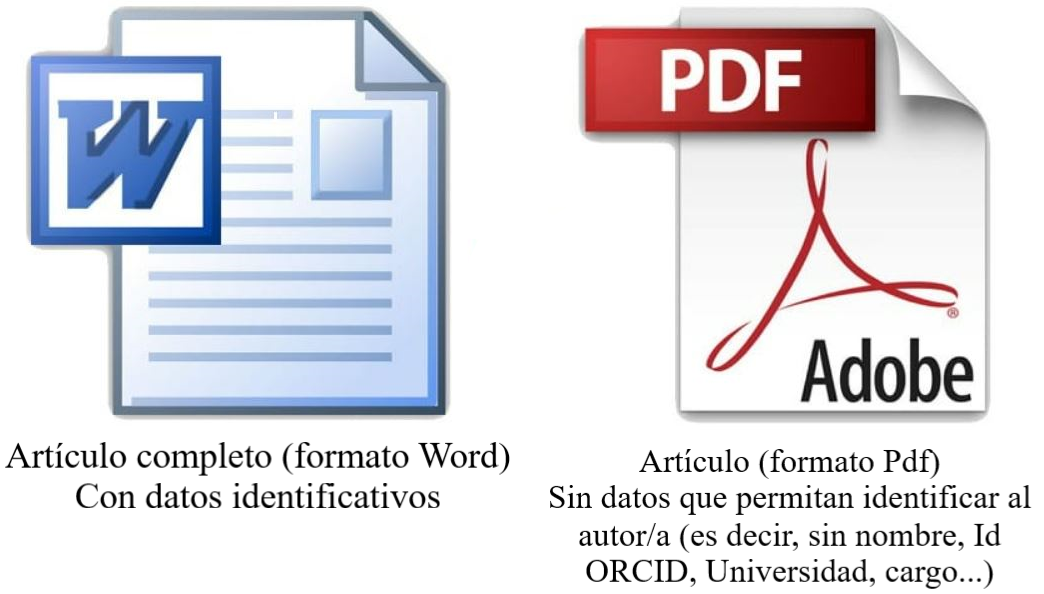
Afterwards, the metadata must be entered and the submission confirmed. The submission process will be complete when the author receives an email confirming submission.
If the above guidelines are not followed or the template available on the journal's web platform is not used, the work may be automatically rejected.
2. Document Format and Features:
Authors are requested to follow the following formatting guidelines:
Font: Arial
Margins:
- Top: 2.50 cm
- Bottom: 2.50 cm
- Left: 3.00 cm
- Right: 3.00 cm
- Header: 1.25 cm
- Footer: 1.25 cm
Notes should be numbered consecutively in the footnotes, not at the end of the text. It is recommended to minimize their use.
Non-textual elements (such as tables, charts, maps, graphs, illustrations, etc.) included in the work must be included in the appropriate place in the text. All must be numbered and titled, their source must be specified at the bottom, and they must be explicitly referenced in the text.
Headings must be marked with Arabic numerals (1., 2., 3., etc.), as well as subheadings (1.1., 1.2., 1.3., etc.).
Each article must include:
- An abstract of no more than 180 words in Spanish and English, clearly and concisely stating the objectives, main results, and conclusions of the work.
- Keywords: a maximum of seven in Spanish and their translation into English (they must be internationally accepted terms in the social sciences).
- Bibliographic references, adapted to the corresponding template.
3. Rules for bibliographic citations:
a. Book:
Last Name Last Name, A., Book Title, Publisher, City, Year.
b. Journal Article:
Last Name Last Name, A., "Article Title", Journal Title, Publisher, City, Year.
c. Book Chapter:
Last Name Last Name, A., "Book Chapter Title", in AA.VV. (Last Name Last Name, A. Dir.), Book Title, Publisher, City, Year.
d. Report:
Name of Entity, Title of Report, City, Year, available at: [URL] (if applicable).
e. News or digital media content:
Name of media outlet (if author is mentioned, replace with Last Name Last Name, A.), “Title of News”, Name of media outlet, date (day, month, year), available at: [URL].
4. Rules for normative and jurisprudential references:
- The first time legal texts are cited in the text, the complete reference must appear, which must include the normative rank, number, date, and name of the regulation. For subsequent citations, an abbreviation will suffice.
- Case law citations must include the ruling and court or body, chamber, date, and reference.
5. Editorial Process:
Peer Review System:
The article submitted for review will be reviewed by two external reviewers, confidentially and anonymously, who will issue a report on whether it should be published, which will be taken into consideration by the Editorial Board. The revised work, subject to the inclusion of modifications, must be corrected and returned by the authors to the journal within a maximum of one month, regardless of whether minor or major corrections are requested. If necessary, the new version will be sent again to the external reviewers. The authors will receive the reviewers' evaluation reports anonymously so that they can make any necessary corrections.
Editorial Process:
Once the evaluation process is complete, the main author of the work will be notified of its acceptance or rejection for publication.
Editorial Policy:
Criteria for acceptance/rejection of papers:
The factors on which the decision to accept or reject papers is based are the following: lack of originality, timeliness, relevance and applicability of the results, methodological quality, presentation, good writing, and organization.
Responsibilities:
The journal does not accept previously published material. Authors are responsible for obtaining the appropriate permission to partially reproduce material (tables, graphs, figures, or text) from other publications and websites and for properly citing their source.
6. Proposed corrections/recommendations to authors after peer review:
When corrections/recommendations are proposed, authors must review their papers within a maximum of 10 working days (unless otherwise indicated).
Proposed corrections/modifications should preferably be made to the template document using revision marks, preferably in red/purple, by resubmitting the document through the journal's web platform (not through a "resubmission," but by attaching the file to the appropriate place in the "discussion" that has been opened).
Editorial
La presentación del número o editorial, que tendrá una estructura libre y será elaborada exclusivamente por el presidente, el director, los coordinadores y los secretarios de la revista. En el caso de un número extraordinario o monográfico, también podrá ser elaborada por el coordinador responsable de este número.
Estudios doctrinales
Los estudios doctrinales, que constituirán el núcleo más importante de la revista, resultarán de investigaciones originales y contarán, al menos, con la siguiente estructura: título del trabajo (en castellano y en inglés), resumen (en castellano y en inglés), palabras clave (en castellano y en inglés), cuerpo de texto y referencias bibliográficas utilizadas.
Estudios jurisprudenciales
Los estudios jurisprudenciales, que tendrán una estructura abierta y versarán sobre resoluciones judiciales novedosas y de interés.
Tribuna de Actualidad
Los trabajos de la sección Tribuna de Actualidad, que serán muy breves y versarán sobre diversas materias de actualidad.
Reseñas bibliográficas
Y las reseñas bibliográficas, que versarán sobre obras (tanto colectivas como de autoría única) recientes y de interés.
Epílogo
El epílogo, que tendrá un carácter opcional, es una parte muy reducida del número en la que se ofrece un resumen general de su contenido.
Copyright Notice
In the Revista de Estudios Juridico Laborales y de Seguridad Social (REJLSS) we are clearly committed to a policy of open access to scientific knowledge (See Berlin Declaration).

Those authors who have publications with this journal accept the following terms:

This journal provides immediate free access to its content under the principle of making research freely available to the public. All the contents published in the REJLSS are subject to the Creative Commons license

Attribution-NonCommercial-NoDerivatives 4.0 International (CC BY-NC-ND 4.0)

Copyrights are of two kinds: moral and patrimonial. Moral rights are perpetual, inalienable, non-transferable, inalienable, unattachable and imprescriptible prerogatives. In accordance with Spanish copyright legislation, the authors who publish in REJLSS retain the moral right over their work, as well as the ownership of the patrimonial right, which will be transferred to the University of Malaga for its dissemination in open access.

The patrimonial rights, refer to the benefits that are obtained by the use or disclosure of the works. REJLSS is published in open access and is exclusively authorized to perform or authorize by any means the use, distribution, dissemination, reproduction, adaptation, translation or transformation of the work.


It is the responsibility of the authors to obtain the necessary permissions of the images that are subject to copyright.
Authors whose contributions are accepted for publication in this journal retain the non-exclusive right to use their contributions for academic, research and educational purposes, including self-archiving or depositing in open access repositories of any kind.
The electronic edition of this magazine is edited by the Editorial of the University of Malaga (UmaEditorial), being necessary to cite the origin in any partial or total reproduction.

The authors may adopt other non-exclusive license agreements for the distribution of the version of the published work (eg: deposit it in an institutional telematic archive or publish it in a monographic volume) provided that the initial publication is indicated in this magazine.
Authors are allowed and recommended to disseminate their work through the Internet (eg, in institutional telematic archives or on their website) before and during the submission process, which can produce interesting exchanges and increase citations of the published work.
Privacy Statement
The names and email addresses entered in this journal site will be used exclusively for the stated purposes of this journal and will not be made available for any other purpose or to any other party.
19.png)
