Kant on the Philosophical Significance of the Telescope
DOI:
https://doi.org/10.24310/nyl.19.2025.20551Keywords:
Kant, Astronomy, Telescope, Critique, Boundary determination, Highest goodAbstract
A footnote in the Critique of Pure Reason asserts, surprisingly, that astronomy teaches us two fundamental lessons of the critical philosophy: about the limits of theoretical cognition, and about the need to shift to practical philosophy and concern ourselves with the highest good. This article aims to explain this footnote, with reference to passages in Kant’s published and unpublished writings. A first set of passages concern the Leibnizian distinction between clear and obscure representations. Making a very different point to the footnote in the Critique, Kant claims that the telescope can clarify our representations. A second set of passages, in the third Critique, Reflexionen and lecture transcripts, suggest that astronomers have a particular tendency towards metaphysical issues. By combining the two sets of passages, I argue, we can reconstruct what Kant could have had in mind in the footnote. Astronomy is significance for the critical philosophy because it so successfully extends our knowledge, and thus, paradoxical as it may sound, reveals the greater field of what we do not know.
Downloads
Metrics
References
Adickes, E. (1925): Kant als Naturforscher. Vol. 2. Berlin: de Gruyter.
Cassirer, E. (1981): Kant’s Life and Thought. Trans. James Haden. New Haven: Yale.
Clavier, P. (1997): Kant: Les idées cosmologiques. Paris: PUF.
Clewis, R. R. (2009): The Kantian Sublime and the Revelation of Freedom. Cambridge: Cambridge University Press.
Clewis, R. R. (2015): «The Place of the Sublime in Kant’s Project», Studi Kantiani 28: 149-68.
Ertl, W. 2002. «Hume’s Antinomy and Kant’s Critical Turn», British Journal for the His-tory of Philosophy 10.4: 617-40.
Falkenburg, B. (2000): Kants Kosmologie: Die wissenschaftliche Revolution der Natur-philosophie im 18. Jahrhundert. Frankfurt am Main: Klostermann.
Feynman, R. (1964): The Feynman Lectures on Physics. Vol 1. New York: Addison Wes-ley.
Friedman, M. (1992): Kant and the Exact Sciences. Cambridge, MA: Harvard University Press.
Friedman, M. (2013): Kant’s Construction of Nature: A Reading of the Metaphysical Foundations of Natural Science. Cambridge: Cambridge University Press.
Gava, G. (2014): «Kant’s Definition of Science in the Architectonic of Pure Reason and the Essential Ends of Reason», Kant-Studien 105.3: 372-93.
Grüne, S. (2009): Blinde Anschauung. Die Rolle von Begriffen in Kants Theorie sinnlicher Synthesis. Frankfurt: Klostermann.
Heimsoeth, H. (1970a): «Kants Erfahrung mit den Erfahrungswissenschaften», in Studien zur Philosophie Immanuel Kants II: Methodenbegriffe der Erfahrungswis-senschaften und Gegensätzlichkeiten spekulativer Weltkonzeption. Bonn: Bouvier, 1970, 1-85.
Heimsoeth, H. (1970b): «Astronomisches und Theologisches in Kants Weltverständ-nis», in Studien zur Philosophie Immanuel Kants II, 86-108.
Hinske, N. (1966): «Kants Begriff der Antinomie und die Etappen seiner Ausarbei-tung», Kant-Studien 56.3: 485-96.
Hooke, R. (1665): Micrographia: or Some Physiological Descriptions of Minute Bodies Made by Magnifying Glasses. With Observations and Inquiries Thereupon. London: The Royal Society.
Howard, S. (2022a): «Kant on Limits, Boundaries, and the Positive Function of Ide-as», European Journal of Philosophy 30: 64-78.
Howard, S. (2022b): «From the Boundary of the World to the Boundary of Reason: The First Antinomy and the Development of Kant’s Critical Philosophy», HOPOS: The Journal of the International Society for the History of Philosophy of Science 12.1: 225-41.
Howard, S. (2023): «Kant's Universal Natural History and Analogical Reasoning in Cosmology» in Between Leibniz, Newton, and Kant: Philosophy and Science in the Eighteenth Century. Second Edition. Ed. Wolfgang Lefèvre. Cham: Springer, 247-70.
Kant, I. (1902–): Kants gesammelte Schriften. 29 vols. Ed. Preussischen Akademie der Wissenschaften and successors. Berlin: de Gruyter.
Kant, I. (2000): Königsberger Kantiana. Ed. Sabina Laetitia Kowalewski and Werner Stark. Hamburg: Meiner.
Leibniz, G. W. ([1710] 1985): Theodicy. Trans. E.M. Huggard. La Salle, Illinois: Open Court.
Leibniz, G. W. (1989): Philosophical Essays. Ed. and trans. Roger Ariew and Daniel Garber. Indianapolis: Hackett.
Leibniz, G. W. (1996): New Essays on Human Understanding. Trans. and ed. Peter Remnant and Jonathan Bennett. Cambridge: Cambridge University Press.
Locke, J. ([1690] 1997): An Essay Concerning Human Understanding. Ed. Peter Wool-house. London: Penguin.
Look, B. ed. (2021): Leibniz and Kant. Oxford: Oxford University Press.
Meer, R. (2019): Der transzendentale Grundsatz der Vernunft. Funktion und Struktur des Anhangs zur Transzendentalen Dialektik der Kritik der reinen Vernunft. Berlin: de Gruyter.
Schönecker, D., D. Schulting and N. Strobach (2011): «Kants kopernikanisch-newtonische Analogie», Deutsche Zeitschrift für Philosophie 59.4: 497-518.
Smith, J. (2011): Divine Machines: Leibniz and the Sciences of Life. Princeton, NJ: Princeton University Press.
Sturm, T. (2020): «Kant on the Ends of the Sciences», Kant-Studien 111.1: 1-28.
Sturm, T. and Larissa Wallner (forthcoming): «Kant’s Empirical Account of Science», ms.
Waschkies, H.-J. (1987): Physik und Physikotheologie des Jungen Kant. Die Vorgeschich-te seiner Allgemeinen Naturgeschichte und Theorie des Himmels. Amsterdam: Grüner.
Watkins, E. (2019): «Kant on Rational Cosmology», in Kant on Laws. Cambridge: Cam-bridge University Press, 191-211.
Wilson, C. (1995): The Invisible World: Early Modern Philosophy and the Invention of the Microscope. Princeton, NJ: Princeton University Press.
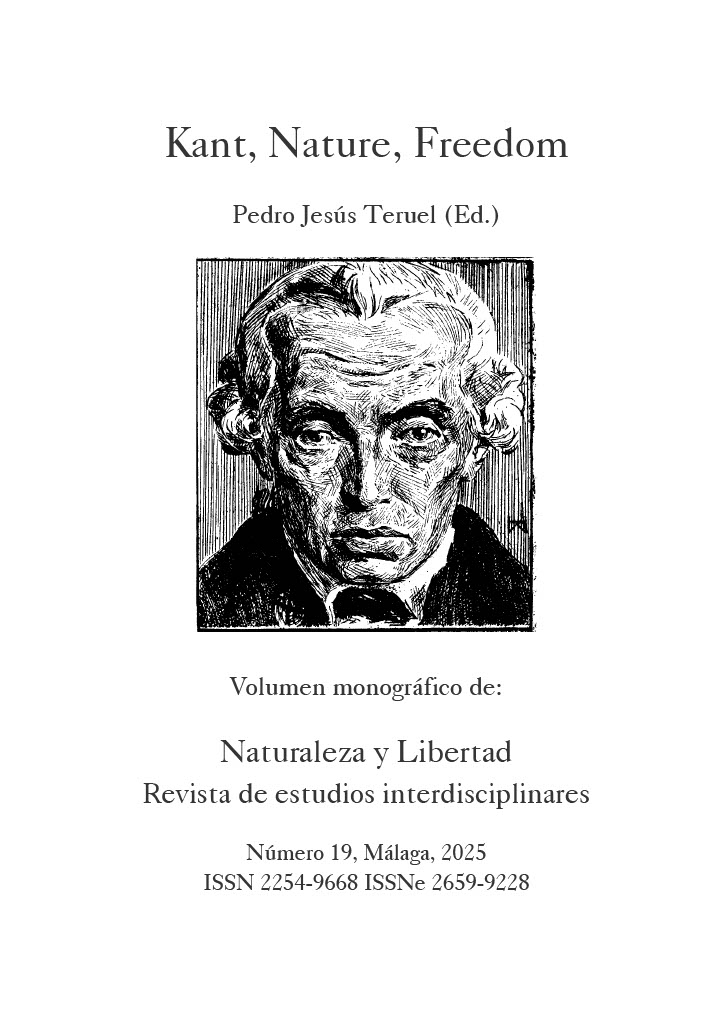
Published
How to Cite
Issue
Section
License
Copyright (c) 2025 Nature & Freedom. Journal of Interdisciplinary Studies

This work is licensed under a Creative Commons Attribution-NonCommercial-ShareAlike 4.0 International License.
Those authors who have publications with this journal, accept the following terms:
1. Copyright and licensing information are clearly described on the journal’s web site: all content published in Naturaleza y Libertad is open acces without limit, and are subject to the Attribution-NonCommercial-ShareAlike 4.0 International (CC BY-NC-SA 4.0) license. The full text of which can be consulted at https://creativecommons.org/licenses/by-nc-sa/4.0/
2. It is the responsibility of the authors to obtain the necessary permissions for the images that are subject to copyright. The authors whose contributions are accepted for publication in this journal will retain the non-exclusive right to use their contributions for academic, research and educational purposes, including self-archiving or deposit in open access repositories of any kind. The electronic edition of this magazine is edited by the Editorial de la University of Malaga (UmaEditorial), being necessary to cite the origin in any partial or total reproduction.
3. This journal allows and encourages authors to publish papers on their personal websites or in institutional repositories, both before and after their publication in this journal, as long as they provide bibliographic information that accredits, if applicable, your posting on it.
4. In no case will anonymous papers be published.




18.png)