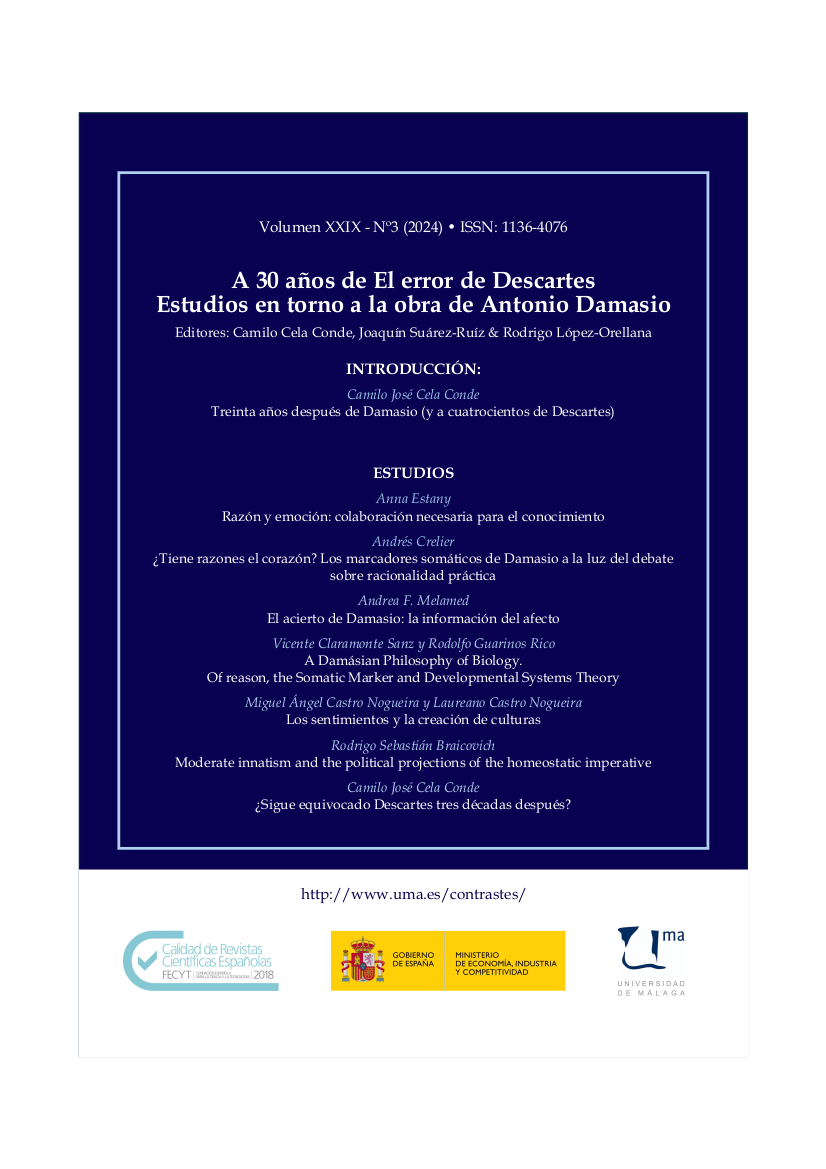
A Damasian Philosophy of Biology?
Of reason, the Somatic Marker and Developmental Systems Theory
DOI:
https://doi.org/10.24310/contrastes.29.3.2024.20226Keywords:
Philosophy of Biology, evolutionary epistemology, developmental systems theory, mirror neurons, emotional empathyAbstract
The Damasian concept of emotion and the self fits within the emotivist tradition, viewing mind and reason as embodied realities linked to the body and its social and natural interactions. Emotion, for Damásio, creates the context for reason to operate effectively, aligning with anti-Cartesian ideas. Due to the role of emotions, this may be used to suggest that living beings are not just skin-bound entities but processes integrating body and environment. Therefore, we examine both his relevance to contemporary philosophy of mind and self, and his possible contribution to naturalized metaphysics, particularly within Developmental Systems Theory.
Downloads
Metrics
Publication Facts
Reviewer profiles N/A
Author statements
Indexed in
-
—
- Editor & editorial board
- profiles
- Academic society
- N/A
- Publisher
- Universidad de Málaga

To learn about these publication facts, click 
PF is maintained by the Public Knowledge Project
References
ADOLPHS, R. et al. (2003), «Dissociable Neural Systems for Recognizing Emotions». Brain Cognition, 52, pp. 61-69. DOI: https://doi.org/10.1016/s0278-2626(03)00009-5.
ALEXANDER, R. (1987), The Biology of Moral Systems. New York: Aldine de Gruyter. DOI: https://doi.org/10.4324/9780203700976.
AURELI, E. et al. (2002), «Conflict Resolution Following Aggression in Gregarious Animals: A Predictive Framework». Animal Behaviour, 64, pp. 325-343. DOI: https://doi.org/10.1006/anbe.2002.3071
BUBER, M. (2017), Yo y tú. Barcelona: Herder.
CALDER, A. et al. (2001), «Neuropsycolochy of Fear and Loathing». Nature Reviews Neuroscience, 2, pp. 352-363. DOI: https://doi.org/10.1038/35072584.
DAMÁSIO, A. (1996), «The Somatic Marker Hypothesis and the Possible Functions of the Prefrontal Cortex». Philosophical Transactions of The Royal Society B, Biological Sciences, 29/351(1346): pp. 1413-20. DOI: https://doi.org/10.1098/rstb.1996.0125. PMID: 8941953.
DAMÁSIO, A. (2001), La sensación de lo que ocurre. Cuerpo y emoción en la construcción de la conciencia. Barcelona: Debate.
DAMÁSIO, A. (2005), En busca de Espinoza. Neurobiología de la emoción y los sentimientos. Barcelona: Crítica.
DAMÁSIO, A. (1999), El error de Descartes. La razón de las emociones. Santiago de Chiule: Andrés Bello.
DAMÁSIO, A. (2006), El error de Descartes. La emoción, la razón y el cerebro humano. Barcelona: Drakontos.
DAMÁSIO, H. et al. (1994), «The Return of Phineas Gage: Clues about the Brain from the Skull of a Famous Patient». Science, 264/5162: pp. 1102-1105. DOI: https://doi.org/10.1126/science.8178168.
DARWIN, CH. (2009), La expresión de las emociones. Pamplona: Laetoli.
DE WAAL, F. & LUTTRELL, L. (1988), «Mechanisms of social reciprocity in three primate species: Symetrical relationship characteristics or cognition?». Ethology and Sociobiology, 9, pp. 101-118. DOI: https://doi.org/10.1016/0162-3095(88)90016-7.
DE WAAL, F. (2007), Primates y filósofos. La evolución de la moral del simio al hombre. Barcelona: Paidós.
DECETY, J. & CHAMINADE, T. (2003), «Neural Correlates of Feeling Sympathy». Neu-ropsychologia, 41, pp. 127-138. DOI: https://doi.org/10.1016/S0028-3932(02)00143-4.
GAZZANIGA, M. (2006), El cerebro ético. Barcelona: Paidós.
GAZZANIGA, (2012), ¿Qué nos hace humanos? La explicación científica de nuestra singularidad como especie. Barcelona: Espasa.
GRIFFITHS, P. (2017). «Genetic, epigenetic and exogenetic information in development and evolution». Interface focus, 7/5, 20160152. DOI: https://doi.org/10.1098/rsfs.2016.0152.
GRIFFITHS, P. & GRAY, R. (1994), «Developmental Systems and Evolutionary Explanation». The Journal of Philosophy, 91/6, pp. 277-304. DOI: https://doi.org/10.2307/2940982.
GRIFFITHS, P. & STOTZ, K. (2013). Genetics and philosophy: an introduction. Cambridge: University Press. DOI: https://doi.org/10.1017/CBO9780511744082.
HUME, D. (1988), Tratado sobre la naturaleza humana. Madrid: Tecnos.
HUTCHISON, W. et al. (1999), «Pain-Related Neurons in the Human Cingulate Cortex». Nature Neuroscience, 2, pp. 403-405. DOI: https://doi.org/10.1038/8065.
IACOBONI, M. (2009), Neuronas espejo. Empatía, neuropolítica, autismo, imitación o de cómo comprendemos a los otros. Madrid: Tecnos.
KROLAK-SALMON, P. et al. (2003), «An Attention Modulate Response to Disgust in Human Ventror Anterior Insula». Annals of Neurology, 53, pp. 446-453. DOI: https://doi.org/10.1002/ana.10502.
OYAMA, S. (2000), «Causal Democracy and Causal Contributions in Developmental Systems Theory». Philosophy of Science, 67, pp. S332-S347. DOI: https://www.jstor.org/stable/188679.
PLOMIN, R. et al. (1993), «Genetic Change and Continuities from Fourteen to Twenty Months: The MacArthur Longitudinal Twin Study». Child Development, 64, pp. 1354-1376. PMID: 8222877.
RIZZOLATTI, G. & SINIGAGLIA, C. (2006), Neuronas espejo. Los mecanismos de la empatía emocional. Barcelona: Paidós.
SCHIENLE, A. et al. (2002), «The Insula is Not Specifically Involved in Disgust Processing: An fMRI Study». Neuroreport, 13, pp. 2023-2036. DOI: https://doi.org/10.1097/00001756-200211150-00006.
SINGER, T. et al. (2004), «Empathy for Pain Involves the Affective but Not Sensory Components of Pains». Science, 303, pp. 1157-1162. DOI: https://doi.org/10.1126/science.1093535.
TRIVERS, R. (1971), «The Evolution of Reciprocal Altruism». The Quarterly Review of Biology, 46/1: pp. 35-57. DOI: http://www.jstor.org/stable/2822435.
WADDINTONG, C. (1957), The Strategy of the Genes. A Discussion of Some spects of Theoretical Biology. London: George Allen & Unwin LTD.
WEST, M. & KING, A. (1987), «Settling Nature and Nurture into an ontogenetic niche». Developmental Psichobiology, 20/5, pp. 549-562. DOI: https://doi.org/10.1002/dev.420200508.
WESTERMARCK, E. (1912), The Origin and Development of the Moral Ideas. London: Macmillan.
WILSON, E. (1980), Sociobiología. La nueva síntesis. Barcelona: Omega.
Downloads
Published
How to Cite
Issue
Section
License
This journal provides immediate free access to its content under the principle of making research freely available to the public. All content published in Contrastes. Revista Internacional de Filosofía, are subject to the Creative Commons Attribution-NonCommercial-ShareAlike 4.0 license whose full text can be found at <http://creativecommons.org/licenses/by-nc-sa/4.0>
It is the responsibility of the authors to obtain the necessary permissions of the images that are subject to copyright.
Authors whose contributions are accepted for publication in this journal will retain the non-exclusive right to use their contributions for academic, research and educational purposes, including self-archiving or repository in open access repositories of any kind.
The electronic edition of this magazine is edited by the Editorial Service of the University of Malaga (Uma Editorial), being necessary to cite the origin in any partial or total reproduction.








5.png)
