Call for papers, vol. 17
2022-11-16
Call for papers for vol. 17 of Naturaleza y Libertad
Read more about Call for papers, vol. 17Naturaleza y libertad publishes exclusively scientific material (papers, notes and commentaries, book reviews) related to the subject matter to which its title refers, which includes:
A distinctive feature of Naturaleza y Libertad is the importance it attaches to interdisciplinary and transdisciplinary aspects, which makes it a useful instrument to try to overcome the age-old separation between science and humanities.
The sequence of the publication is annual. In addition to the publication of miscellaneous issues, monographic issues are planned as well.
The journal publishes papers in Spanish and English, although occasionally texts may be published in other languages of the Iberian Peninsula, as well as in other international languages that are common vehicles for the expression of scientific knowledge.
Indexed in: REDIB, Miar, The Philosopher's Index, Google Scholar, ROAD, WorldCat, BASE (Bielefeld Academic Search Engine)
Evaluated in: Latindex catálogo 2.0, ÍnDICEs-CSIC, ERIH PLUS, CIRC: Clasificación Integrada de Revistas Científicas
Included in the following directories of periodicals: DOAJ, Ulrich's Periodicals Directory, Dialnet, Dulcinea, DRJI (Directory of Research Journals Indexing)



Call for papers for vol. 17 of Naturaleza y Libertad
Read more about Call for papers, vol. 17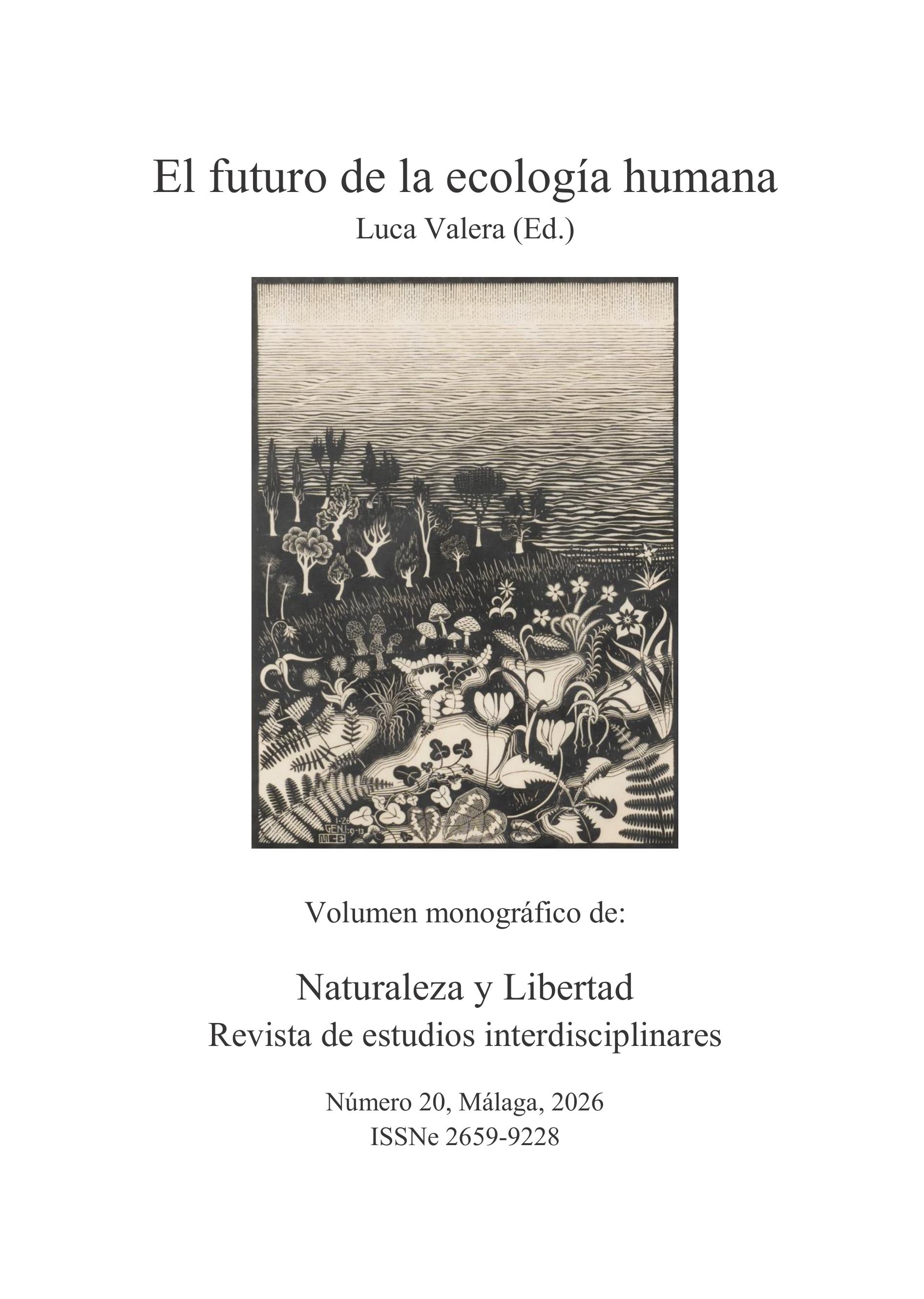
Monographic Issue: The Future of Human Ecology
Editor: Luca Valera
The proposal that guides this special issue is based on a conviction that, in this era of ecological crisis, is unavoidable: the ecological question is, above all, an anthropological question and concerns human habitation. Human beings do not appear before the world as an external entity that randomly decides on an available environment, as if it were a warehouse that does not belong to them; quite the contrary, they inhabit reality as part of a web of relationships whose consistency shapes and is shaped by their practices. Within this perspective, human ecology is not a moral appendage to “scientific” ecology, nor a repertoire of ethical exhortations or norms presented to human beings in a heterologous manner; Rather, it is an integral way of life that calls for a rethinking of the categories that order our actions (such as technology, economics, politics, spirituality, education) and a repositioning of the common good as a normative horizon. In this sense, “healing the wound of the ecosystem” requires first healing the inner fracture that disarticulates the human subject and renders him incapable of ethically governing the technical and economic power that he himself deploys; only then does care for our common home cease to be a slogan and become a “way of life”. Ethics thus ceases to be a ‘label’ and becomes a way of inhabiting the oikos – as suggested by the etymology of ethos.
18.png)