Filosofía damasiana de la biología
Sobre la razón, el marcador somático y la teoría de los sistemas de desarrollo
DOI:
https://doi.org/10.24310/contrastes.29.3.2024.20226Palabras clave:
Filosofía de la Biología, epistemología evolucionista, teoría de los sistemas de desarrollo, neuronas espejo, empatía emocionalResumen
El concepto damasiano de la emoción y el yo encaja en la tradición emotivista, que considera la mente y la razón como realidades encarnadas vinculadas al cuerpo y a sus interacciones sociales y naturales. Para Damásio, la emoción crea el contexto necesario para que la razón funcione eficazmente, en consonancia con las ideas anticartesianas. Debido al papel de las emociones, ello puede emplearse para sugerir que los seres vivos no son meras entidades ligadas a la piel, sino procesos que integran cuerpo y entorno. Por lo tanto, examinamos tanto su relevancia para la filosofía contemporánea de la mente y el yo, como su posible contribución a la metafísica naturalizada, en particular dentro de la teoría de sistemas de desarrollo.
Descargas
Referencias
ADOLPHS, R. et al. (2003), «Dissociable Neural Systems for Recognizing Emotions». Brain Cognition, 52, pp. 61-69. DOI: https://doi.org/10.1016/s0278-2626(03)00009-5.
ALEXANDER, R. (1987), The Biology of Moral Systems. New York: Aldine de Gruyter. DOI: https://doi.org/10.4324/9780203700976.
AURELI, E. et al. (2002), «Conflict Resolution Following Aggression in Gregarious Animals: A Predictive Framework». Animal Behaviour, 64, pp. 325-343. DOI: https://doi.org/10.1006/anbe.2002.3071
BUBER, M. (2017), Yo y tú. Barcelona: Herder.
CALDER, A. et al. (2001), «Neuropsycolochy of Fear and Loathing». Nature Reviews Neuroscience, 2, pp. 352-363. DOI: https://doi.org/10.1038/35072584.
DAMÁSIO, A. (1996), «The Somatic Marker Hypothesis and the Possible Functions of the Prefrontal Cortex». Philosophical Transactions of The Royal Society B, Biological Sciences, 29/351(1346): pp. 1413-20. DOI: https://doi.org/10.1098/rstb.1996.0125. PMID: 8941953.
DAMÁSIO, A. (2001), La sensación de lo que ocurre. Cuerpo y emoción en la construcción de la conciencia. Barcelona: Debate.
DAMÁSIO, A. (2005), En busca de Espinoza. Neurobiología de la emoción y los sentimientos. Barcelona: Crítica.
DAMÁSIO, A. (1999), El error de Descartes. La razón de las emociones. Santiago de Chiule: Andrés Bello.
DAMÁSIO, A. (2006), El error de Descartes. La emoción, la razón y el cerebro humano. Barcelona: Drakontos.
DAMÁSIO, H. et al. (1994), «The Return of Phineas Gage: Clues about the Brain from the Skull of a Famous Patient». Science, 264/5162: pp. 1102-1105. DOI: https://doi.org/10.1126/science.8178168.
DARWIN, CH. (2009), La expresión de las emociones. Pamplona: Laetoli.
DE WAAL, F. & LUTTRELL, L. (1988), «Mechanisms of social reciprocity in three primate species: Symetrical relationship characteristics or cognition?». Ethology and Sociobiology, 9, pp. 101-118. DOI: https://doi.org/10.1016/0162-3095(88)90016-7.
DE WAAL, F. (2007), Primates y filósofos. La evolución de la moral del simio al hombre. Barcelona: Paidós.
DECETY, J. & CHAMINADE, T. (2003), «Neural Correlates of Feeling Sympathy». Neu-ropsychologia, 41, pp. 127-138. DOI: https://doi.org/10.1016/S0028-3932(02)00143-4.
GAZZANIGA, M. (2006), El cerebro ético. Barcelona: Paidós.
GAZZANIGA, (2012), ¿Qué nos hace humanos? La explicación científica de nuestra singularidad como especie. Barcelona: Espasa.
GRIFFITHS, P. (2017). «Genetic, epigenetic and exogenetic information in development and evolution». Interface focus, 7/5, 20160152. DOI: https://doi.org/10.1098/rsfs.2016.0152.
GRIFFITHS, P. & GRAY, R. (1994), «Developmental Systems and Evolutionary Explanation». The Journal of Philosophy, 91/6, pp. 277-304. DOI: https://doi.org/10.2307/2940982.
GRIFFITHS, P. & STOTZ, K. (2013). Genetics and philosophy: an introduction. Cambridge: University Press. DOI: https://doi.org/10.1017/CBO9780511744082.
HUME, D. (1988), Tratado sobre la naturaleza humana. Madrid: Tecnos.
HUTCHISON, W. et al. (1999), «Pain-Related Neurons in the Human Cingulate Cortex». Nature Neuroscience, 2, pp. 403-405. DOI: https://doi.org/10.1038/8065.
IACOBONI, M. (2009), Neuronas espejo. Empatía, neuropolítica, autismo, imitación o de cómo comprendemos a los otros. Madrid: Tecnos.
KROLAK-SALMON, P. et al. (2003), «An Attention Modulate Response to Disgust in Human Ventror Anterior Insula». Annals of Neurology, 53, pp. 446-453. DOI: https://doi.org/10.1002/ana.10502.
OYAMA, S. (2000), «Causal Democracy and Causal Contributions in Developmental Systems Theory». Philosophy of Science, 67, pp. S332-S347. DOI: https://www.jstor.org/stable/188679.
PLOMIN, R. et al. (1993), «Genetic Change and Continuities from Fourteen to Twenty Months: The MacArthur Longitudinal Twin Study». Child Development, 64, pp. 1354-1376. PMID: 8222877.
RIZZOLATTI, G. & SINIGAGLIA, C. (2006), Neuronas espejo. Los mecanismos de la empatía emocional. Barcelona: Paidós.
SCHIENLE, A. et al. (2002), «The Insula is Not Specifically Involved in Disgust Processing: An fMRI Study». Neuroreport, 13, pp. 2023-2036. DOI: https://doi.org/10.1097/00001756-200211150-00006.
SINGER, T. et al. (2004), «Empathy for Pain Involves the Affective but Not Sensory Components of Pains». Science, 303, pp. 1157-1162. DOI: https://doi.org/10.1126/science.1093535.
TRIVERS, R. (1971), «The Evolution of Reciprocal Altruism». The Quarterly Review of Biology, 46/1: pp. 35-57. DOI: http://www.jstor.org/stable/2822435.
WADDINTONG, C. (1957), The Strategy of the Genes. A Discussion of Some spects of Theoretical Biology. London: George Allen & Unwin LTD.
WEST, M. & KING, A. (1987), «Settling Nature and Nurture into an ontogenetic niche». Developmental Psichobiology, 20/5, pp. 549-562. DOI: https://doi.org/10.1002/dev.420200508.
WESTERMARCK, E. (1912), The Origin and Development of the Moral Ideas. London: Macmillan.
WILSON, E. (1980), Sociobiología. La nueva síntesis. Barcelona: Omega.
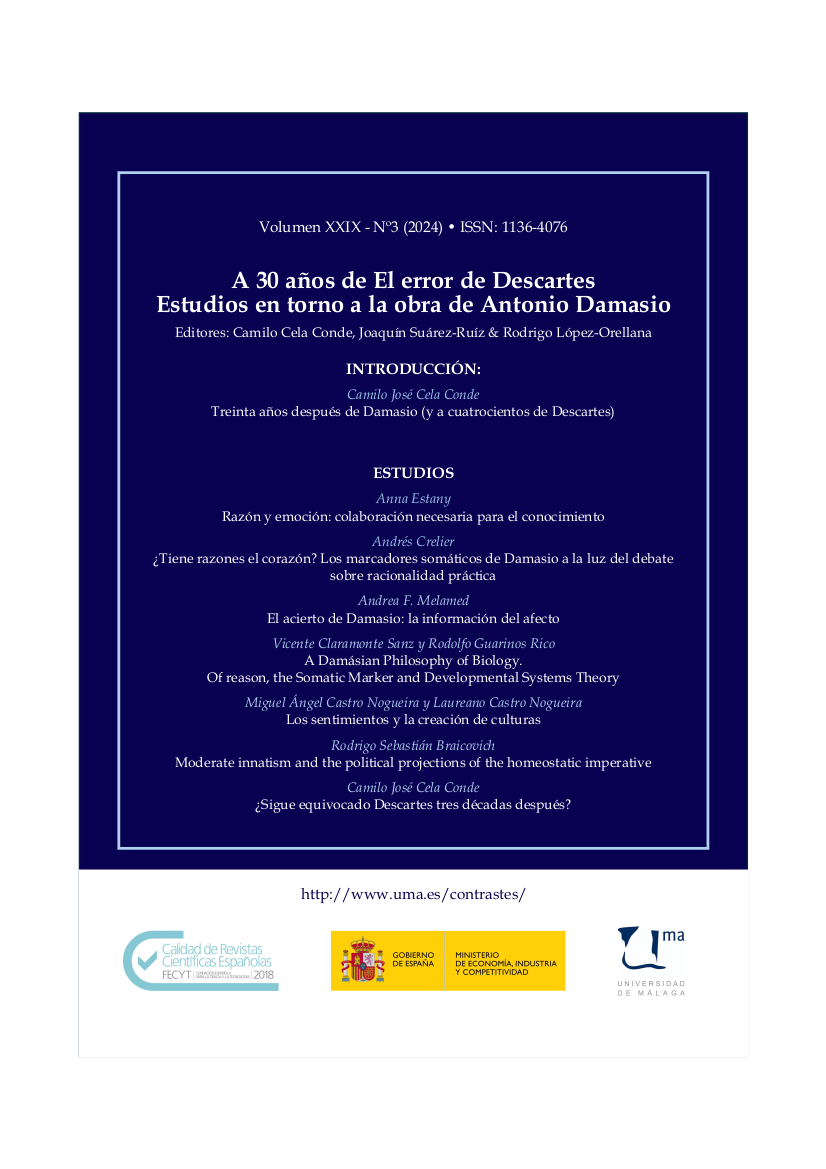
Publicado
Dimensions
Citations




Número
Sección
Licencia
Esta revista provee acceso libre inmediato a su contenido bajo el principio de hacer disponible gratuitamente la investigación al público. Todos los contenidos publicados en Contrastes. Revista internacional de Filosofía, están sujetos a la licencia Creative Commons Reconocimento-NoComercia-Compartirigual 4.0 cuyo texto completo puede consultar en <http://creativecommons.org/licenses/by-nc-sa/4.0>
Es responsabilidad de los autores/as obtener los permisos necesarios de las imágenes que están sujetas a derechos de autor.
Los autores/as cuyas contribuciones sean aceptadas para su publicación en esta revista conservarán el derecho no exclusivo de utilizar sus
contribuciones con fines académicos, de investigación y educativos,
incluyendo el auto-archivo o depósito en repositorios de acceso abierto de cualquier tipo.
La edición electrónica de esta revista esta editada por la Editorial de la
Universidad de Málaga (UmaEditorial), siendo necesario citar la procedencia en cualquier reproducción parcial o total.




5.png)
