Typification of the Linnaean name Rhamnus tinctoria, the basionym of Flueggea tinctoria (Euphorbiaceae), an endemic plant to the Iberian Peninsula flora
DOI :
https://doi.org/10.24310/abm.50.2025.21144Mots-clés :
Iter Hispanicum, Loefling, Linnaeus, neotype, nomenclature, Spain, tamujoRésumé
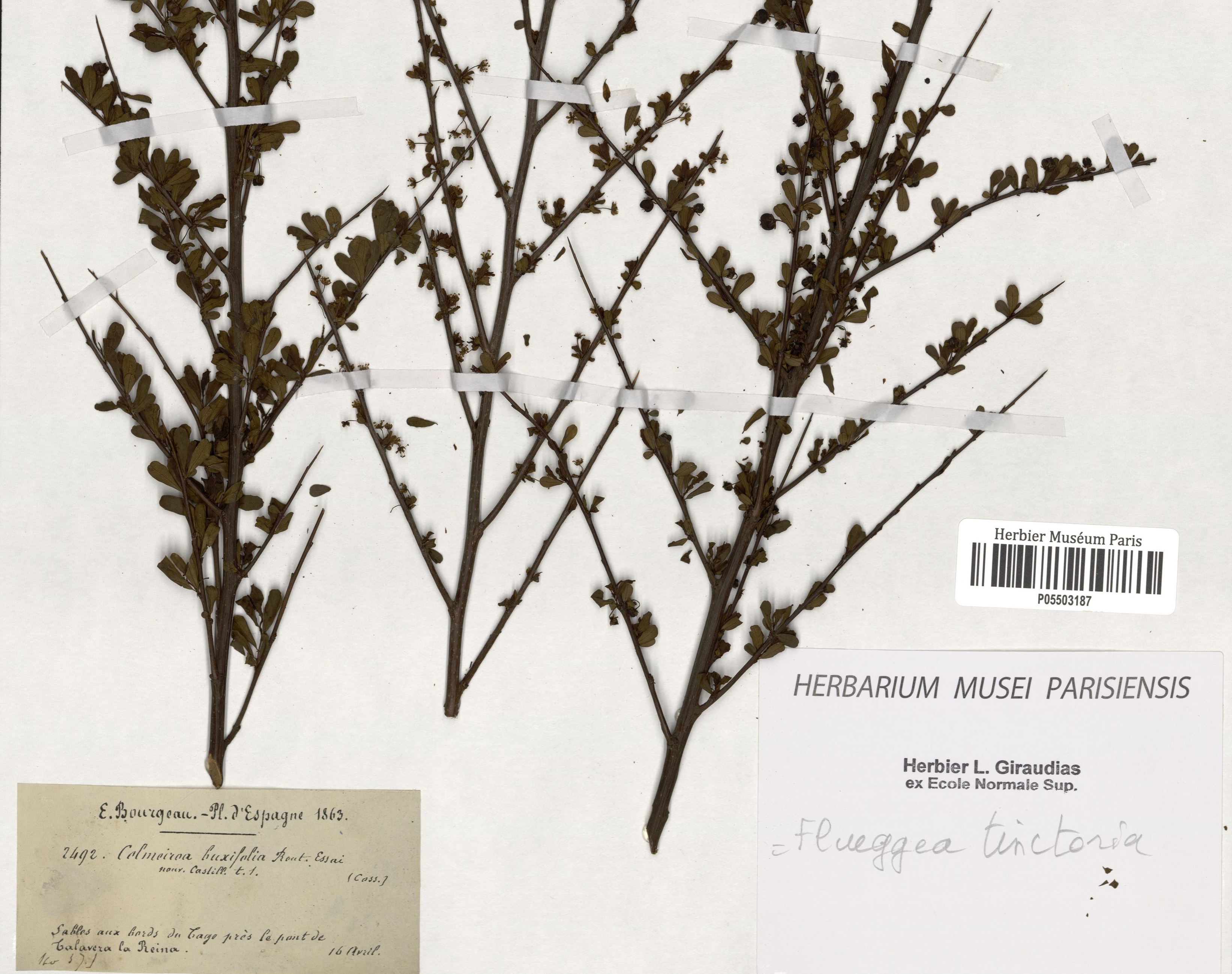
The name Rhamnus tinctoria was published in 1758 by Linnaeus in Loefling’s Iter Hispanicum. The work was published posthumously after Loefling’s death in Venezuela in 1756. Although Linnaeus received specimens from Loefling’s Iberian collections, several were lost, so Linnaeus relied on Loefling’s notes for these taxa. Since it was impossible to find original material of Rhamnus tinctoria in the various Linnaean and Linnaean-associated herbaria, a neotype has been designated for this Linnaean name. The neotype selected is a specimen preserved at MA, collected in central Spain (Talavera de la Reina, Toledo). This specimen belongs to the exsiccatum “E. Bourgeau. Plantes d’Espagne” (number 2492), which contains several duplicates (e.g., at P, barcodes P05595291, P05503187, P05502243).
Téléchargements
Métriques
Références
Benedí, C. (1997). Flueggea Willd. In Castroviejo, S., Aedo, C., Benedí, C., Laínz ,M., Muñoz Garmendia, F., Nieto Feliner, G. & Paiva, J. (Eds.), Flora Iberica, 8 (pp. 191–193). Madrid: Real Jardín Botánico, CSIC.
Blanco Salas, J., Ruiz Téllez, T., Pérez Bargueño, A. & Vázquez Pardo, F.M. (2018). Flueggea tinctoria. In Pardo de Santayana, M., Morales, R., Tardío, J., Aceituno, L. & Molina, M. (Eds.), Inventario Español de los Conocimientos Tradicionales relativos a la Biodiversidad Segund Fase (Tomo2) (pp. 120–122). Madrid: Ministerio de Agricultura y Pesca, Alimentación y Medio Ambiente.
Cano-Maqueda, J. & Talavera, S. (2011). A taxonomic revision of the Campanula lusitanica complex (Campanulaceae) in the Western Mediterranean region. Anales del Jardín Botánico de Madrid, 68(1), 15–47.
Clusius, C. (1576). Rariorum aliquot stirpium per Hispanias obseruatarum Historia, libris dvobvs expressa: ad Maximilianvm II. Imperatorem. Antverpiae: Ex officina Christophori Plantini, Architypographi Regij.
Dorr, L.J. & Wiersema, J.H. (2010a). Names of American vascular plants published in Loefling’s Iter Hispanicum (1758) and its German translation (1766). Taxon, 59, 1245–1262.
Dorr, L.J. & Wiersema, J.H. (2010b). (1947–1958) Proposals to reject twelve names emanating from Loefling’s Iter Hispanicum (1758), Ayenia sidiformis (Malvaceae), Cofer (Symplocaceae), Cruzeta and C. hispanica (Amaranthaceae), Edechia inermis and E. spinosa (Rubiaceae), Justicia putata (Acanthaceae), Menais and M. topiaria (?Boraginaceae), Muco (Capparaceae), Samyda parviflora (Salicaceae), and Spermacoce suffruticosa (Rubiaceae). Taxon, 59, 1280–1282.
Dorr, L.J. & Wiersema, J.H. (2010c). Typification of names of American species of vascular plants proposed by Linnaeus and based on Loefling’s Iter Hispanicum (1758). Taxon, 59, 1571–1577.
González Bueno, A. & Basante Pol, R. (2015). José Hortega (1703–1761): La peripecia vital e intelectual de un boticario ilustrado. Madrid: Instituto de Estudios Madrileños.
Loefling, P. (1758). Petri Loefling ... Iter Hispanicum, eller Resa til Spanska Länderna uti Europa och America, förrättad ifrån år 1756, med Beskrifningar och Rön öfver De Märkvärdigaste Växter, utgifven Efter Dess Frånfålle af Carl Linnæus. Stockholm: Tryckt på Direct. Lars Salvii kostnad.
Loefling, P. (1766). Peter Loeflings ... Reise, nach den spanischen Ländern in Europa und America in den Jahren 1751 bis 1756. Nebst Beobachtungen und Anmerkungen über die merkwürdigen Gewächse herausgegeben von Herrn Carl von Linné ... aus dem Schwedischen übersetzt durch D. Alexander Bernhard Kölpin ... Mit Rupfern. Berlin und Stralsund: Gottlieb August Lange.
López González, G. (2001). Los árboles y arbustos de la Península Ibérica e Islas Baleares. Madrid: Editorial Mundi-Prensa.
López González, G. (2011). 173. Asparagus draconis L. –primera denominación moderna del drago canario-, Rhamnus tinctoria L., y Gypsophila struthium L., tres nombres paralelos. Lagascalia, 31, 200–203.
Lucena Giraldo, M., Maldonado, L., Puig-Samper, M.A. (1987). Loefling y la botánica española. La expedición al Orinoco (1754-1761). Asclepio, 9(2), 69–83.
Ruiz de la Torre, J. (2006). Flora Mayor. Madrid: Organismo Autónomo de Parques Nacionales, Dirección General para la Biodiversidad.
Tellería, M.T. (2007). El viaje virtual de Linneo por España. Sociedad Geográfica Española, 28, 116–123.
Thomas, O. (1893). Suggestions for the more definite use of the word “Type” and its compounds, as denoting specimens of a greater or less degree of authenticity. Proceedings of the Zoological Society of London, 1893, 241–242.
Turland, N.J., Wiersema, J.H., Barrie, F.R., Greuter, W., Hawksworth, D.L., Herendeen, P.S., Knapp, S., Kusber, W.H., Li, D.Z., Marhold, K., May, T.W., McNeill, J., Monro, A.M., Prado, J., Price, M.J. & Smith, G.F. (Eds.) (2018). International code of nomenclature for algae, fungi, and plants (Shenzhen Code) adopted by the Nineteenth International Botanical Congress Shenzhen, China, July 2017. Regnum vegetabile 159. Koeltz, Glashütten.
Webster, G.L. (1984). A revision of Flueggea (Euphorbiaceae). Allertonia, 3(4), 259–312.
Téléchargements
Publiée
Comment citer
Numéro
Rubrique
Licence
(c) Tous droits réservés Pedro Pablo Ferrer Gallego 2025

Ce travail est disponible sous licence Creative Commons Attribution - Pas d’Utilisation Commerciale - Partage dans les Mêmes Conditions 4.0 International.
Toutes les informations concernant la licence d'utilisation des travaux publiés dans Acta Botanica Malacitana et les droits d'auteur sont disponibles dans notre Politique Éditoriale.






1.png)