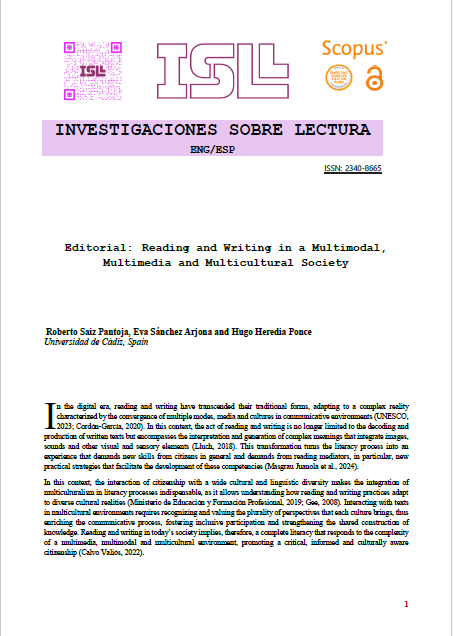
Editorial Reading and Writing in a Multimodal, Multimedia and Multicultural Society
Editorial Reading and Writing in a Multimodal, Multimedia and Multicultural Society
Abstract
In the digital era, reading and writing have transcended their traditional forms, adapting to a complex reality characterized by the convergence of multiple modes, media and cultures in communicative environments (UNESCO, 2023; Cordón-García, 2020). In this context, the act of reading and writing is no longer limited to the decoding and production of written texts but encompasses the interpretation and generation of complex meanings that integrate images, sounds and other visual and sensory elements (Lluch, 2018). This transformation turns the literacy process into an experience that demands new skills from citizens in general and demands from reading mediators, in particular, new practical strategies that facilitate the development of these competencies (Masgrau Juanola et al., 2024).
In this context, the interaction of citizenship with a wide cultural and linguistic diversity makes the integration of multiculturalism in literacy processes indispensable, as it allows understanding how reading and writing practices adapt to diverse cultural realities (Ministerio de Educación y Formación Profesional, 2019; Gee, 2008). Interacting with texts in multicultural environments requires recognizing and valuing the plurality of perspectives that each culture brings, thus enriching the communicative process, fostering inclusive participation and strengthening the shared construction of knowledge. Reading and writing in today’s society implies, therefore, a complete literacy that responds to the complexity of a multimedia, multimodal and multicultural environment, promoting a critical, informed and culturally aware citizenship (Calvo Valiós, 2022). The content of each article is summarized below.
Downloads
References
Calvo Valiós, V. (2022). La lectura en la sociedad digital. En R. Tabernero Sala (Coord.), Leer por curiosidad. Los libros de no ficción en la formación de lectores (p. 23–36). Graó.
Cordón-García, J. (2020). La lectura digital. Intelección, apropiación y contextos. Biblioteche Oggi Trends, 6(3), 28-40. http://dx.doi.org/10.3302/2421-3810-202002-028-1
Lluch, G. (2018). Claves para promocionar la lectura en la red. Editorial Síntesis.
Masgrau Juanola, M., Kunde, K., da Rocha Gaspar, D. y Arenas Delgado, C. (2024). Leitura digital e intermedial: Orientações didáticas para uma mediação de leitura que integra diferentes linguagens artísticas. Palíndromo, Florianópolis, 16(38), 1–27. https://doi.org/10.5965/2175234616382024e0003
UNESCO (2023). Informe de seguimiento de la educación en el mundo 2023. Tecnología en la educación: ¿una herramienta en los términos de quién? Editorial UNESCO.
Downloads
Published
Dimensions
Citations
Issue
Section
License
Copyright (c) 2024 Roberto Saiz Pantoja, Eva Sánchez Arjona, Hugo Heredia Ponce
All contents published in Investigaciones sobre Lectura are protected under the Creative Commons Attribution-NonCommercial-ShareAlike 4.0 International (CC BY-NC-SA 4.0) license. All about this license is available in the following link: <http://creativecommons.org/licenses/by-nc-sa/4.0>
Users can copy, use, redistribute, share and exhibit publicly as long as:
- The original source and authorship of the material are cited (Journal, Publisher and URL of the work).
- It is not used for comercial purposes.
- The existence of the license and its especifications are mentioned.
There are two sets of authors’ rights: moral and property rights. Moral rights are perpetual prerogatives, unrenounceable, not-transferable, unalienable, imprescriptible and inembargable. According to authors’ rights legislation, Investigaciones sobre Lectura recognizes and respects authors moral rights, as well as the ownership of property rights, which will be transferred to University of Malaga in open access. The property rights are referred to the benefits that are gained by the use or the dissemination of works. Investigaciones sobre Lectura is published in an open access form and it is exclusively licenced by any means for doing or authorising distribution, dissemination, reproduction, , adaptation, translation or arrangement of works.
Authors are responsable for obtaining the necessary permission to use copyrighted images.




31.png)