New layer of information: epitranscriptomics
DOI:
https://doi.org/10.24310/enbio.v9i166.17491Keywords:
epitranscriptomics, modified nucleosides, translation regulationAbstract
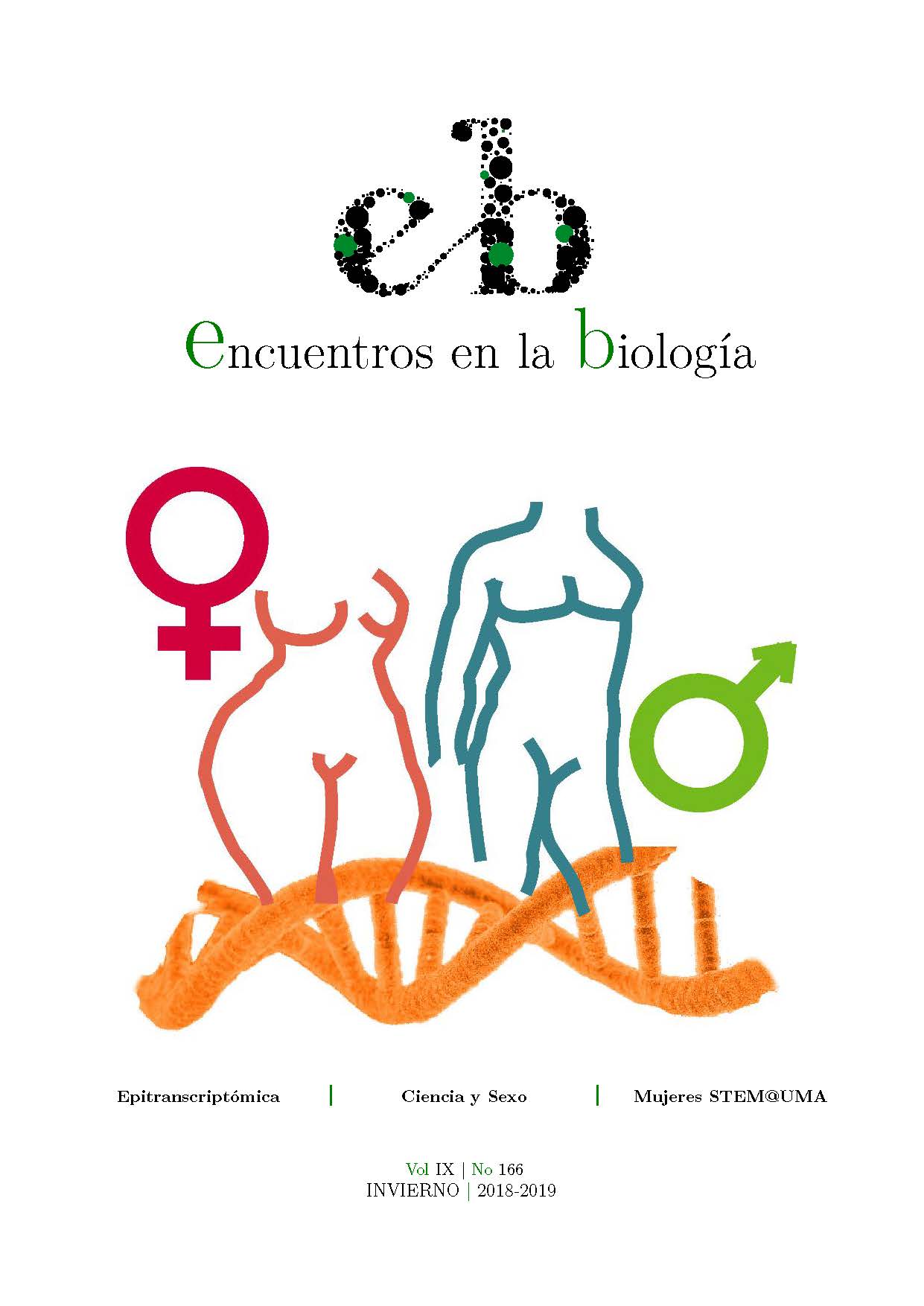
The nucleosides of nucleic acids (DNA and RNA) undergo chemical modifications, mainly in their nitrogenous bases, which constitute a new layer of information. The set of modifications suffered by RNA is known as epitranscriptome. In this article, we review the physiological importance of the epitranscriptome, mainly in the regulation of translation.
Downloads
Metrics
Publication Facts
Reviewer profiles N/A
Author statements
Indexed in
-
—
- Editor & editorial board
- profiles
- Academic society
- N/A
- Publisher
- Uma Editorial. Universidad de Málaga

To learn about these publication facts, click 
PF is maintained by the Public Knowledge Project
References
Sood AJ y otros. DNAmod: the DNA modification database.bioRxiv. 071712, 2018.
Boccaletto P y otros. MODOMICS: a database of RNA modification pathways. 2017 update. Nucleic Acids Res. 46: D303–D307, 2018.
Nicoglou A y Merlin F. Epigenetics: A way to bridge the gap between biological fields. Stud. Hist. Philos. Biol. Biomed. Sci. 66: 73-82, 2017.
Luo C y otros. Dynamic DNA methylation: In the right place at the right time. Science 361: 1336-1340, 2018.
Sloan K y otros. Tuning the ribosome: The influence of rRNA modification on eukaryotic ribosome biogenesis and function. RNA Biol. 14: 1138-1152, 2017.
7
Soko?owski M y otros. Cooperativity between different tRNA modifications and their modification pathways. Biochim. Biophys. Acta Gene Regul. Mech. 1861: 409-418, 2018.
Dubin DT y Taylor RH. The methylation state of poly A-containing messenger RNA from cultured hamster cells. Nucleic Acids Res. 2: 1653-1668, 1975.
Perry RP y Kelley DE. Methylated constituents of heteroge- neous nuclear RNA: Presence in blocked 50 terminal structures. Cell 6: 13-19, 1975.
Saletore Y y otros. The birth of the Epitranscriptome: deciphering the function of RNA modifications. Genome Biol. 13: 175, 2012.
Peer E y otros. The Epitranscriptome in Translation Regula- tion. Cold Spring Harb. Perspect. Biol. pii: a032623, 2018.
Karijolich J y Yu YT. Converting nonsense codons into sense codons by targeted pseudouridylation. Nature 474: 395-398, 2011.
Yang X y otros. 5-methylcytosine promotes mRNA ex-port—NSUN2 as the methyltransferase and ALYREF as an m5C reader. Cell Res. 27: 606-625, 2017.
Vandivier LE y Gregory BD. New insights into the plant epitranscriptome. J. Exp. Bot. 69: 4659-4665, 2018.
Tang C y otros. ALKBH5-dependent m6A demethylation controls splicing and stability of long 30-UTR mRNAs in male germ cells. Proc. Natl. Acad. Sci. 115: E325-E333, 2017.
Downloads
Published
How to Cite
Issue
Section
License
Esta obra está bajo licencia internacional Creative Commons Reconocimiento-NoComercial-CompartirIgual 4.0.
Esta revista provee acceso libre inmediato a su contenido bajo el principio de hacer disponible gratuitamente la investigación al público. Todos los contenidos publicados en Encuentros en la Bilogía están sujetos a la licencia Creative Commons Reconocimento-NoComercia-Compartirigual 4.0 cuyo texto completo puede consultar en <http://creativecommons.org/licenses/by-nc-sa/4.0>
Se pueden copiar, usar, difundir, transmitir y exponer públicamente, siempre que:
Se cite la autoría y la fuente original de su publicación (revista, editorial y URL de la obra).
No se usen para fines comerciales.
Se mencione la existencia y especificaciones de esta licencia de uso
Los derechos de autor son de dos clases: morales y patrimoniales. Los derechos morales son prerrogativas perpetuas, irrenunciables, intransferibles, inalienables, inembargables e imprescriptibles. De acuerdo con la legislación de derechos de autor, Encuentros en la Biología reconoce y respeta el derecho moral de los autores/as, así como la titularidad del derecho patrimonial, el cual será cedido a la Universidad de Málaga para su difusión en acceso abierto. Los derechos patrimoniales, se refieren a los beneficios que se obtienen por el uso o divulgación de las obras. Encuentros en la Biología se publica en open access y queda autorizada en exclusiva para realizar o autorizar por cualquier medio el uso, distribución, divulgación, reproducción, adaptación, traducción o transformación de la obra.
Es responsabilidad de los autores/as obtener los permisos necesarios de las imágenes que están sujetas a derechos de autor.
Los autores/as cuyas contribuciones sean aceptadas para su publicación en esta revista conservarán el derecho no exclusivo de utilizar sus contribuciones con fines académicos, de investigación y educativos, incluyendo el auto-archivo o depósito en repositorios de acceso abierto de cualquier tipo.
La edición electrónica de esta revista esta editada por la Editorial de la Universidad de Málaga (UmaEditorial), siendo necesario citar la procedencia en cualquier reproducción parcial o total.




