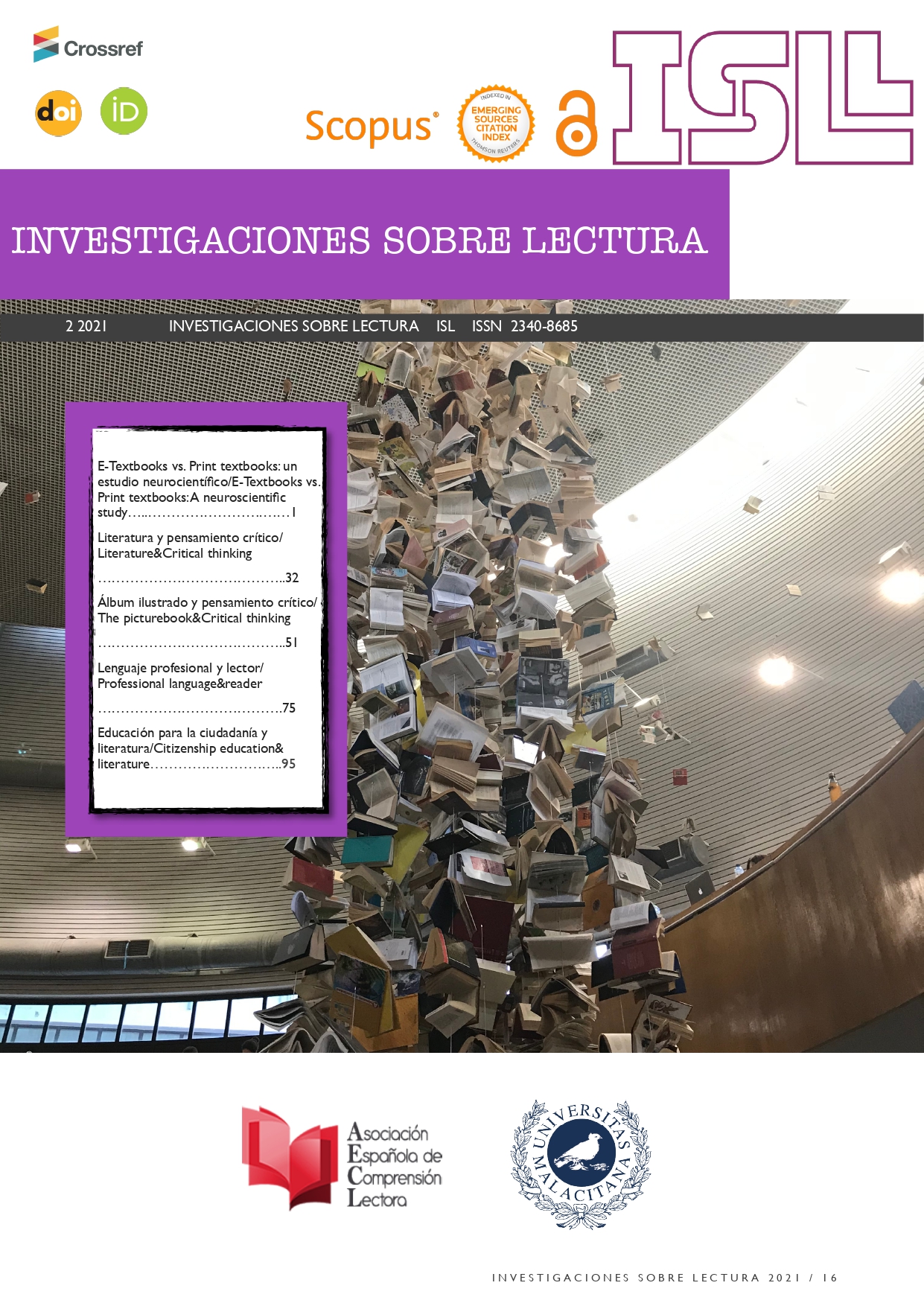
E-Textbooks vs. Print textbooks: A neuroscientific study on reading and completing exercises in primary school students
DOI:
https://doi.org/10.24310/isl.vi16.13683Keywords:
neuroscience, psycholinguistics, textbook, reading, educational technologyAbstract
Textbooks remained as the most widely used didactic materials in schools and, for some years now, its digital format has tried to find a niche in the classroom, given that children and young people are increasingly receptive to technological developments. Within these technological innovations, pupils live engaging and stimulating experiences that share with others in a natural and active way, therefore it is normal for them to find the traditional didactic resources they use in their schools as not very motivating. Aiming at finding out if textbooks are perceived as attractive materials to the participants of this study and what emotional effects caused them in the pupils, we have carried out a case study in which five neuromarketing devices were placed on the participants during reading and performance process (post-reading tasks) in both paper and digital textbooks. The data obtained reveled different physical and emotional reactions with high scores in the case of the on-paper learning, both in frontal asymmetry, electrodermal activity and pupillary dilation. Regarding the emotional parameters, there were participants with very high levels of stress and rejection, especially with the on-screen learning (E-textbook), while others obtained high enjoyment scale scores, specifically with the book in paper format.
Downloads
References
Downloads
Published
Dimensions
Issue
Section
License
All contents published in Investigaciones sobre Lectura are protected under the Creative Commons Attribution-NonCommercial-ShareAlike 4.0 International (CC BY-NC-SA 4.0) license. All about this license is available in the following link: <http://creativecommons.org/licenses/by-nc-sa/4.0>
Users can copy, use, redistribute, share and exhibit publicly as long as:
- The original source and authorship of the material are cited (Journal, Publisher and URL of the work).
- It is not used for comercial purposes.
- The existence of the license and its especifications are mentioned.
There are two sets of authors’ rights: moral and property rights. Moral rights are perpetual prerogatives, unrenounceable, not-transferable, unalienable, imprescriptible and inembargable. According to authors’ rights legislation, Investigaciones sobre Lectura recognizes and respects authors moral rights, as well as the ownership of property rights, which will be transferred to University of Malaga in open access. The property rights are referred to the benefits that are gained by the use or the dissemination of works. Investigaciones sobre Lectura is published in an open access form and it is exclusively licenced by any means for doing or authorising distribution, dissemination, reproduction, , adaptation, translation or arrangement of works.
Authors are responsable for obtaining the necessary permission to use copyrighted images.
How to Cite







31.png)