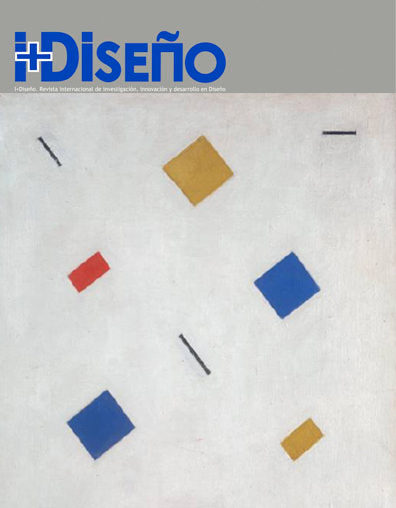
De Stijl and Bauhaus
DOI:
https://doi.org/10.24310/Idiseno.2011.v4i.12664Keywords:
De Stijl, Bauhaus, Neo-Plasticism, Nieuwe Beelding, Theo van Doesburg, Piet Mondrian, Gerrit Rietveld, Oskar Schlemmer, neoplastic design, neoplastic typography, typography and design De Stijl, Weimar, Walter Gropius, Dutch avant-garde, modern movementAbstract
Neo-Plasticism or De Stijl gathered a heterogeneous group of artists in The Netherlands between 1916 and 1917. The neoplasticists’ ethical and aesthetic task was aimed to renew the bond between art and life; the artists believed that by creating a new visual style they would also be establishing a new life style. Van Doesburg’s arrival in Weimar in April 1921, as well as other artists’ of the European avant-garde, would be crucial to the change from a teaching method and an attitude based on craftsmanship to a machine and mass production aesthetic, which would take place in 1923.
Downloads
Download data is not yet available.
References
Downloads
Published
2011-01-09
Dimensions
Citations




Issue
Section
Articles
License
Aquellos autores/as que tengan publicaciones con esta revista, aceptan los términos siguientes:- Los autores/as conservarán sus derechos de autor y garantizarán a la revista el derecho de primera publicación de su obra, el cuál estará simultáneamente sujeto a la Licencia de reconocimiento de Creative Commons que permite a terceros compartir la obra siempre que se indique su autor y su primera publicación esta revista.
- Los autores/as podrán adoptar otros acuerdos de licencia no exclusiva de distribución de la versión de la obra publicada (p. ej.: depositarla en un archivo telemático institucional o publicarla en un volumen monográfico) siempre que se indique la publicación inicial en esta revista.
- Se permite y recomienda a los autores/as difundir su obra a través de Internet (p. ej.: en archivos telemáticos institucionales o en su página web) antes y durante el proceso de envío, lo cual puede producir intercambios interesantes y aumentar las citas de la obra publicada. (Véase El efecto del acceso abierto).
How to Cite
Moreno Cañizares, A. (2011). De Stijl and Bauhaus. I+Diseño. Revista Científica De Investigación Y Desarrollo En Diseño, 4, 64-76. https://doi.org/10.24310/Idiseno.2011.v4i.12664

14.png)