
Illness, Suffering, Thought. Nietzsche and Human Existence
DOI:
https://doi.org/10.24310/EstudiosNIETen.vi22.14222Keywords:
suffering, illness, human existenceAbstract
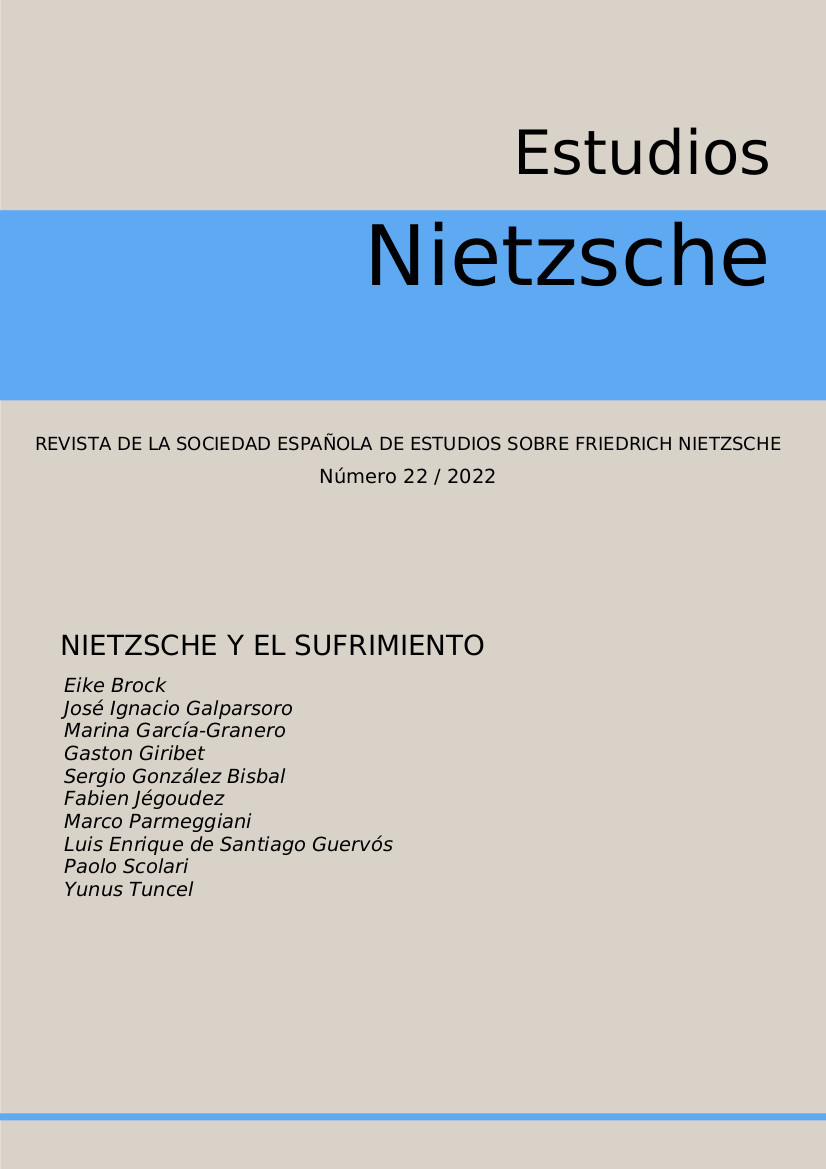
Thomas Mann asserts that Nietzsche also has another name: illness. In fact, when you look at life of philosopher of Röcken, it’s impossible not to come across his pathology: beyond the delirious madness that marks the last decade, the whole his existence appears indelibly marked by illness. And in Nietzsche the autobiographical theme of illness is inseparable from the philosophical problem of suffering. By considering his personal experience of illness as crucial, Nietzsche desires to experiment up to the point thought can resist and in which direction it takes whenever it is under the pressure of evil. His sharp investigation shows how the negative cannot be eliminated from existence, nor justified, but it constitutes a necessary ingredient: without tears, man would signify too much joy and one would never arrive at the laughter.
Downloads
References
Downloads
Published
Dimensions
Issue
Section
License
As of issue 21 (2021) this journal is published only in open access (diamond route).
From that number 21, like the previous numbers published in NIETZSCHE STUDIES, they are subject to the Creative Commons Acknowledgment-NoComercia-ShareIgual 4.0 license, the full text of which can be consulted at <http://creativecommons.org/licenses/by-nc-sa/4.0 >
It is the responsibility of the authors to obtain the necessary permissions of the images that are subject to copyright.
This work is licensed under a Creative Commons Attribution-NonCommercial-ShareAlike 4.0 International License.
Copyright generates two different rights: moral rights and patrimonial rights that EJFB recognizes and respects. Moral rights are those relating to the recognition of the authorship. They are rights of a personal nature that are perpetual, inalienable, unseizable and imprescriptible as consequence of the indivisible union of the author and his/her work.
Patrimonial rights are those that can be derived from the reproduction, distribution, adaptation or communication of the work, among others.
How to Cite





11.png)
