Philosophy and power of a Nietzschean edition
Keywords:
Nietzsche, critical edition, complete works, interpretation, posthumous legacyAbstract
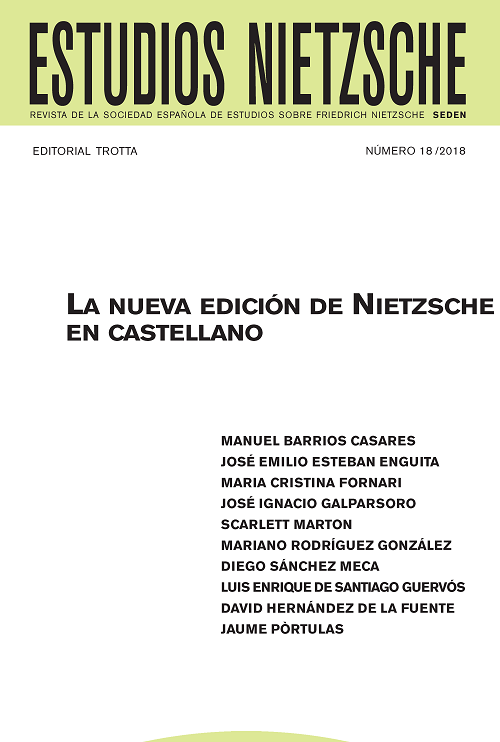
In this article we try to present the ideas that have presided over the Spanish edition of Nietzsche’s Complete Works and Posthumous legacy, whose publication took place between 2006 and 2016. It explains the meaning that the editors have wanted to give to this edition in view of the other major editions of Nietzsche’s works already made, and that have conditioned, in a very decisive way, the image and interpretation of this author’s thought throughout the twentieth century. The widespread interest thatNietzsche’s thought and work continues to raise made it necessary to have a reliable and complete edition of his writings in Spanish, such as that which had existed for years in the great languages of ?? European culture. The situation in this regard for Spanish-speaking scholars left much to be desired, as there were few well-translated texts and many othersthat lacked rigor and reliability. The purpose of this edition has been to cover this gap by undertaking a full and rigorous edition of both the posthumous legacy and the works published by Nietzsche.
Downloads
References
Downloads
Dimensions
Issue
Section
License
As of issue 21 (2021) this journal is published only in open access (diamond route).
From that number 21, like the previous numbers published in NIETZSCHE STUDIES, they are subject to the Creative Commons Acknowledgment-NoComercia-ShareIgual 4.0 license, the full text of which can be consulted at <http://creativecommons.org/licenses/by-nc-sa/4.0 >
It is the responsibility of the authors to obtain the necessary permissions of the images that are subject to copyright.
This work is licensed under a Creative Commons Attribution-NonCommercial-ShareAlike 4.0 International License.
Copyright generates two different rights: moral rights and patrimonial rights that EJFB recognizes and respects. Moral rights are those relating to the recognition of the authorship. They are rights of a personal nature that are perpetual, inalienable, unseizable and imprescriptible as consequence of the indivisible union of the author and his/her work.
Patrimonial rights are those that can be derived from the reproduction, distribution, adaptation or communication of the work, among others.

11.png)
