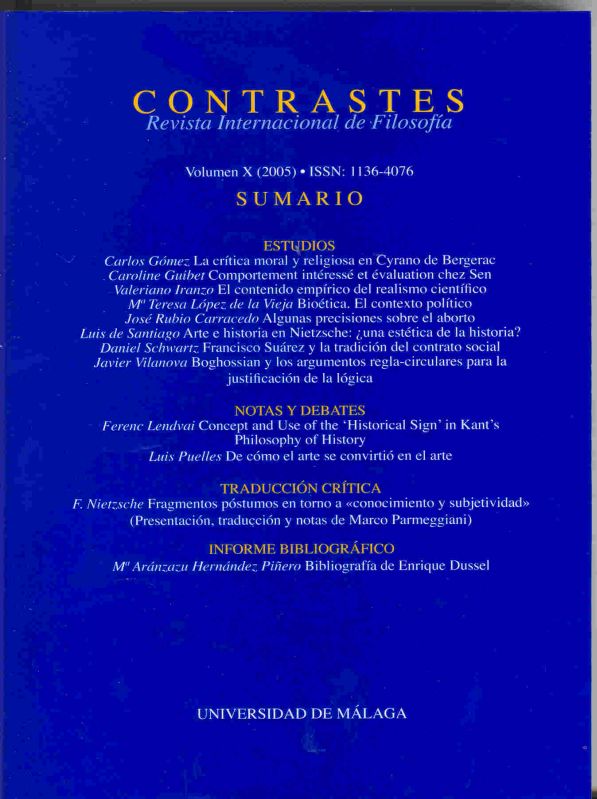
Boghossian y los argumentos regla-circulares para la justificación de la lógica
DOI:
https://doi.org/10.24310/Contrastescontrastes.v0i0.1891Abstract
resumen
En este trabajo se evalúa críticamente el papel de la Teoría de las definiciones implícitas (y en concreto la teoría de boghossian) en la resolución de dos problemas en torno al conocimiento de la lógica: el problema de la explicación (explicar cómo obtenemos creencias sobre nuestras reglas de inferencia), y el problema de la justificación (justificar que nuestras creencias así obtenidas son conocimiento). Se fijan cinco resultados a alcanzar: aprioricidad, factualismo, normatividad, aplicabilidad y no circularidad viciosa. Se argumentará que, aunque dichos resultados se pueden alcanzar respecto al problema de la explciación, no se evita circularidad viciosa en el problema de la justificación
PALABRAS CLAVE
LÓGICA, CONOCIMIENTO, DEFINICIÓN IMPLÍCITA, CIRCULARIDAD
ABSTRACT
This paper examines the rol of implicit Definitions Theory (specially Boghossian's theory) in the solution of two related problems about the status of logical knowledge: the explanation problem (how do we obtain beliefs concerning our rules of inference) and the justification problem (how do we know our beliefs concerning rules of inferences are justified). Five goals are assigned to the Implicit Definition Theory: apriocism, factualism, normativity, aplicability and not vicious circularity. it will be argued that these five goals are reached for the explanation problem, but nt for the justification problem.
KEYWORDS
LOGIC, KNOWLEDGE, IMPLICIT DEFINITION, CIRCULAR ARGUMENTS
Downloads
References
Downloads
Dimensions
Issue
Section
License
This journal provides immediate free access to its content under the principle of making research freely available to the public. All content published in Contrastes. Revista Internacional de Filosofía, are subject to the Creative Commons Attribution-NonCommercial-ShareAlike 4.0 license whose full text can be found at <http://creativecommons.org/licenses/by-nc-sa/4.0>
It is the responsibility of the authors to obtain the necessary permissions of the images that are subject to copyright.
Authors whose contributions are accepted for publication in this journal will retain the non-exclusive right to use their contributions for academic, research and educational purposes, including self-archiving or repository in open access repositories of any kind.
The electronic edition of this magazine is edited by the Editorial Service of the University of Malaga (Uma Editorial), being necessary to cite the origin in any partial or total reproduction.
How to Cite








5.png)
