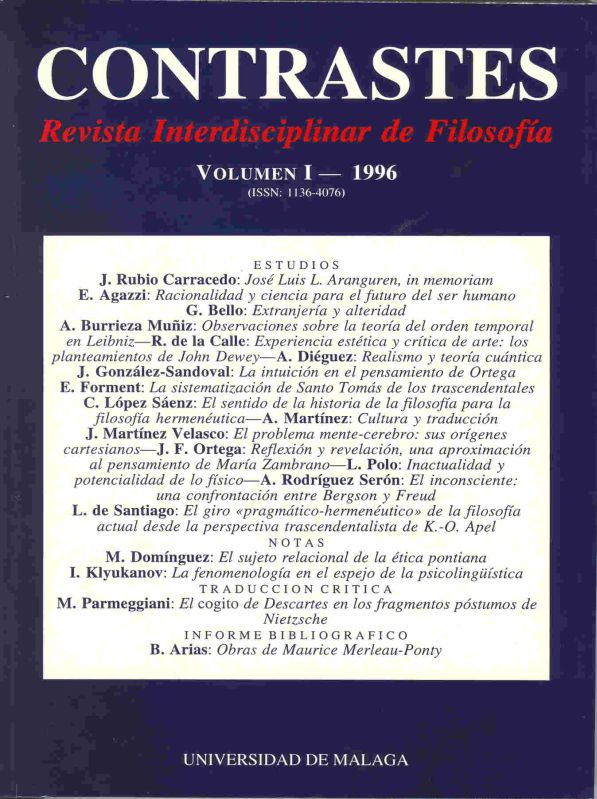
La intuición en el pensamiento de Ortega
DOI:
https://doi.org/10.24310/Contrastescontrastes.v1i0.1882Abstract
RESUMEN
Este artículo constituye un estudio sobre el concepto de la intuición en el pensamiento de Ortega y Gasset, referido a los tres órdenes de “cosas” en los que es requerida como forma de conocimiento: intuición sensible, intuición de valores e intuición del prójimo. Como intuición sensible se analiza la diversidad de significados presentes en su obra, así como una determinación genérica de dicho concepto, en conexión con el “yo ejecutivo”, que sirve de base para determinar los niveles en el proceso perceptivo, y los modos de relación del hombre con las “cosas”. En la intuición de valores, e intuición del prójimo, se determina que el planteamiento “superador” de Ortega es desplegado desde una inicial adscripción al pensamiento de Scheler, hasta posiciones más personales, que le llevan a proponer una problemática facultad “estimativa”, mediante la cual “asimila” la intuición de valores, o la “perspicacia”, y la “experiencia” como intuición del prójimo.
PALABRAS CLAVE
INTUICION – VALORES – PERCEPCION – ALTERIDAD
ABSTRACT
The paper deals with the concept of intuition in Ortega y Gasset’s thought, where its reference to “things” reveals it as a form of cognition: sensible, intuition, value intuition and intuition of the other. In the first case, the different meanings of sensible intuition will be discussed and its very concept, as connecetd with the “yo ejecutivo”, wich is the base to determining the levels of the perception process and the ways man deals with “things”. Concerning the issues of value intuition and intuition of the other, from an initial assumption of Scheler’s thesis, Ortega moves on to advance a problematical “estimative” faculty, under wich value intuition, or “sharpeness”, and “experience” as intuition of the other are “assimilated”.
KEYWORDS
INTUITION – VALUES – PERCEPTION – OTHERNESS
Downloads
References
Downloads
Dimensions
Issue
Section
License
This journal provides immediate free access to its content under the principle of making research freely available to the public. All content published in Contrastes. Revista Internacional de Filosofía, are subject to the Creative Commons Attribution-NonCommercial-ShareAlike 4.0 license whose full text can be found at <http://creativecommons.org/licenses/by-nc-sa/4.0>
It is the responsibility of the authors to obtain the necessary permissions of the images that are subject to copyright.
Authors whose contributions are accepted for publication in this journal will retain the non-exclusive right to use their contributions for academic, research and educational purposes, including self-archiving or repository in open access repositories of any kind.
The electronic edition of this magazine is edited by the Editorial Service of the University of Malaga (Uma Editorial), being necessary to cite the origin in any partial or total reproduction.
How to Cite








5.png)
