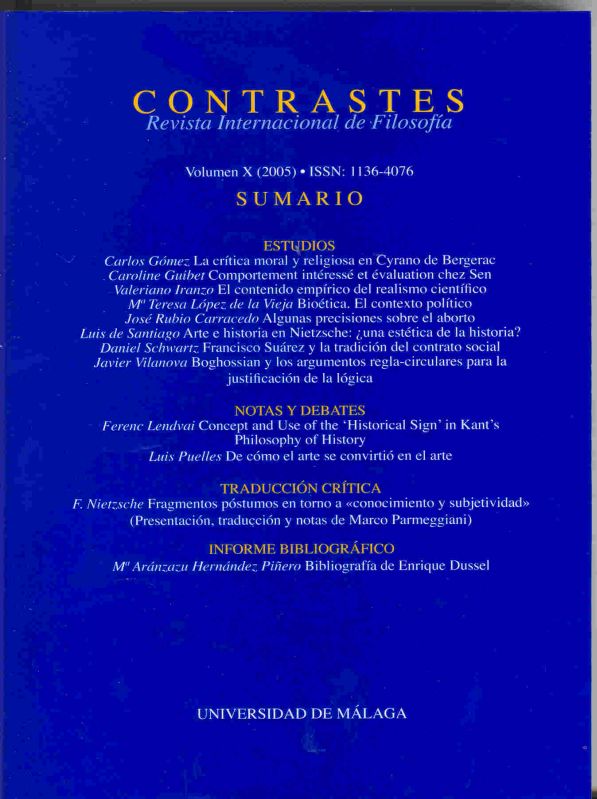
Bioética. El contexto político
DOI:
https://doi.org/10.24310/Contrastescontrastes.v0i0.1878Keywords:
BIOÉTICA, ÉTICA DE LA INVESTIGACIÓN CIENTÍFICA, IDEOLOGÍA, DERECHOS DE LOS CIUDADANOSAbstract
RESUMEN
El artículo argumenta en favor de un enfoque político de la Bioética. Por entender que el discurso bioético tendrá un alcance global solo después de revisar sus compromisos básicos e ideología. En los años setenta, Liberalismo y Pragmatismo dejaron su impronta en la disciplina. De un lado, el papel central de la autonomía estaba relacionado con los valores de la Nueva frontera políticaM de otro el Pragmatismo, la "ideología americana", derivó hacia el giro aplicado en Ética. al comienzo, la Bioética pretendía al acuerdo entre valores morales y ciencia, siendo un "puente" hacia el futuro. Sin embargo el consenso como valor prioritario desaconsejaba los debates políticos. Por esta razón, la Bioética se distanció del movimiento a favor de los derechos civiles. En beneficio de la imparcialidad liberal, la disciplina tuvo que redefinir fronteras, hacia dentro y hacia fuera. El modelo científico prevaleció sobre el modelo político. Pero el pragmatismo en cuestiones científicas era problemático. En los años noventa, el "Informe final" de la Comisión encargaba de investifar los hechos (ACHRE) demostró los experimentos con humanos habían ignorado los estándares morales y los derechos de los pacientes. En Estados Unidos.
PALABRAS CLAVE
BIOÉTICA, ÉTICA DE LA INVESTIGACIÓN CIENTÍFICA, IDEOLOGÍA, DERECHOS DE LOS CIUDADANOS
ABSTRACT
the article argues in favour of a political perspective about Bioethics, thinking that global discourse would expand at a global level only after the re-examination of basic commitments and ideology. Liberalism and Pragmatism imprinted their traces over the discipline the seventies. On the one hand the central role of autonomy was related to the values of the New frontier in politicis. On the other hand Pragmatism, the "American ideology", produced the practical turn in Ethics. At first, Bioethics aimed the consensus between moral values and sciencie, being like a "bridge" to the future. Consensus as a supreme value discouraged political debates, though. For that reason, Bioethics disentangled itself from the civil right movements. Fot he sake of liberal impartiality, the bioethical discourse had to adjust Pragmatism in scientific issues was flawed. The "Final Report of the Committee" (ACHRE) in charge of the investifation proved in the nineties that experimentation on humans had ignored moral standards and patients rights. In the United States.
KEYWORDS
BIOETHICS, ETHICS OF SCIENCE, IDEOLOGY, CITIZENS RIGHTS
Downloads
References
Downloads
Dimensions
Issue
Section
License
This journal provides immediate free access to its content under the principle of making research freely available to the public. All content published in Contrastes. Revista Internacional de Filosofía, are subject to the Creative Commons Attribution-NonCommercial-ShareAlike 4.0 license whose full text can be found at <http://creativecommons.org/licenses/by-nc-sa/4.0>
It is the responsibility of the authors to obtain the necessary permissions of the images that are subject to copyright.
Authors whose contributions are accepted for publication in this journal will retain the non-exclusive right to use their contributions for academic, research and educational purposes, including self-archiving or repository in open access repositories of any kind.
The electronic edition of this magazine is edited by the Editorial Service of the University of Malaga (Uma Editorial), being necessary to cite the origin in any partial or total reproduction.
How to Cite








5.png)
