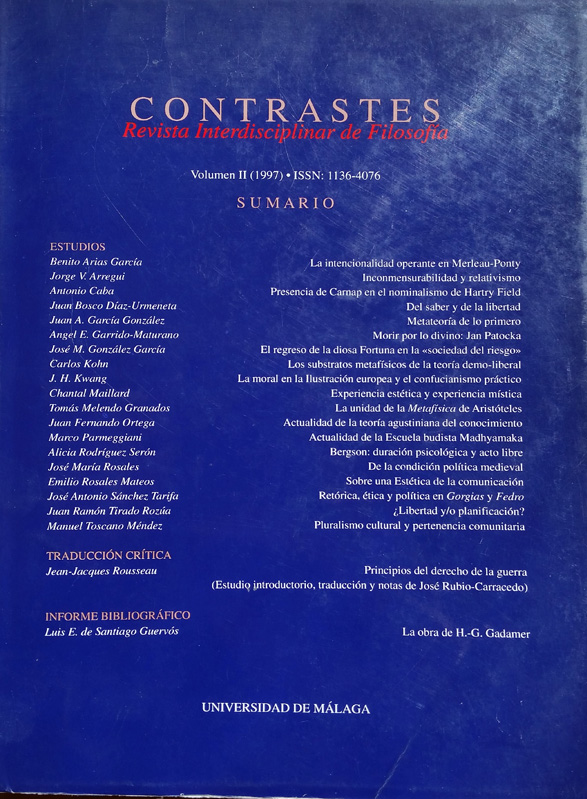
Actualidad de la escuela budista Madhymaka. En torno al nihilismo
DOI:
https://doi.org/10.24310/Contrastescontrastes.v2i0.1827Abstract
RESUMEN
La obra de Nagarjuna(Siglo II), el fundador de la Escuela budista Madhymaka, se revela en la actualidad como una de las maneras más agudas y radicales de afrontar el problema teórico y vital del nihilismo. En especial, el filósofo japonés contemporaneo Nishitani Keiji (1900-1990), perteneciente a la Escuela de Kyoto, descubre afinidades esenciale entre los métodos filosóicos de Nagarjuna y Nietzsche, orientadas hacia una "autosuperación" del nihilismo. Se trata de profundizar la nietzscheana afirmación dionisiaca de la vida a través del "camino medio" de Nagarjuna: la autorrealización mental y vital de la "vacuidad (shunyatá)-
NAGARJUNA-NISHITANI-NIHILISMO-VACUIDAD
ABSTRACT
The work of Nagarjuna (s.II), founder of the Buddhist School Madhyamaka, currently appears as a very smart and radical way of conronting the theoretical and vital problem of nihilism. For example, the contemporary Japanese philosopher Nishitani Keiji (1900-1990), member of the Kyoto School, shows the esential affinity between Nagarjuna's and Nietzche's philosophical methods, both oriented towards a "self-overcoming"of nihilism. nishitani tries to study in depth Nietzsche'es Dionysian affirmation of life thought Nagarjuna's "Middle Way": the mental and vital self- relatization of emptiness (shunyatá)
KEYWORDS
NAGARJUNA-NISHITANI.NIHILISM-EMPTINESS
Downloads
References
Downloads
Dimensions
Issue
Section
License
This journal provides immediate free access to its content under the principle of making research freely available to the public. All content published in Contrastes. Revista Internacional de Filosofía, are subject to the Creative Commons Attribution-NonCommercial-ShareAlike 4.0 license whose full text can be found at <http://creativecommons.org/licenses/by-nc-sa/4.0>
It is the responsibility of the authors to obtain the necessary permissions of the images that are subject to copyright.
Authors whose contributions are accepted for publication in this journal will retain the non-exclusive right to use their contributions for academic, research and educational purposes, including self-archiving or repository in open access repositories of any kind.
The electronic edition of this magazine is edited by the Editorial Service of the University of Malaga (Uma Editorial), being necessary to cite the origin in any partial or total reproduction.
How to Cite








5.png)
