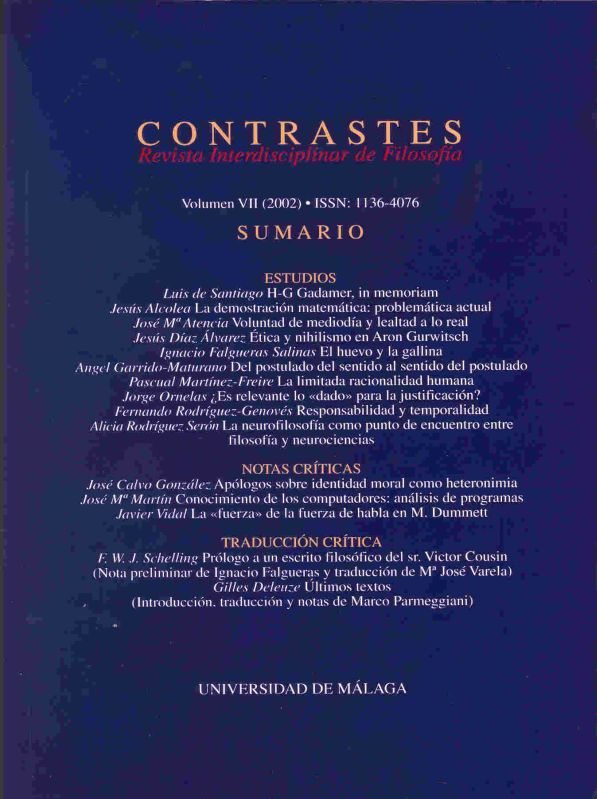
La neurofilosofía como punto de encuentro entre filosofía y neurociencias
DOI:
https://doi.org/10.24310/Contrastescontrastes.v7i0.1646Keywords:
NEUROFILOSOFÍA, FILOSOFÍA, NEUROCIENCIAS, CIENCIAS COGNITIVASAbstract
RESUMEN
Los progresos tecnológicos y teóricos alcanzados por las neurociencias en estos últimos veinticinco añis, y sus implicaciones para la filosofía, han renovado las posibilidades de aproximación entre ambas, propiciando el desarrollo de un nuevo ámbito de estudio dentro de la filosofía: la neurofilosofía. El presente trabajo se propone sugerir cómo este campo emergente podría ser concebido como un punto de encuentro para la reflexión conjunta y la interacción entre filosofía y neurociencias, no marcado necesariamente por la absorción de la primera por la segunda.
PALABRAS CLAVE
NEUROFILOSOFÍA, FILOSOFÍA, NEUROCIENCIAS, CIENCIAS COGNITIVAS
ABSTRACT
The technological and theoretical advances in neurosciencies in the past twenty-five years, as well as their implications for philosophy have opened promising perspectives for the renewal of approache between both, thus encouraging the development of a arising field within philosophy: neurophilosophy. The purpose of this paper is to suggest how this new field study could be considered to be a point of union for the joint reflection and interaction between philosophy and neurosciencies, without the first being absorbed by the second.
KEYWORDS
NEUROPHILOSOPHY, PHILOSOPHY, NEUROSCIENCES, COGNITIVE SCIENCES
Downloads
References
Downloads
Dimensions
Issue
Section
License
This journal provides immediate free access to its content under the principle of making research freely available to the public. All content published in Contrastes. Revista Internacional de Filosofía, are subject to the Creative Commons Attribution-NonCommercial-ShareAlike 4.0 license whose full text can be found at <http://creativecommons.org/licenses/by-nc-sa/4.0>
It is the responsibility of the authors to obtain the necessary permissions of the images that are subject to copyright.
Authors whose contributions are accepted for publication in this journal will retain the non-exclusive right to use their contributions for academic, research and educational purposes, including self-archiving or repository in open access repositories of any kind.
The electronic edition of this magazine is edited by the Editorial Service of the University of Malaga (Uma Editorial), being necessary to cite the origin in any partial or total reproduction.
How to Cite








5.png)
