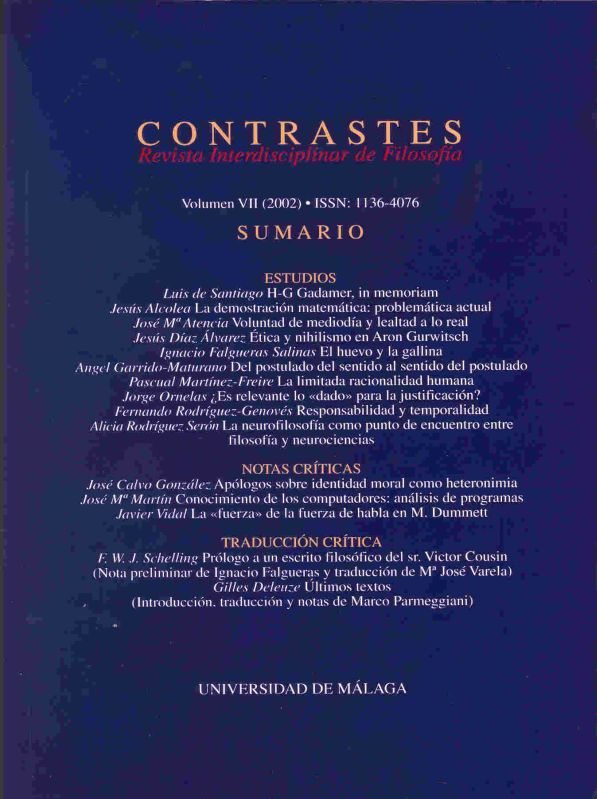
La limitada racionalidad humana
DOI:
https://doi.org/10.24310/Contrastescontrastes.v7i0.1644Keywords:
RACIONALIDAD, CONDICIÓN HUMANA, ARISTÓTELES, FREUDAbstract
RESUMEN
En primer lugar, se analiza la teoría clásica, tal como la formuló Aristóteles, de los seres humanos como animales racionales. En segundo lugar, se presenta la caracterización del hombre como no animal e irracional que ofrece Martinho da Vila. En tercer lugar, se consideran las tesis freudianas sobre la mezcla de racionalidad e irracionalidad en los humanos. En cuarto lugar, se señalan algunos puntos de vista recientes, debidos a Simon así como a la psicología y neurociencia actuales, sobre la limitación de la razón humana y su relación con las emociones. Finalmente se argumenta que ni Aristóteles ni Martinho da Vila describen bien la condición humana.
PALABRAS CLAVE
RACIONALIDAD-CONDICIÓN HUMANA-ARISTÓTELES-FREUD
ABSTRACT
Fistly the classical theory, as put forward by Aristotle, about the human beings as rational animals is analysed. Secondly the description of man as no animal and irrational offered by Martnho da Vila is presented. Thirly the Freudian thseses on the mixture os rational and irrational aspects in humans are considered. Forurthly some recent points of view, by Simon and the current psychology and neurosciencie, about the limitation of human reason and irs relation with emotions are pointed out. Lastly it is argued that neithert Aristotle nor Martinho da Vila decribe well the human nature.
KEYWORDS
RATIONALITY-HUMAN NATURE-ARISTOTLE-FREUD
Downloads
References
Downloads
Dimensions
Issue
Section
License
This journal provides immediate free access to its content under the principle of making research freely available to the public. All content published in Contrastes. Revista Internacional de Filosofía, are subject to the Creative Commons Attribution-NonCommercial-ShareAlike 4.0 license whose full text can be found at <http://creativecommons.org/licenses/by-nc-sa/4.0>
It is the responsibility of the authors to obtain the necessary permissions of the images that are subject to copyright.
Authors whose contributions are accepted for publication in this journal will retain the non-exclusive right to use their contributions for academic, research and educational purposes, including self-archiving or repository in open access repositories of any kind.
The electronic edition of this magazine is edited by the Editorial Service of the University of Malaga (Uma Editorial), being necessary to cite the origin in any partial or total reproduction.
How to Cite








5.png)