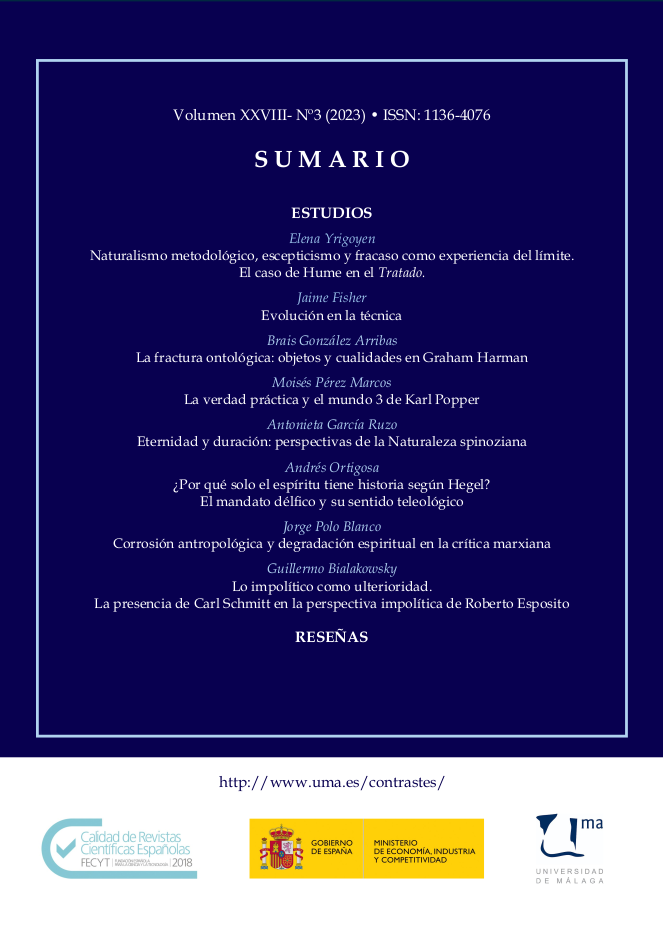
Eternity and Duration: Perspectives of Spinozian Nature
DOI:
https://doi.org/10.24310/Contrastescontrastes.v28i3.15514Keywords:
eternity, duration, Spinoza, duality, univocityAbstract
The purpose of this paper is to support the thesis that the Spinozian notions of eternity and duration cannot be considered as ontological but rather as gnoseological, unlike Spinoza’s readings throughout history. To accomplish this, it analyze the three kinds of human knowledge -imagination, reason, intuitive science- to show that Spinoza presents his actions as those which give rise to the perspectives of eternity and duration. These movements allow us to understand that duality, by being gnoseological, does not represent an objection to ontological univocity. At the same time, it allows us to investigate in greater depth the Spinozian philosophical project and the role knowledge occupies in it.
Downloads
References
ALLISON, H. (1987), Benedict de Spinoza. An Introduction, New Haven and London: Yale University Press.
BENNETT, J. (1984), A Study of Spinoza’s Ethics, USA: Hackett Publishing Company.
CHAUI, M. (2008), «O fim da metafísica: Espinoza e a ontologia do necessário» en Tatián, D. (ed.), Spinoza: cuarto coloquio, Ed. Brujas, Córdoba.
CHAUI, M. (1999), A Nervura do real. Imanência e liberdade em Espinosa, São Paulo: Companhia das Letras.
CURLEY, E. M. (1988), Behind the Geometrical Method: A Reading of Spinoza’s Ethics, Princeton: Princeton University Press. DOI: https://doi.org/10.1515/9780691214269
DE DIJN, H. (1991), «Metaphysics as Ethics» en Yovel, Y. (ed), God and Nature: Spinoza´s Metaphysics: Papers Presented at the First Jerusalem Conference, Leiden: E. J. Brill.
DELEUZE, G. (2013), Spinoza. Filosofía práctica, Buenos Aires: Tusquets.
DELEUZE, G. (2008), En medio de Spinoza, Buenos Aires: Cactus.
DELEUZE, G. (1996), Spinoza y el problema de la expresión, trad. Horst Vogel, Barcelona: Muchnik editores S. A.
EREMIEV, B., PLACENCIA, L. (2008), Introducción al Tratado de la reforma del entendimiento, Buenos Aires: Colihue Clásica.
HALLETT, H. F. (1928), «Spinoza’s Conception of Eternity», Mind, Vol. 37, No. 147. DOI: https://doi.org/10.1093/mind/XXXVII.147.283
JARRETT, C. (2001), «Spinoza´s distinction between essence and existence», Iyyun The Jerusalem Philosophical Quarterly 50, Julio 2001, pp. 245-252. KLEIN, J. (2002), «By eternity I understand’: Eternity according to Spinoza», Olyyun. The Jerusalem Philosophical Quarterly 51, Julio 2002, pp. 295–324.
MARSHALL, E. (2013), The Spiritual Automaton. Spinoza’s Science of the Mind, Oxford: Oxford University Press. DOI: https://doi.org/10.1093/acprof:oso/9780199675531.001.0001
MARTIN, C. P. (2008), «The Framework of Essences in Spinoza’s Ethics», British Journal for the History of Philosophy, 16:3, pp. 489-509. DOI: https://doi.org/10.1080/09608780802200489
MORFINO, V. (2015), «Esencia y Relación» en Revista Pensamiento Político, Num. 6, Universidad Diego Portales.
PARKINSON, G. H. R (1954), Spinoza’s theory of knowledge, Glasgow – New York – Toronto: Oxford University Press.
PRELORENTZOS, Y. (1996), Temps, durée et éternité dans les Principes de la philosophie de Descartes de Spinoza, Paris: Presses de l´Université de Paris-Sorbonne.
SAVAN, D. (1994), «Spinoza on Duration, Time, and Eternity» en Graeme Hunter (ed.) Spinoza. The Enduring Questions, Toronto: University of Toronto Press.
SCHMALTZ, T. (2015), «Spinoza on Eternity and Duration: The 1663 Connection» en Melamed, Y. (ed.), The Young Spinoza. A Metaphysician in the Making, Oxford: Oxford University Press, pp. 205-220. DOI: https://doi.org/10.1093/acprof:oso/9780199971657.003.0014
SIBILIA, G. (2017), De la producción eterna de lo real al tiempo vivido. Ontología y temporalidad en Spinoza, Tesis doctoral, Universidad de Buenos Aires, Facultad de Filosofía y Letras.
SPINOZA, B. (2011), Ética demostrada según el orden geométrico, Introducción, traducción y notas de Vidal Peña, Alianza, Madrid.
SPINOZA, B. (2008), Tratado de la reforma del entendimiento, Traducción de Boris Eremiev y Luis Placencia, Colihue, Buenos Aires.
SPINOZA, B. (1988), Tratado de la reforma del entendimiento/Principios de filosofía de Descartes/Pensamientos metafísicos, Traducción de Atilano Domínguez, Alianza, Madrid.
SPINOZA, B. (1990), Tratado breve, Traducción, notas y prólogo de Atilano Domínguez, Alianza, Madrid.
SPINOZA, B. (2007), Epistolario, Traducción de Oscar Cohan, Ed. Colihue, Buenos Aires.
STEINBERG, D. (2009), «Knowledge in Spinoza’s Ethics» en Koistinen, O. (ed) The Cambridge Companion to Spinoza’s Ethics, Cambridge: Cambridge Uniersity Press. DOI: https://doi.org/10.1017/CCOL9780521853392.008
VILJANEN, V. (2011), Spinoza’s Geometry of Power, New York: Cambridge University Press. DOI: https://doi.org/10.1017/CBO9781139005210
WOLFSON, H. A. (1934), The Philosophy of Spinoza. Unfolding the Latent Processes of His Reasoning. Vol I, USA: Harvard University Press.
YOVEL, Y. (1988), Spinoza and Other Heretic, Princeton: Princenton University Press DOI: https://doi.org/10.1515/9780691237640
Downloads
Published
Dimensions
Issue
Section
License
This journal provides immediate free access to its content under the principle of making research freely available to the public. All content published in Contrastes. Revista Internacional de Filosofía, are subject to the Creative Commons Attribution-NonCommercial-ShareAlike 4.0 license whose full text can be found at <http://creativecommons.org/licenses/by-nc-sa/4.0>
It is the responsibility of the authors to obtain the necessary permissions of the images that are subject to copyright.
Authors whose contributions are accepted for publication in this journal will retain the non-exclusive right to use their contributions for academic, research and educational purposes, including self-archiving or repository in open access repositories of any kind.
The electronic edition of this magazine is edited by the Editorial Service of the University of Malaga (Uma Editorial), being necessary to cite the origin in any partial or total reproduction.
How to Cite








5.png)