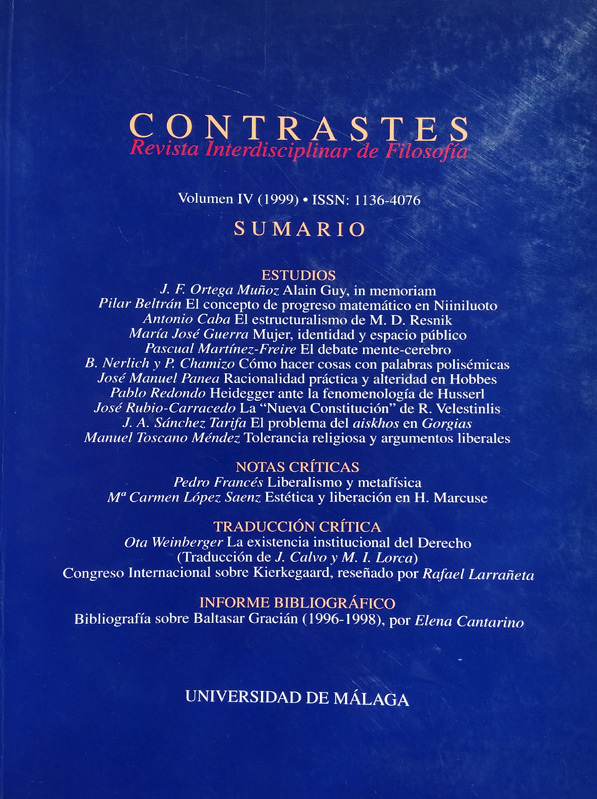
Heidegger ante la fenomenología de Husserl
DOI:
https://doi.org/10.24310/Contrastescontrastes.v4i0.1259Abstract
RESUMEN
Heidegger ha ejercido una crítica constante de la fenomenología de Husserl desde el momento en que empezó a impartir sus primeras lecciones académicas. uno de los momentos culminantes de este proceso es Prolegomena zur Geschichte des Zeitbegriffs, el curso del verano de 1925. Haciendo un análisis detallado de la fenomenología de la conciencia de Husserl, Heidegger denuncia que los presupuestos en los que aquella se apoya la acercan a la filosofía tradicional y la alejan de sus pretensiones iniciales. La "fascinación por la tradición" y el predominio de la teoría son los resultados principales de esta crítica (destrucción) inmanente,
PALABRAS CLAVE
FENOMENOLOGÍA-CONCIENCIA-HUSSERL-HEIDEGGER
ABSTRACT
As from his early lectures in the university, Heidegger has been criticizing the phenomenology of Husserl. A critical moment of this process is Prolegomena zur Geschichte des Zeitbegriffs, the summer of 1925 course. By examining Husserl's phenomenology of conscience, Heidegger denounces that its assumptions lean it towards traditional philosophy and keep it away from its initial pretensions. The main outcomes of the critique are both the "fascination with tradition"and the primacy of theory
KEYWORDS
PHENOMENOLOGY-CONSCIENCE-HUSSERL-HEIDEGGER
Downloads
References
Downloads
Dimensions
Issue
Section
License
This journal provides immediate free access to its content under the principle of making research freely available to the public. All content published in Contrastes. Revista Internacional de Filosofía, are subject to the Creative Commons Attribution-NonCommercial-ShareAlike 4.0 license whose full text can be found at <http://creativecommons.org/licenses/by-nc-sa/4.0>
It is the responsibility of the authors to obtain the necessary permissions of the images that are subject to copyright.
Authors whose contributions are accepted for publication in this journal will retain the non-exclusive right to use their contributions for academic, research and educational purposes, including self-archiving or repository in open access repositories of any kind.
The electronic edition of this magazine is edited by the Editorial Service of the University of Malaga (Uma Editorial), being necessary to cite the origin in any partial or total reproduction.
How to Cite








5.png)
