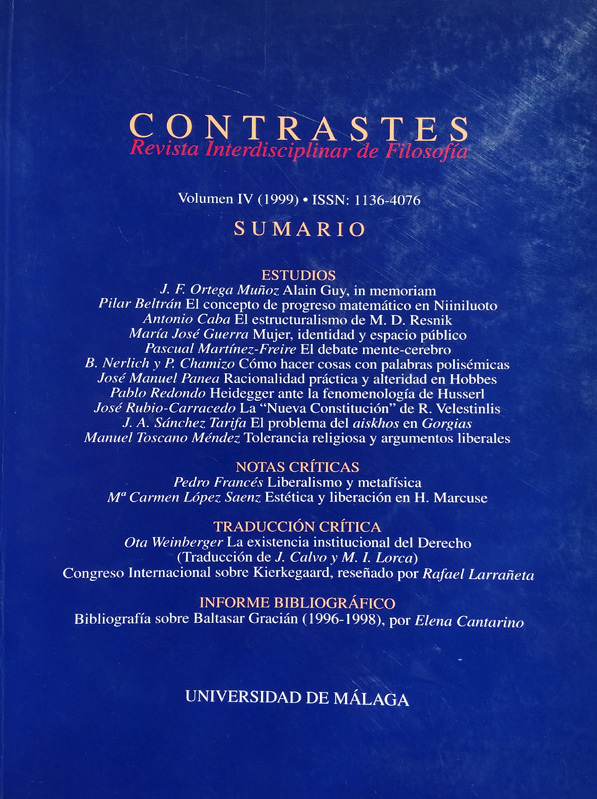
Cómo hacer cosas con palabras polisémicas: El uso de la ambigüedad en el lenguaje ordinario
DOI:
https://doi.org/10.24310/Contrastescontrastes.v4i0.1252Abstract
RESUMEN
Se asume normalmente que, en las conversaciones ordinarias, los hablantes evitan los significados múltiplesy que los oyentes desambiguan automáticamente las proferencias en función del contexto. En contraste, nosotros queremos hacer ver que la gente explota activamente la polisemia en la conversación a fin de establecer y consolidar los lazos sociales entre los hablantes. y esto también consolida a la larga, el sistema compartido de significados. nuestra investigación sobre el uso pragmático de la polisemia constrasta con la investigación tradicional sobre la polisemia, que se ha centrado en oraciones artificiales tomadas fuera de contexto. En vez de estudira esta "polisemia muerta", nosotros queremos estudiar la "polisemia viva", y en la medida en que es creada y explotada en la integración lingüística.
PALABRAS CLAVE
AMBIGÜEDAD-CHISTE-METÁFORA-POLISEMIA
ABSTRACT
It is normally asumed that in ordinary discourse speakers avoid multiple meanings and hearesrs disambiguate utterances automatically in context. We want to show by contrast that people actively exploit polysemy in conversation so as to establish and strengthen social bonds between speakers. In the long run this also streghens the shared system of meanings. our research into the pragmatic use o polysemy contrast with traditional research into polysemy wich has focused on artificial sentences taken out of context. instead of studying this "dead polisemy" we want to study "live polysemy", as it is created and exploited in linguistic interaction
KEYWORDS
AMBIGUITY-JOKE-METHAPHOR-POLYSEMY
Downloads
References
Downloads
Dimensions
Issue
Section
License
This journal provides immediate free access to its content under the principle of making research freely available to the public. All content published in Contrastes. Revista Internacional de Filosofía, are subject to the Creative Commons Attribution-NonCommercial-ShareAlike 4.0 license whose full text can be found at <http://creativecommons.org/licenses/by-nc-sa/4.0>
It is the responsibility of the authors to obtain the necessary permissions of the images that are subject to copyright.
Authors whose contributions are accepted for publication in this journal will retain the non-exclusive right to use their contributions for academic, research and educational purposes, including self-archiving or repository in open access repositories of any kind.
The electronic edition of this magazine is edited by the Editorial Service of the University of Malaga (Uma Editorial), being necessary to cite the origin in any partial or total reproduction.
How to Cite








5.png)