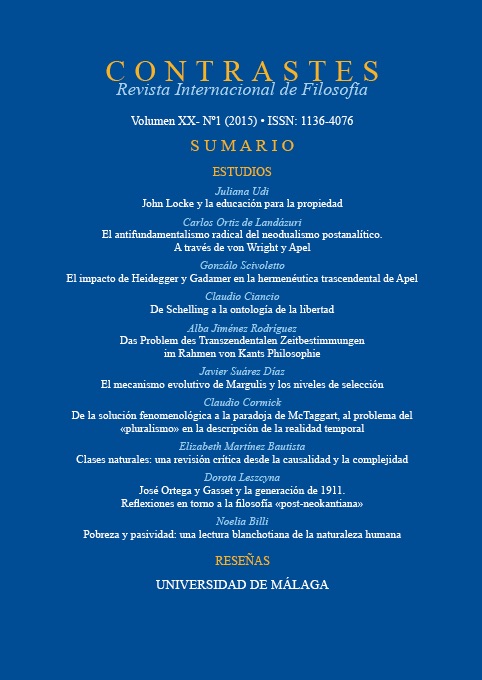
Poverty and passivity: a Blanchotian reading of human nature
DOI:
https://doi.org/10.24310/Contrastescontrastes.v20i1.2304Keywords:
Poverty, Passivity, Blanchot, Heidegger, EspositoAbstract
Human negativity is “dialectized” within the framework of the compensatory conceptions of Human Nature. After analysing this point, we will call attention to the difficulties it implies when approaching the contemporary questions around the Human Being. We will demonstrate the importance of renewing the notion of ‘absence of nature’ that circulates in a certain German line of research on the human, of which the notion of ‘poverty’ postulated by Heidegger will constitute the exemplum. Making use of the interpretation of “poverty” made by M. Blanchot, we will indicate the possibility of reading the absence of nature not as pure negativity but as nondialectizable passivity that affects Man.Downloads
References
Downloads
Published
Dimensions
Citations




Issue
Section
License
This journal provides immediate free access to its content under the principle of making research freely available to the public. All content published in Contrastes. Revista Internacional de Filosofía, are subject to the Creative Commons Attribution-NonCommercial-ShareAlike 4.0 license whose full text can be found at <http://creativecommons.org/licenses/by-nc-sa/4.0>
It is the responsibility of the authors to obtain the necessary permissions of the images that are subject to copyright.
Authors whose contributions are accepted for publication in this journal will retain the non-exclusive right to use their contributions for academic, research and educational purposes, including self-archiving or repository in open access repositories of any kind.
The electronic edition of this magazine is edited by the Editorial Service of the University of Malaga (Uma Editorial), being necessary to cite the origin in any partial or total reproduction.




5.png)