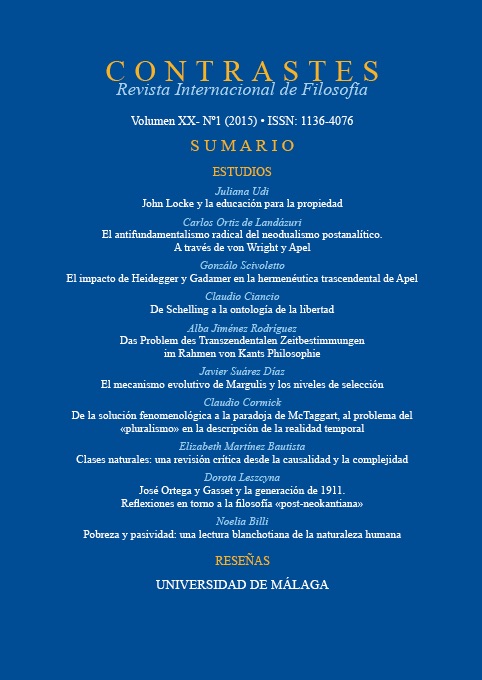
The radical anti-fundamentalism of post-analytic neo-dualism. Through von Wright and Apel
DOI:
https://doi.org/10.24310/Contrastescontrastes.v20i1.2295Keywords:
Semiotics, Heuristics, Falsificationism, Analysis, Neo-dualismAbstract
Subsequently to the theory of the games of language by the latest Wittgenstein, post-analytic neo-dualism attributed a radically anti-fundamentalistic attitude to Russell, the first Wittgenstein and Popper, based on three reasons, at least according to von Wright and Apel: The inductive dogmatic foundation of the logical positivism of the two first cases; the permanent hypothetical re-foundation of the critical rationalism of Popper; and, finally, the explanatory-understanding foundation defended in a melioristic way by the semantic pragmatism of the latter. But not withstanding this basic agreement, von Wright and Apel disagreed about the merely pragmatic, or rather pragmatic transcendental sense that, in spite of everything, should be awarded to the notion of foundation in the followers of these new tendencies of post-analytic neo-dualism.Downloads
References
Downloads
Published
Dimensions
Citations




Issue
Section
License
This journal provides immediate free access to its content under the principle of making research freely available to the public. All content published in Contrastes. Revista Internacional de Filosofía, are subject to the Creative Commons Attribution-NonCommercial-ShareAlike 4.0 license whose full text can be found at <http://creativecommons.org/licenses/by-nc-sa/4.0>
It is the responsibility of the authors to obtain the necessary permissions of the images that are subject to copyright.
Authors whose contributions are accepted for publication in this journal will retain the non-exclusive right to use their contributions for academic, research and educational purposes, including self-archiving or repository in open access repositories of any kind.
The electronic edition of this magazine is edited by the Editorial Service of the University of Malaga (Uma Editorial), being necessary to cite the origin in any partial or total reproduction.




5.png)