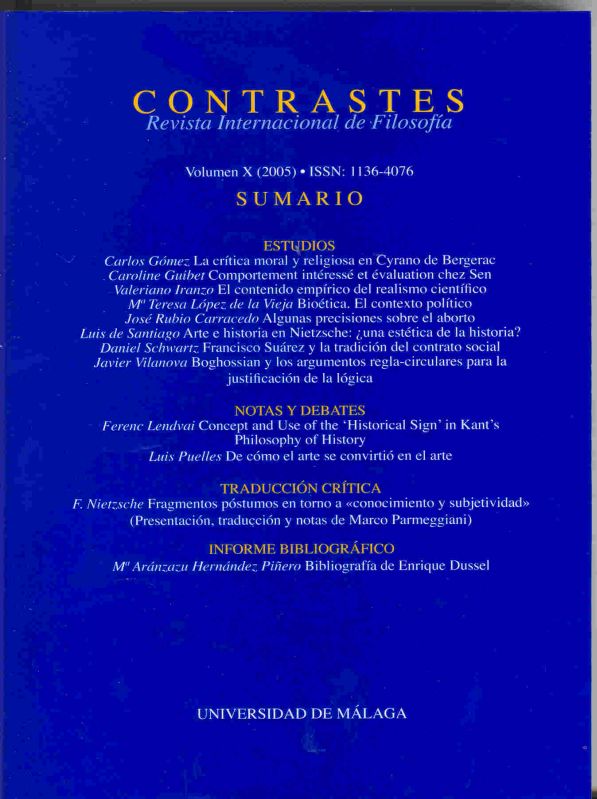
El contenido empírico del realismo científico
DOI:
https://doi.org/10.24310/Contrastescontrastes.v0i0.1872Keywords:
REALISMO CIENTÍFICO, OBSERVACIÓN, TEORÍA, INFERENCIA A LA MEJOR EXPLICACIÓNAbstract
RESUMEN
Una forma común de entender el realismo científico (RC) en las últimas décadas ha sido plantearlo como una inferencia explicativa: RC es la mejor explicación del éxito predictivo-instrumental de la ciencia. Algunos de sus partidarios mantienen, además que es una hipótesis empíricamente constrastable. Intentaré argumentar, que, entendido así, RC no es empíricamente contrastable. En primer lugar, aunque el éxito predictivo-instrumental initerrumpido de una teoría T es una consecuencia observacional de la verdad de T, este hecho no hecho no constituye una evidencia empírica diferente del propio "explanandum". En segundo lugar, elaorar un registro histórico del éxito -no sólo empírico, sino teórico- obtenido mediante la postulación de entidades por consideraciones explicativas, confirmaría como mucho, y eso suponiendo que fuera posible, una cocincidencia entre una metodología determinada y unos resultados, pero no daría cuenta del vínculo explicativo entre éxito predictivo instrumental por un lado, y verdad y existencia, por otro. Por consiguiente, RC no es una hipótesis empírica en un sentido genuino; a fortiori, tampoco es una hipótesis científica. Esta conclusión, no obstante, no cierra el camino a un realismo científico de carácter local.
PALABRAS CLAVE
REALISMO CIENTÍFICO, OBSERVACIÓN, TEORÍA, INFERENCIA A LA MEJOR EXPLICACIÓN
ABSTRACT
A common way of understanding scientific realism (SR) during the latest decades says that SR is the best explanation of the predictive success enjoyed by scientific theories. Some os this advocates claim, aslo, that SR is an empirically testable hypothesis. I will try to argue that, as an explanation of predictive sucess, SR is not empirically testable. Firstly, even though the uninterrupted preditive success of T is an observational consequence of T´s truth, this fact is not a kind of evidence distinguishable from the very explanandum. Secondly, a historical record of success obtained by postulating theoretical emities would confirm, at most, a correlation between some methodological norms and some particular results. But confirming such correlation is not the same as vindicating an explanotory link between truth and existence (the explanans), and predictive success (the explanandum). In sum, SR is not a genuine empirical hypothesis; a fortiori, it is neither a scientific hypothesis. Anyway, this conclusion does not forbid some kind of "local" scientific realism.
KEYWORDS
SCIENTIFIC REALISM, OBSERVATION, THEORY, INFERENCE TO THE BEST EXPLANATION
Downloads
References
Downloads
Dimensions
Citations




Issue
Section
License
This journal provides immediate free access to its content under the principle of making research freely available to the public. All content published in Contrastes. Revista Internacional de Filosofía, are subject to the Creative Commons Attribution-NonCommercial-ShareAlike 4.0 license whose full text can be found at <http://creativecommons.org/licenses/by-nc-sa/4.0>
It is the responsibility of the authors to obtain the necessary permissions of the images that are subject to copyright.
Authors whose contributions are accepted for publication in this journal will retain the non-exclusive right to use their contributions for academic, research and educational purposes, including self-archiving or repository in open access repositories of any kind.
The electronic edition of this magazine is edited by the Editorial Service of the University of Malaga (Uma Editorial), being necessary to cite the origin in any partial or total reproduction.




5.png)