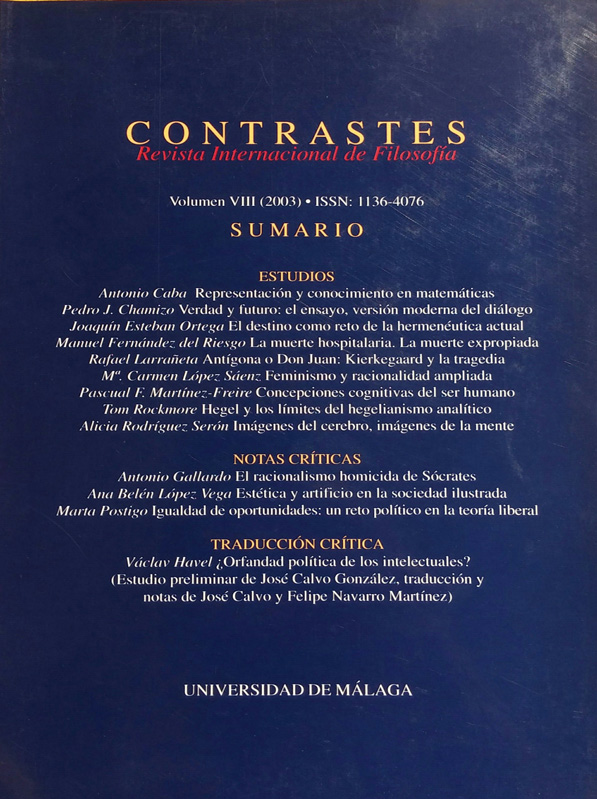
El racionalismo homicida de Sócrates
DOI:
https://doi.org/10.24310/Contrastescontrastes.v8i0.1844Keywords:
SÓCRATES-NIETZSCHE-RACIONALISMO-TRAGEDIAAbstract
RESUMEN
Nietzsche con su habitual tono, radical y vehemente afirma que "todo el mundo conoce la tesis socrática, la virtus es el saber: se peca únicamente por ignorancia. El virtuoso es el feliz". En estas tres formas básicas del optimismo está la muerte de la tragedia, que es pesimista. Pues bien, todas estas circunstancia arrastran a Nietzsche a considerar a Sócrates como un homicida, es decir, un homicida racionalista que aniquila la tragedia al despojarla de su componente dionisiaco, irracional e imprevisible.
PALABRAS CLAVE
SÓCRATES-NIETZSCHE-RACIONALISMO-TRAGEDIA
ABSTRACT
Nietzsche with its habitual tone, vehement and radical affirms that the entire world knows the Socratic thesis; the virtue is the knowledge, to sin only by ignorance. The virtuous is happy. In these three basic forms of the optimism is the death of the tragedy, which is pessimistic. The, all these circumstances drag to Nietzsche to considerer to Socrates like a monicide, so a rationalist homicide that amihilates the tragedy when undressing it of its dionisiaco, irrational and unforeseeable component.
KEYWORDS
SOCRATES-NIETZSCHE-RATIONALISM-TRAGEDY
Downloads
References
Downloads
Dimensions
Citations




Issue
Section
License
This journal provides immediate free access to its content under the principle of making research freely available to the public. All content published in Contrastes. Revista Internacional de Filosofía, are subject to the Creative Commons Attribution-NonCommercial-ShareAlike 4.0 license whose full text can be found at <http://creativecommons.org/licenses/by-nc-sa/4.0>
It is the responsibility of the authors to obtain the necessary permissions of the images that are subject to copyright.
Authors whose contributions are accepted for publication in this journal will retain the non-exclusive right to use their contributions for academic, research and educational purposes, including self-archiving or repository in open access repositories of any kind.
The electronic edition of this magazine is edited by the Editorial Service of the University of Malaga (Uma Editorial), being necessary to cite the origin in any partial or total reproduction.




5.png)
