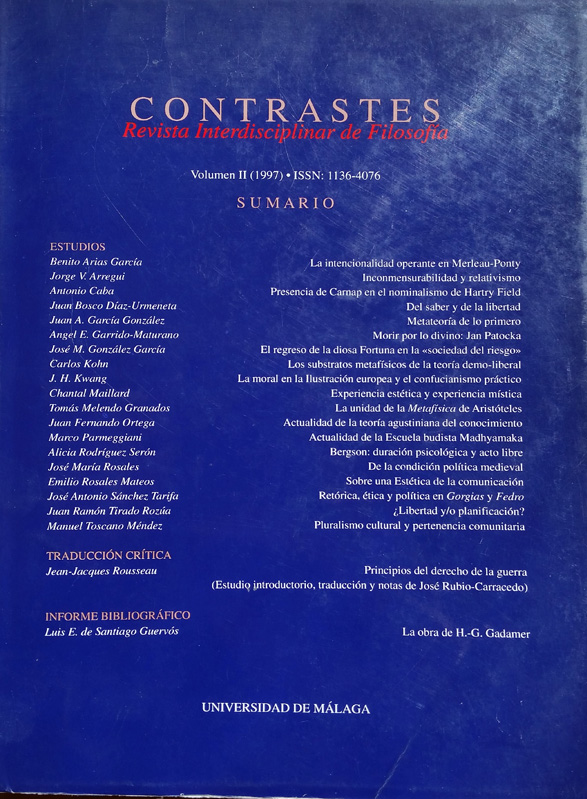
Retórica, ética y política en Gorgias y Fedro
DOI:
https://doi.org/10.24310/Contrastescontrastes.v2i0.1833Abstract
RESUMEN
Nuestro trabajo establece una comparación entre los dos periodos en que Platon realizó Gorgias y Fedro, para comprobar si hubo un cambio en sus concepciones retóricas, éticas y políticas o si, por el contrario,mantiene una undiad de pensamiento sin que se alteren sus creencias básicas sobre tales conceptos. Para realizar nuestro estudio, primero expondremos las ideas fundamentales que Platón presenta en Gorgias sobre retórica, ética y política, posteriormetne haremos lo propio en Fedro y finalmente sacaremos las conclusiones pertinentes en función de nuestro análisis sobre los puntos de consenso o de dusenso en ambos diálogos.
PALABRAS CLAVES
FEDRO-GORGIAS-PLATON-RETORICA
ABSTRACT
The present work establishes a comparison between two periods of Plato's thought, in order to analize how his thinking evolved in his rhetorical, ethical and political conceptions. For this reason, two important dialogues have been chosen Gorgias and Phaedrus, in which may topics are developed, linking them with the aspects referred to above in wich one can evaluate whether Plato changed his main conceptions about rhetorical, ethical and political reality or, whather on the other hand, he continued to ahve an unity of thiking thoughout the great period in wich he carried out his intellectual work
KEYWORDS
GORGIAS-PHAEDRUS-PLATO-RHETORIC
Downloads
References
Downloads
Dimensions
Citations




Issue
Section
License
This journal provides immediate free access to its content under the principle of making research freely available to the public. All content published in Contrastes. Revista Internacional de Filosofía, are subject to the Creative Commons Attribution-NonCommercial-ShareAlike 4.0 license whose full text can be found at <http://creativecommons.org/licenses/by-nc-sa/4.0>
It is the responsibility of the authors to obtain the necessary permissions of the images that are subject to copyright.
Authors whose contributions are accepted for publication in this journal will retain the non-exclusive right to use their contributions for academic, research and educational purposes, including self-archiving or repository in open access repositories of any kind.
The electronic edition of this magazine is edited by the Editorial Service of the University of Malaga (Uma Editorial), being necessary to cite the origin in any partial or total reproduction.




5.png)
