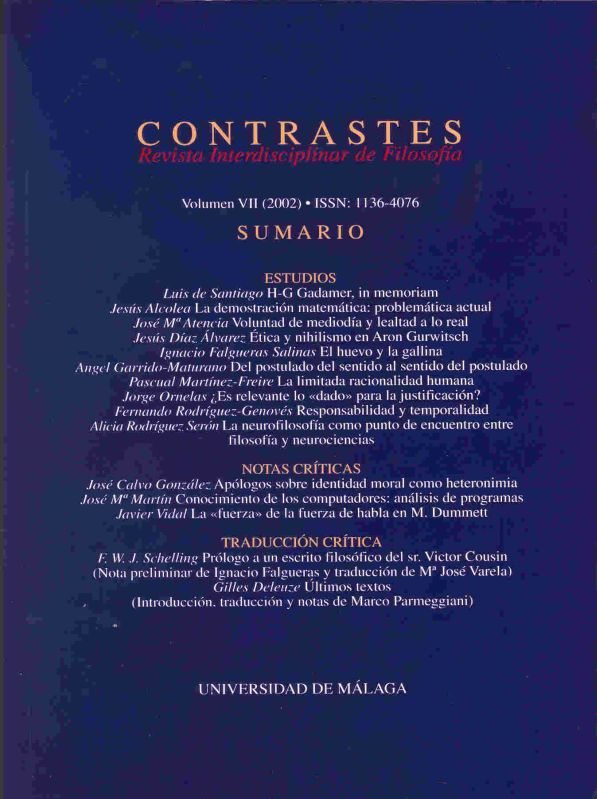
¿Es relevante lo "dado" para la justificación?
DOI:
https://doi.org/10.24310/Contrastescontrastes.v7i0.1643Keywords:
MITO DE LO DADO, FUNDACIONALISMO, COHERENTISMO, JUSTIFICACIÓNAbstract
RESUMEN
El presente trabajo es un intento por desentrañar qué papel desempeña la experiencia dentro del proceso de justificación del conocimiento empírico. El debate contemporáneo está dominado por dos bandos antagónicos: en un extremo están los empiristas fundacionalistas para quienes la experiencia, lo "Dado", es el fundamento epistémico de todo el conocimiento y en el otro extremo se encuentran los coherentistas, quienes rechazan que la experiencia tenga cabida dentro del proceso de justificación. El objetivo de este trabajo consite en mostrar un modelo alternativo de la justificación que recoge las virtudes de ambos extremos.
PALABRAS CLAVE
MITO DE LO DADO-FUNDACIONALISMO-COHERENTISMO-JUSTIFICACIÓN
ABSTRACT
My purpose in this essay is to bring to light the role played by experience in the justification process of empirical knowledge. Contemporary debate is dominated by two antagonistic sides: on one extreme we have the foundationalist empiricists for whom experience, the Goven, is the epistemic foundation of all knowledge; and on the other extreme we have the coherentists who reject that experience has any room in the justification process. This paper attempts to present an alternative model of justification that gathers the virtues of both sides.
KEYWORDS
MYTH OF THE GIVEN-FOUNDATIONALISM-COHERENTISM-JUSTIFICATION
Downloads
References
Downloads
Dimensions
Citations




Issue
Section
License
This journal provides immediate free access to its content under the principle of making research freely available to the public. All content published in Contrastes. Revista Internacional de Filosofía, are subject to the Creative Commons Attribution-NonCommercial-ShareAlike 4.0 license whose full text can be found at <http://creativecommons.org/licenses/by-nc-sa/4.0>
It is the responsibility of the authors to obtain the necessary permissions of the images that are subject to copyright.
Authors whose contributions are accepted for publication in this journal will retain the non-exclusive right to use their contributions for academic, research and educational purposes, including self-archiving or repository in open access repositories of any kind.
The electronic edition of this magazine is edited by the Editorial Service of the University of Malaga (Uma Editorial), being necessary to cite the origin in any partial or total reproduction.




5.png)
