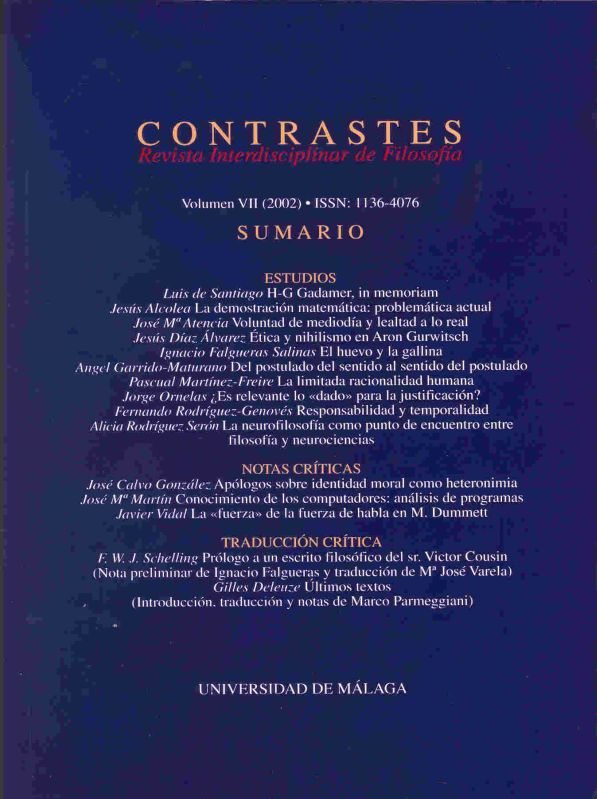
El huevo o la gallina
DOI:
https://doi.org/10.24310/Contrastescontrastes.v7i0.1641Keywords:
TEORÍA DE LA VIDA, COSMOLOGÍA, ANTROPOLOGÍA, MÉTODO SITÉMICOAbstract
RESUMEN
Un atento examen de la conocida y problemática cuestión "¿qué es antes el huevo o la gallina?" sirve, en este breve escrito, de introducción metodológica al estudio filósofico de la vida orgánica. Una vez señalado lo incorrecto de la disyunción, se procede, mediante sucesivas ampliaciones, a una profundización teórica en sus implícitos, y, finalmente, a la detección del supuesto que la problematiza y que reside en el sentido pretendidamente unívoco del "antes". La multiplicidad de sentidos reales de la anterioridad pone de manifiesto que el método adecuado para entender la vida orgánica es el método sistémico.
PALABRAS CLAVE
TEORÍA DE LA VIDA-COSMOLOGÍA-ANTROPOLOGÍA-MÉTODO SITÉMICO
ABSTRACT
A carefully study of the popular puzzle "what comes first, the chicken or the egg?" will serve in this short paper as a methodological introduction for the philosophical theory of organic life. After pointing that this disjunction is incorrect, I will arrive, by means of successive amplifications, at an in-depth theoretical study of their assumptions, ans, eventually, at the dislosure of the implicit aspects that make its understanding problematic and which are rooted in the supposed univocal meaning of "first". The multiplicity of actual meanings of priority makes clear that the systemic method is the appropriate one in order to understand organic life.
KEYWORDS
THEORY OF LIFE-COSMOLOGY-ANTHROPOLOGY-SISTEMIC METHOD
Downloads
References
Downloads
Dimensions
Citations




Issue
Section
License
This journal provides immediate free access to its content under the principle of making research freely available to the public. All content published in Contrastes. Revista Internacional de Filosofía, are subject to the Creative Commons Attribution-NonCommercial-ShareAlike 4.0 license whose full text can be found at <http://creativecommons.org/licenses/by-nc-sa/4.0>
It is the responsibility of the authors to obtain the necessary permissions of the images that are subject to copyright.
Authors whose contributions are accepted for publication in this journal will retain the non-exclusive right to use their contributions for academic, research and educational purposes, including self-archiving or repository in open access repositories of any kind.
The electronic edition of this magazine is edited by the Editorial Service of the University of Malaga (Uma Editorial), being necessary to cite the origin in any partial or total reproduction.




5.png)
