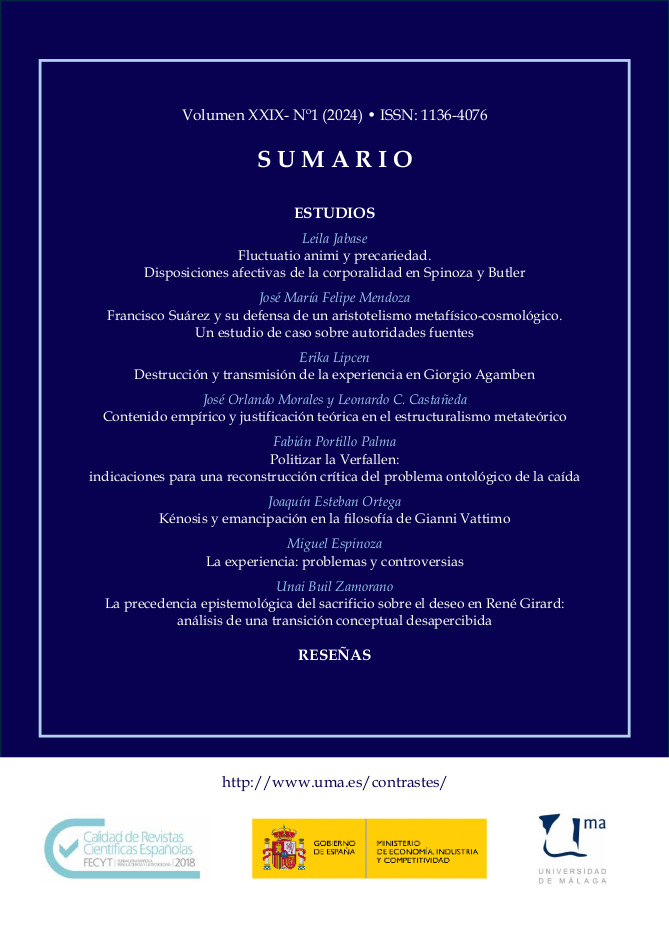
Empirical Content and Theoretical Justification in Metatheoretical Structuralism
DOI:
https://doi.org/10.24310/contrastes.29.2.2024.16092Keywords:
scientific theories, constructive empiricism, structuralism, metatheory, theoretical justificationAbstract
In the structuralist conception of scientific theory, it is common for their theses to be interpreted as neutral with respect to epistemological engagement, since their analysis is structural (Diederich, 1996). However, we intend to show that there is no such epistemological neutrality in one of the key pieces of metatheoretical structuralism, the notion of "intentional applications", and that from this derives an epistemic commitment related to the justification of scientific theories, according to which science is a "network" of logical relations between theories. To achieve that, we propose to analyze the semantic and epistemological implications of that notion and the role it plays in theoretical testability. One of the most radical consequences of the proposed analysis is that the previous notion (intentional applications) implies that some theories are justified by others; in other words, the justification of scientific theories would fall into an inter-theoretical coherentism, which we will specify later. Naturally, it is important to note that the defenders of metatheoretical structuralism (Balzer, Moulines & Sneed, 1987) and (Díez & Moulines, 1997) accept this implication and coherentist thesis. However, the problematic point, and what is new in this article, is that coherentismo compromises the justification of theories as it implies a regressus ad infinitum in the formal reconstruction. This defect of structuralism leads to two additional critics, one from the pragmatic point of view and the other form the semantic point of view. The first is that, if we accept the regressus thesis, the reconstruction may be unsuccessful for pragmatic effects, in other words, the formal correction of a theory obliges us to correct the set of presupposed theories that intervene in it. In the same way, the semantic dependence of a theory on its predecessors implies that if one of its fundamental concepts is modified, then a general review of all related theories in which the concept in question is relevant. The work, then, is an advance in this direction.
Downloads
References
Downloads
Published
Dimensions
Citations




Issue
Section
License
This journal provides immediate free access to its content under the principle of making research freely available to the public. All content published in Contrastes. Revista Internacional de Filosofía, are subject to the Creative Commons Attribution-NonCommercial-ShareAlike 4.0 license whose full text can be found at <http://creativecommons.org/licenses/by-nc-sa/4.0>
It is the responsibility of the authors to obtain the necessary permissions of the images that are subject to copyright.
Authors whose contributions are accepted for publication in this journal will retain the non-exclusive right to use their contributions for academic, research and educational purposes, including self-archiving or repository in open access repositories of any kind.
The electronic edition of this magazine is edited by the Editorial Service of the University of Malaga (Uma Editorial), being necessary to cite the origin in any partial or total reproduction.




5.png)