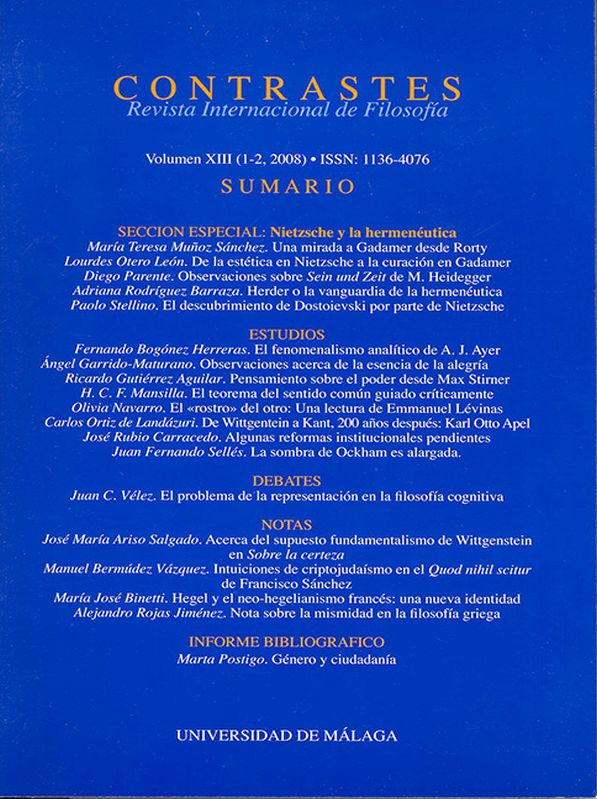
El fenomenalismo analítico de A. J. Ayer
DOI:
https://doi.org/10.24310/Contrastescontrastes.v13i0.1596Abstract
RESUMEN
La segunda etapa del pensamiento filosófico de Ayer es conocida como «fenomenalismo analítico» y se caracteriza por su afirmación: lo que conoce el sujeto no son más datos sensoriales. Esto conlleva la necesidad de de crear lo que se conoce como el lenguaje de «los datos sensoriales», que debería ser previo al lenguaje ordinario y al que podría traducirse el primero mediante la provisión de una serie de reglas con este objeto. Los problemas y las críticas, conectados con la caracterización de que sea un «dato sensorial» surgieron muy pronto y tales problemas provocaron que el propio Ayer fuese obligado a redefinir su posición filosófica.
PALABRAS CLAVE:
DATO SENSORIAL, FENOMENALISMO ANALÍTICO, ENTIDAD CUASIFÍSICA, ENTIDAD LINGÜÍSTICA
ABSTRACT
The second phase of Ayer’s philosophical thought is known as «analytical phenomenalism» and is characterized by his assertion: what the subject knows is not but sense data. This involved the need of creating what is known as the language of «sense data», which should be prior to the ordinary language, and into which the last one could be translated, by means of providing a series of rules on this purpose. Problems and criticism, linked to the characterization of what a «sense datum» could be, arose very soon, and such problems and criticism forced Ayer to redefine his philosophical position.
KEY WORDS.
SENSE DATUM, ANALYTICAL PHENOMENALISM, QUASI-PHYSICAL ENTITY, LINGUISTIC ENTITY
Downloads
References
Downloads
Published
Dimensions
Citations




Issue
Section
License
This journal provides immediate free access to its content under the principle of making research freely available to the public. All content published in Contrastes. Revista Internacional de Filosofía, are subject to the Creative Commons Attribution-NonCommercial-ShareAlike 4.0 license whose full text can be found at <http://creativecommons.org/licenses/by-nc-sa/4.0>
It is the responsibility of the authors to obtain the necessary permissions of the images that are subject to copyright.
Authors whose contributions are accepted for publication in this journal will retain the non-exclusive right to use their contributions for academic, research and educational purposes, including self-archiving or repository in open access repositories of any kind.
The electronic edition of this magazine is edited by the Editorial Service of the University of Malaga (Uma Editorial), being necessary to cite the origin in any partial or total reproduction.




5.png)