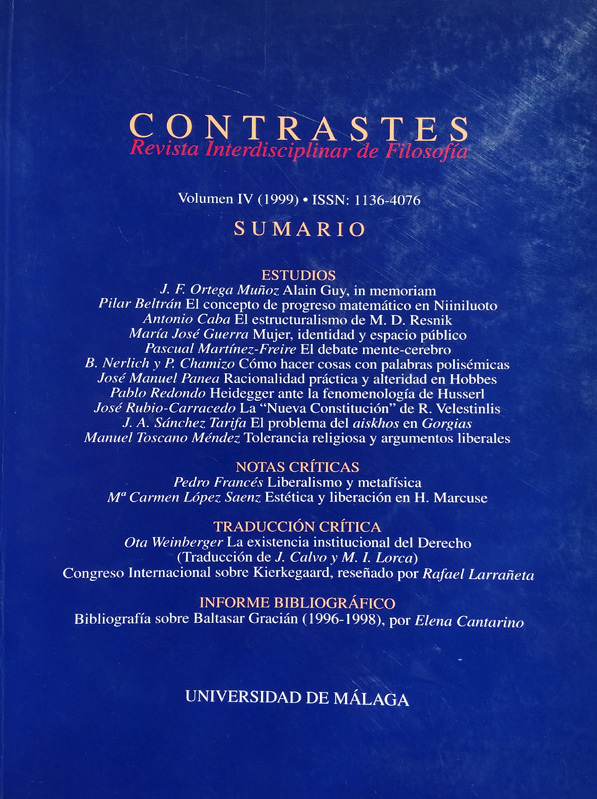
Estética y liberación en H. Marcuse, en el centenario de su nacimiento
DOI:
https://doi.org/10.24310/Contrastescontrastes.v4i0.1287Abstract
RESUMEN
Con ocasión del centenario del filósofo H. Marcuse (1898-1979), la autora reflexiona sobre el pensamiento del mismo tomando como hilo conductor su teoría estética tal y como se plasma a lo largo de su obra. la estrecha relación entre la concepción marcusiana del arte y la liberación humana es lo que hace que la comprensión de aquella resulte imprescindible para interpretar el proyecto filosófico de Marcuse. este artículo valora la paradójica propuesta de Marcuse de un arte autónomo y, a la vez, transformador de la realidad y de la conciencia, con objeto de oponerse tanto al esteticismo, que amenaza con dominar al arte y a la sociedad actuales, como a la subordinación del arte a fines heterónomos.
PALABRAS CLAVE
MARCUSE-ESTÉTICA-TEORÍA CRÍTICA-LIBERACIÓN
ABSTRACT
On the occasion of H.Marcuse's centennary (1989-1979), the paper reviews Marcuse's writings on aesthetics. To interpret his philosophical project, it is necessary to combine his concept of art with his idea of human liberation. The paper assesses Marcuse's paradoxical claim for an autonomous art, wich transforms both reality and consciousness, that opposes aestheticism and the subordination of art to heteronomous ends.
KEYWORDS
MARCUSE-AESTHETICS-CRITICAL THEORY-LIBERATION
Downloads
References
Downloads
Dimensions
Citations




Issue
Section
License
This journal provides immediate free access to its content under the principle of making research freely available to the public. All content published in Contrastes. Revista Internacional de Filosofía, are subject to the Creative Commons Attribution-NonCommercial-ShareAlike 4.0 license whose full text can be found at <http://creativecommons.org/licenses/by-nc-sa/4.0>
It is the responsibility of the authors to obtain the necessary permissions of the images that are subject to copyright.
Authors whose contributions are accepted for publication in this journal will retain the non-exclusive right to use their contributions for academic, research and educational purposes, including self-archiving or repository in open access repositories of any kind.
The electronic edition of this magazine is edited by the Editorial Service of the University of Malaga (Uma Editorial), being necessary to cite the origin in any partial or total reproduction.




5.png)
