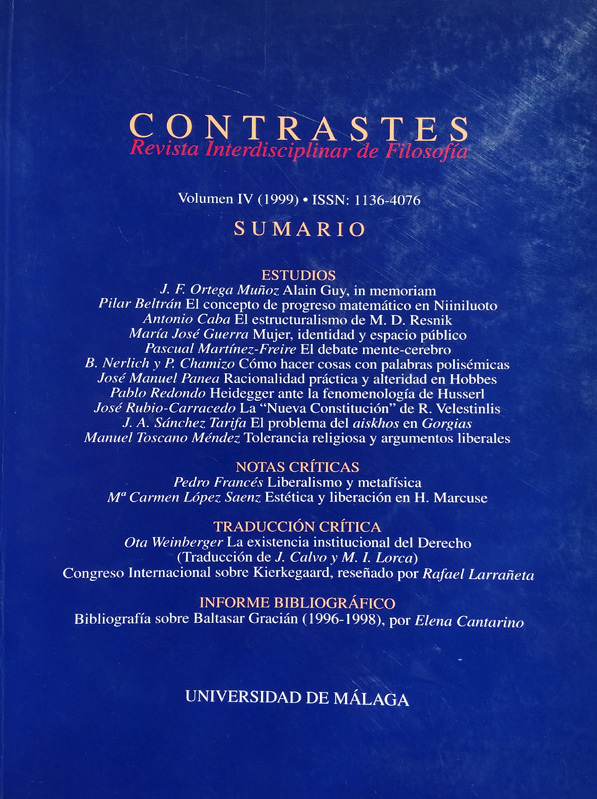
Análisis del concepto de progreso matemático en Ilkka Niiniluoto
DOI:
https://doi.org/10.24310/Contrastescontrastes.v4i0.1238Abstract
RESUMEN
La noción de progreos matemático constituye uno de los elementos del planteamiento filosófico-metodológico de Ilkka Niiniluoto a los que menor atención se les ha prestado. Para esclarecer esta noción en su enfoque, se estudia su propuesta matemática general, que se asienta en una epistemología de realismo científico-crítico. Se resalta la conjunción que propone entre una Metodología de carácter "cuasi-ampírico", que le aproxima a I. Lakatos, y una Epistemología realista, que le hace sintonizar con la ontología del mundo 3 de Karl popper. También se comparan algunos de sus planteamientos matemáticos con los presentados por Henri Pointcaré.
Palabras clave
PROGRESO MATEMÁTICO- VEROSIMILITUD-REALISMO MATEMÁTICO-CONTRUCTIVISMO
ABSTRACT
The notion of mathematical progress is one of the elements of Ilkka Niiniluoto's philosophy and methodology least studied. To clarify it, this paper revises Niiniluoto's philosophy of mathematics, based upon an episemology of criticalscientific realism. The paper underlines his conjunction between a "quasi-empirical" methodology, close to I. Lakatos, and a realist epistemology, close to Karl Popper'sontology of world 3. Finally, a comparison is outlined between niiniluoto"s and Henri Pointcare's mathematics.
KEYWORDS
MATHEMATICAL PROGRESS- TRHTHLIKNESS-MATHEMATICAL REALISM.CONSTRUCTIVISM
Downloads
References
Downloads
Dimensions
Citations




Issue
Section
License
This journal provides immediate free access to its content under the principle of making research freely available to the public. All content published in Contrastes. Revista Internacional de Filosofía, are subject to the Creative Commons Attribution-NonCommercial-ShareAlike 4.0 license whose full text can be found at <http://creativecommons.org/licenses/by-nc-sa/4.0>
It is the responsibility of the authors to obtain the necessary permissions of the images that are subject to copyright.
Authors whose contributions are accepted for publication in this journal will retain the non-exclusive right to use their contributions for academic, research and educational purposes, including self-archiving or repository in open access repositories of any kind.
The electronic edition of this magazine is edited by the Editorial Service of the University of Malaga (Uma Editorial), being necessary to cite the origin in any partial or total reproduction.




5.png)
