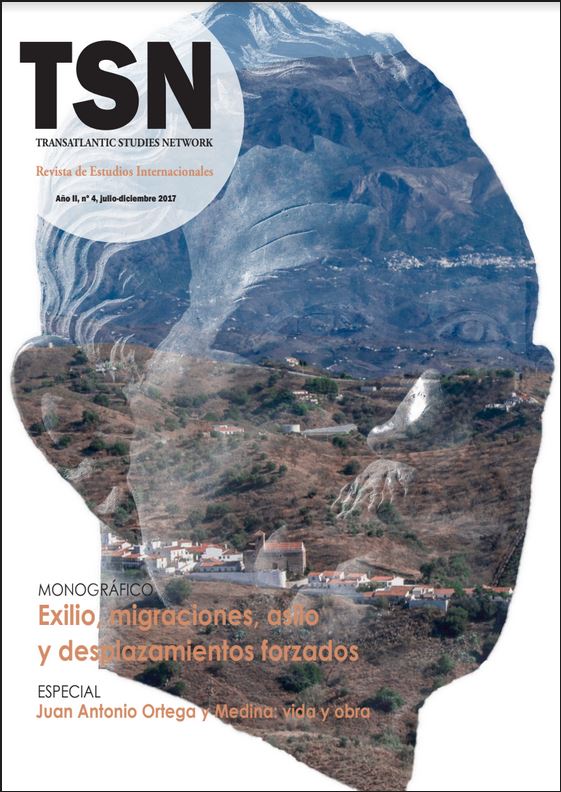
From Málaga to México. From the Republic to Exile. Juan Antonio Ortega y Medina’s Legacy
DOI:
https://doi.org/10.24310/transatlantic-studies-network..4.2017.19366Keywords:
History, Spain, United States, México, Historiography, Juan A. Ortega y Medina, Mexican thought, exile, Spanish Civil War, Málaga, UNAMAbstract
The life and work of Juan A. Ortega y Medina, an historian who was born in Málaga in 1913, is analyzed in this essay from different approaches to the issues he studied. The aim is to show his thought and his historic legacy. He was the author of more than fifteen books on the History of Spain, of the United States, the Protestant Reformation and Voyagers, but he also wrote on the aesthetic ideas of J. J. Winckelmann, on Humboldt and Luther. This essay studies the most important aspects on Ortega’s approach and explains his interest on them as a result of his particular personal experience and his own historical drama as an exile after the Spanish Civil War (1936-1939), where he fought on the side of the republican army. His interest to study the history of Spain after that painful event that marked him for life, together with the great majority of his fellow Spanish companions who suffered the same experience, motivated him to write various works which have become main references for those interested in Spanish and world history. This essay puts its attention in each topic set forth by Ortega and explains the reasons of his interest and the results of the studies he made on them
Downloads
References
Downloads
Published
Dimensions
Citations




Issue
Section
License
Copyright (c) 2024 TSN. Transatlantic Studies Network