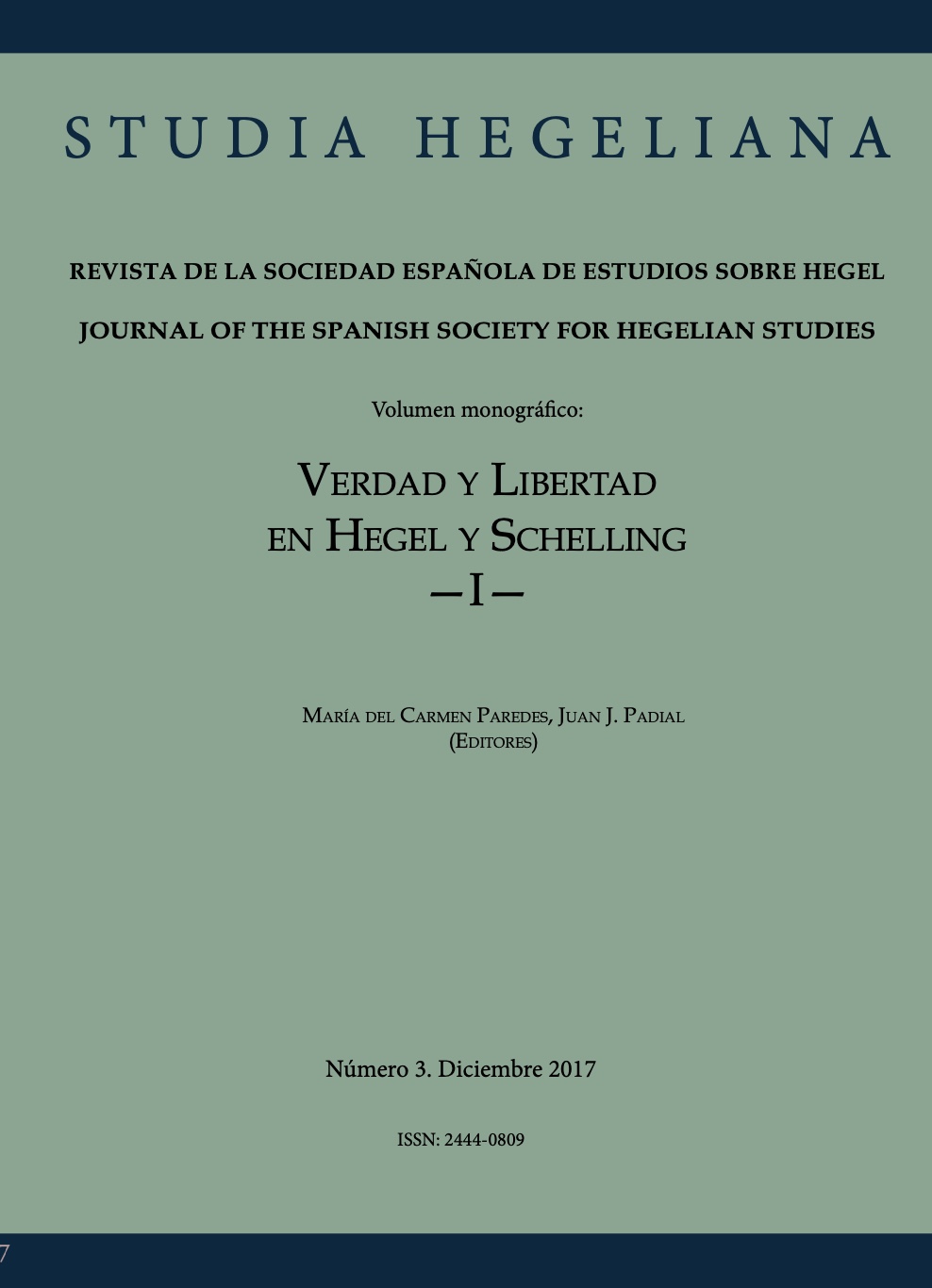
From the Magic Circle to The Ages of the World. Some Philosophical Implications
DOI:
https://doi.org/10.24310/Studiahegelianastheg.v3i.11422Keywords:
SCHELLING, HEGEL, MAGIC, CIRCLE, ROTATION, ETERNITY, TIME, ETERNAL EONS, REALISM, IDEALISM, WILL, CONSCIOUSNESSAbstract
The notions of «the magic circle» and «eternal aeons» have been researched in a previous work to clarify Schelling´s proposal. Now we can research some implicit philosophical problems inherent to these notions. It is concluded that understanding Hegel´s logicism by a sort of realism - and his own precedent - is not a satisfactory idea. The problem is that it preserves his basic idealistic approaches since his youth.
Downloads
References
Downloads
Published
Dimensions
Issue
Section
License
This journal provides immediate free access to its content under the principle of making research freely available to the public. All contents published in Studia Hegeliana. Journal of the Spanish Society for Hegelian Studies, are subject to the Creative Commons Attribution-NonCommercial-ShareAlike 4.0 licence (specifically, CC-by-nc-sa), the full text of which can be found at <http://creativecommons.org/licenses/by-nc-sa/4.0>. Derivative works are therefore permitted as long as they are not used for commercial purposes. The original work may not be used for commercial purposes. The journal is not responsible for the opinions expressed by the authors of the works published in it.
It is the authors' responsibility to obtain the necessary permissions for images that are subject to copyright.
Authors whose contributions are accepted for publication in this journal retain the copyright. It is non-exclusive right to use their contributions for scholarly, research and educational purposes, including self-archiving or deposit in open access repositories of any kind.
Since volume 7 of 2021 the journal Studia Hegeliana has changed the copyright. Since that year the authors have retained the copyright.
The electronic edition of this journal is published by the Editorial de la Universidad de Málaga (UmaEditorial), being necessary to cite the source in any partial or total reproduction.
How to Cite




244.png)