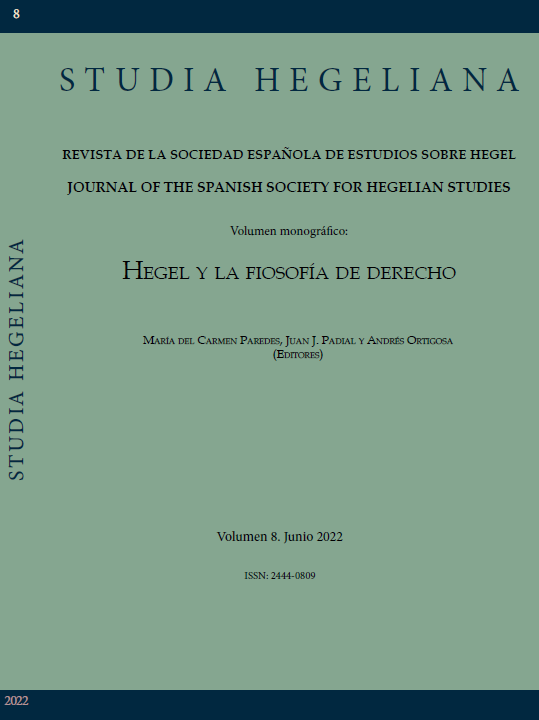
Hegel's Philosophy of Right: An Ascriptivist Institutional Ethics
DOI:
https://doi.org/10.24310/Studiahegelianastheg.v8i.14574Keywords:
Philosophy of Right; Hegel; ethics; cognitivist ascriptivism, Philosophy of Right, Hegel, Ética, Cognitivist ascriptivismAbstract
This paper aims to develop the following hypothesis: Hegel's philosophy of law is a philosophical explanation and systematisation of our practices of demanding and responding to evaluative and normative claims. As will be explained, this hypothesis has three advantages. First, it makes the structure of Hegel's practical philosophy visible and comprehensible. It installs his philosophy of law as "Objective Spirit" in the whole of his encyclopaedic system and this part he outlines in its basic lines with the Fundamental Lines. Secondly, the proposal presented here makes it possible to differentiate the various planes on which the Hegelian exposition moves in the Fundamental Lines, and to explain how they are connected with the overall approach of his philosophy of law. Finally, he understands the whole approach of Hegelian practical philosophy as an expression of a self-modernisation of philosophical ethics with a view to the formulation and substantiation of concrete moral statements.Downloads
References
Downloads
Published
Dimensions
Citations




Issue
Section
License
This journal provides immediate free access to its content under the principle of making research freely available to the public. All contents published in Studia Hegeliana. Journal of the Spanish Society for Hegelian Studies, are subject to the Creative Commons Attribution-NonCommercial-ShareAlike 4.0 licence (specifically, CC-by-nc-sa), the full text of which can be found at <http://creativecommons.org/licenses/by-nc-sa/4.0>. Derivative works are therefore permitted as long as they are not used for commercial purposes. The original work may not be used for commercial purposes. The journal is not responsible for the opinions expressed by the authors of the works published in it.
It is the authors' responsibility to obtain the necessary permissions for images that are subject to copyright.
Authors whose contributions are accepted for publication in this journal retain the copyright. It is non-exclusive right to use their contributions for scholarly, research and educational purposes, including self-archiving or deposit in open access repositories of any kind.
Since volume 7 of 2021 the journal Studia Hegeliana has changed the copyright. Since that year the authors have retained the copyright.
The electronic edition of this journal is published by the Editorial de la Universidad de Málaga (UmaEditorial), being necessary to cite the source in any partial or total reproduction.
244.png)