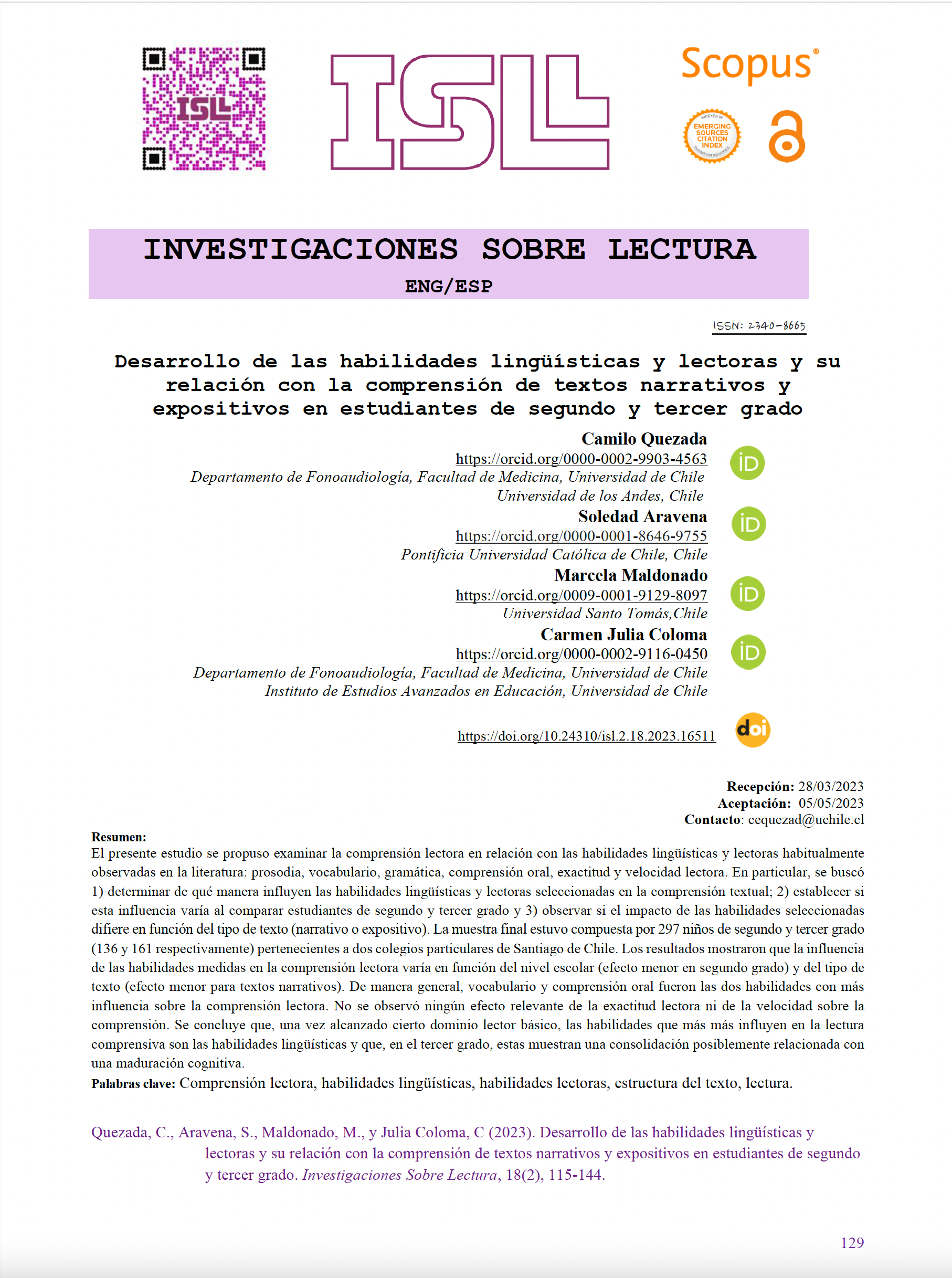
Development of linguistic and reading skills and their relationship with the comprehension of narrative and expository texts in second and third grade students
DOI:
https://doi.org/10.24310/isl.2.18.2023.16511Keywords:
reading comprehension – language skills – reading skills – narrative text – expository textAbstract
The study aimed at examining the links between reading comprehension and the most commonly observed language and reading skills in literature: prosody, vocabulary, grammar, listening comprehension, reading accuracy and reading speed. Specifically, objectives were 1) to determine how selected linguistic and reading skills influence textual comprehension; 2) to establish whether this influence varies when comparing second and third grade students and 3) to observe whether the impact of the selected skills varies depending on the type of text (narrative or expository). The final sample consisted of 297 children (136 second graders and 161 third graders) belonging to two private schools from Santiago, Chile. Results showed that the relationship between reading comprehension and the measured skills varies according to grade (smaller effect in 2nd grade) and type of text (smaller effect for narrative texts). In general, vocabulary and listening comprehension were the two skills most influencing reading comprehension. No relevant effects of reading accuracy or speed on reading comprehension were observed. t is concluded that, once a certain basic reading proficiency is reached, the skills that most influence reading comprehension are linguistic skills and that, in the third grade, these show a consolidation possibly related to cognitive maturation.
Downloads
References
Downloads
Published
Versions
- 2024-01-02 (3)
- 2023-12-22 (2)
- 2023-12-22 (1)
Dimensions
Citations




Issue
Section
License
Copyright (c) 2023 Camilo Quezada Gaponov, Soledad Aravena, Marcela Maldonado, Carmen Julia Coloma
All contents published in Investigaciones sobre Lectura are protected under the Creative Commons Attribution-NonCommercial-ShareAlike 4.0 International (CC BY-NC-SA 4.0) license. All about this license is available in the following link: <http://creativecommons.org/licenses/by-nc-sa/4.0>
Users can copy, use, redistribute, share and exhibit publicly as long as:
- The original source and authorship of the material are cited (Journal, Publisher and URL of the work).
- It is not used for comercial purposes.
- The existence of the license and its especifications are mentioned.
There are two sets of authors’ rights: moral and property rights. Moral rights are perpetual prerogatives, unrenounceable, not-transferable, unalienable, imprescriptible and inembargable. According to authors’ rights legislation, Investigaciones sobre Lectura recognizes and respects authors moral rights, as well as the ownership of property rights, which will be transferred to University of Malaga in open access. The property rights are referred to the benefits that are gained by the use or the dissemination of works. Investigaciones sobre Lectura is published in an open access form and it is exclusively licenced by any means for doing or authorising distribution, dissemination, reproduction, , adaptation, translation or arrangement of works.
Authors are responsable for obtaining the necessary permission to use copyrighted images.




31.png)