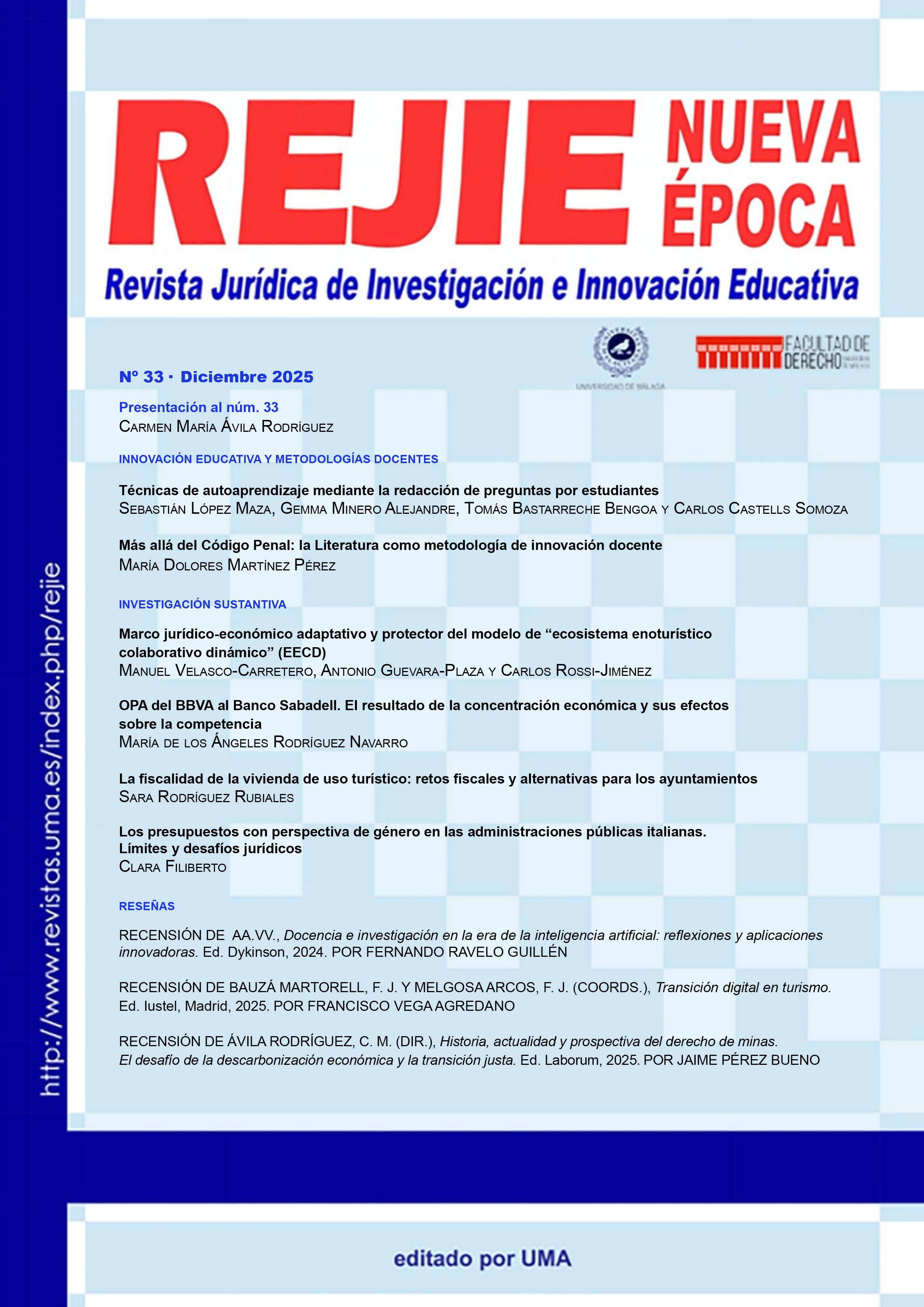
Independent Learning Techniques through the Writing of Questions by Students
DOI:
https://doi.org/10.24310/rejie.33.2025.22631Keywords:
Writing questionnaires, self-directed learning, collaborative work, critical capacityAbstract
The aim of this Innovative Teaching Strategies Project has been to promote the exercise of independent learning skills through questionnaires in students of various topics/subjects of the Law School. The experience has been implemented in very diverse groups in terms of the number of students enrolled and the type of topics (lectures and seminars, compulsory and elective courses, undergraduate and graduate students, private and public law subjects). In addition, the following complementary objectives have been accomplished: 1) the use of collaborative work tools, 2) writing with a command of legal language and synthesis capacity, 3) teamwork and 4) critical and evaluative capacity.
Downloads
References
IBARRA SAIZ, M., y RODRÍGUEZ GÓMEZ, G. (2011), “Aprendizaje autónomo y trabajo en equipo: reflexiones desde la competencia percibida por los estudiantes universitarios”, Revista Electrónica Interuniversitaria de Formación del Profesorado, Vol. 14(4): págs. 73–85. [En línea] http://www.redalyc.org/pdf/2170/217022117006.pdf
MORÓN MORENO, F. (2015), “La importancia de hacer buenas preguntas a nuestros alumnos de la ESO”, Revista Arista Digital, Vol. 54(1): págs. 29-39. [En línea] https://www.afapna.com/aristadigital/archivos_revista/2015_marzo_0.pdf
RUÉ DOMINGO, J. (2009), El aprendizaje autónomo en la universidad. Madrid: Narcea.
SÁNCHEZ SOTO, I. R. (2017), “Aprendizaje basado en preguntas y su impacto en las estrategias de aprendizaje en Física”, Enseñanza de las Ciencias, núm. extraordinario: págs. 1903-1908. [En línea] https://raco.cat/index.php/Ensenanza/article/view/336741
SOLÓRZANO MENDOZA, Y. (2017), “Aprendizaje Autónomo y Competencias”, Dominio de las Ciencias, Vol. 3, núm. extraordinario 1: págs. 241-253. [En línea] https://dominiodelasciencias.com/ojs/index.php/es/article/view/390 (DOI: https://doi.org/10.23857/dc.v3i1.390)
SCHMIDT, V., MOLINA, M. F., CELSI, I., y CORTI, J. F. (2022), “La experiencia de disfrute y su contribución a la realización personal en jóvenes estudiantes”, Revista Electrónica Interuniversitaria de Formación del Profesorado, Vol. 25(2): págs. 59-78. [En línea] https://revistas.um.es/reifop/article/view/517201/324311 (DOI: https://doi.org/10.6018/reifop.517201)
VERA VELÁZQUEZ, R. (2021), “Aprendizaje Autónomo y Desarrollo de Competencias”, Serie Científica de la Universidad de las Ciencias Informáticas, Vol. 14, núm. 10: págs. 131-142. [En línea] https://publicaciones.uci.cu/index.php/serie/article/view/929
Additional Files
Published
Dimensions
Citations



Issue
Section
License
Sin perjuicio de lo dispuesto en el Texto Refundido de la Ley de Propiedad Intelectual, aprobado por Real Decreto Legislativo 1/1996, de 12 de abril, y conforme al mismo, los autores/as ceden a título gratuito, de modo no exclusivo y sin límite temporal los derechos para difundir, reproducir, comunicar y distribuir, en cualquier formato actual o futuro (papel o electrónico), a la Universidad de Málaga (UMA), a fin de que sea publicado en REJIE Nueva Época.
Al realizar el envío, el autor declara que el contenido esencial del mismo no ha sido publicado ni se va a publicar en ninguna otra obra o revista mientras esté en proceso de evaluación en REJIE Nueva Época, comprometiéndose en todo caso a comunicar de inmediato al equipo editorial de la revista cualquier proyecto de publicación de dicho texto, y citando expresamente a la revista en el nuevo proyecto.
Todos los contenidos publicados por REJIE Nueva Época están sujetos a la licencia de Creative Commons Reconocimiento 4.0 Internacional, cuyo texto completo se puede consultar en https://creativecommons.org/licenses/by/4.0/legalcode
Conforme a la misma, se permite la copia, distribución, comunicación pública, obras derivadas y el uso comercial de los contenidos siempre que la fuente y el autor del texto sean citados Así, cuando el autor/a envía su colaboración está explícitamente aceptando esta cesión de derechos de edición y de publicación.
Es responsabilidad de los autores obtener los permisos necesarios de las imágenes que están sujetas a derechos de autor.


20.png)