Dialogues with other arts: Almodóvar
Keywords:
Almodóvar Pedro, Transtextuality, Literature, photography, painting, cinematic self-referentialityAbstract
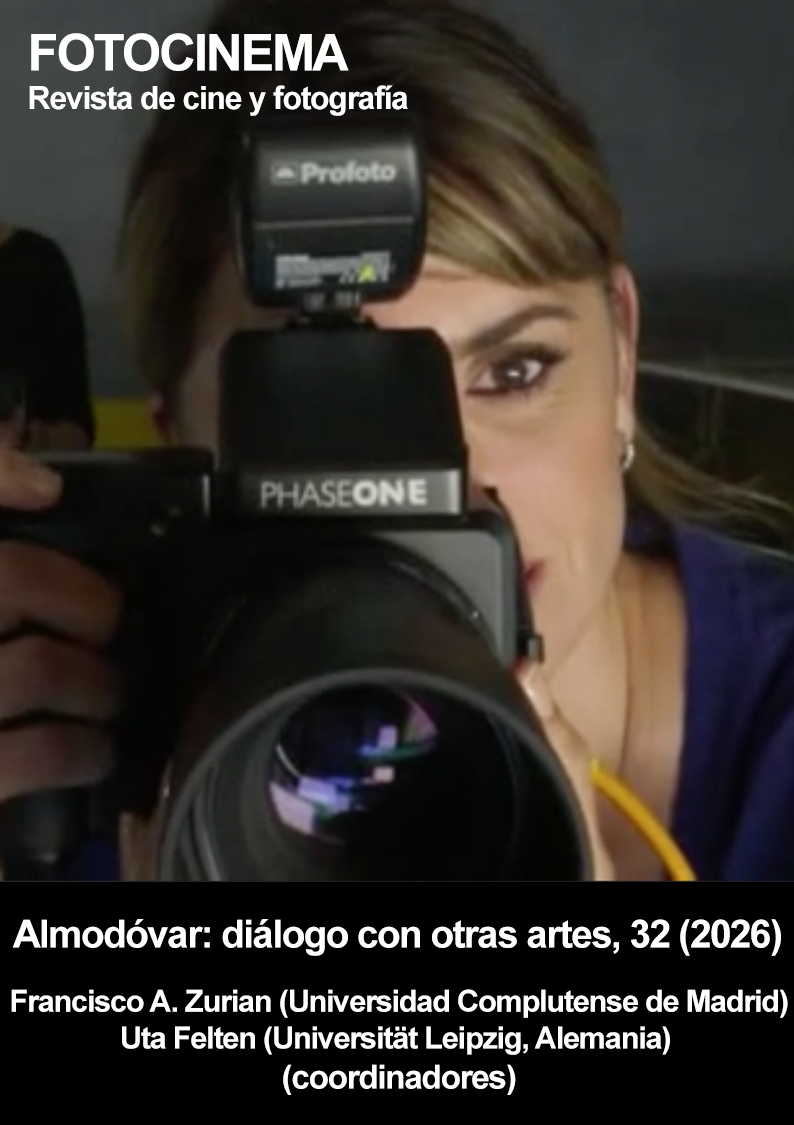
From an academic point of view, interest in Almodóvar's work has also grown throughout the world; just check the number of doctoral theses, scientific publications and conferences around the world where concern for Pedro Almodóvar's cinema is present, both in Spain and international abroad.
The topics that are usually addressed in academic approaches to Almodóvar work are very broad, from historiographical issues to aesthetic issues, from studies on his narrative or script writing, to film analysis, from issues of social representations to gender through cultural or politics problems, etc. This monograph, on this occasion, focuses on the relationships or dialogues that Almodóvar has with the arts, from cinema itself to painting, photography, literature, theater, etc. And all this from all the methodologies that usually operate in film and audiovisual studies: textual, semiotic, narratological, sociological analysis, critical content analysis, cultural and gender studies, feminist, queer and all the long etcetera.
Downloads
References
Almodóvar, P. (2019). Dolor y Gloria. Reservoir Books
Downloads
Published
Dimensions
Issue
Section
License
Copyright (c) 2026 Francisco A. Zurian, Uta A. Felten

This work is licensed under a Creative Commons Attribution-NonCommercial-NoDerivatives 4.0 International License.
All contents published in Fotocinema Revista científica de cine y fotografía are protected under the Creative Commons Attribution-NonCommercial-ShareAlike 4.0 International (CC BY-NC-SA 4.0) license. All about this license is available in the following link: <http://creativecommons.org/licenses/by-nc-sa/4.0>
Users can copy, use, redistribute, share and exhibit publicly as long as:
- The original source and authorship of the material are cited (Journal, Publisher and URL of the work).
- It is not used for comercial purposes.
- The existence of the license and its especifications are mentioned.
There are two sets of authors’ rights: moral and property rights. Moral rights are perpetual prerogatives, unrenounceable, not-transferable, unalienable, imprescriptible and inembargable. According to authors’ rights legislation, Fotocinema. Revista científica de cine y fotografía recognizes and respects authors moral rights, as well as the ownership of property rights, which will be transferred to University of Malaga in open access. The property rights are referred to the benefits that are gained by the use or the dissemination of works. Fotocinema. Revista científica de cine y fotografía is published in an open access form and it is exclusively licenced by any means for doing or authorising distribution, dissemination, reproduction, , adaptation, translation or arrangement of works.
Authors are responsable for obtaining the necessary permission to use copyrighted images.





13.png)