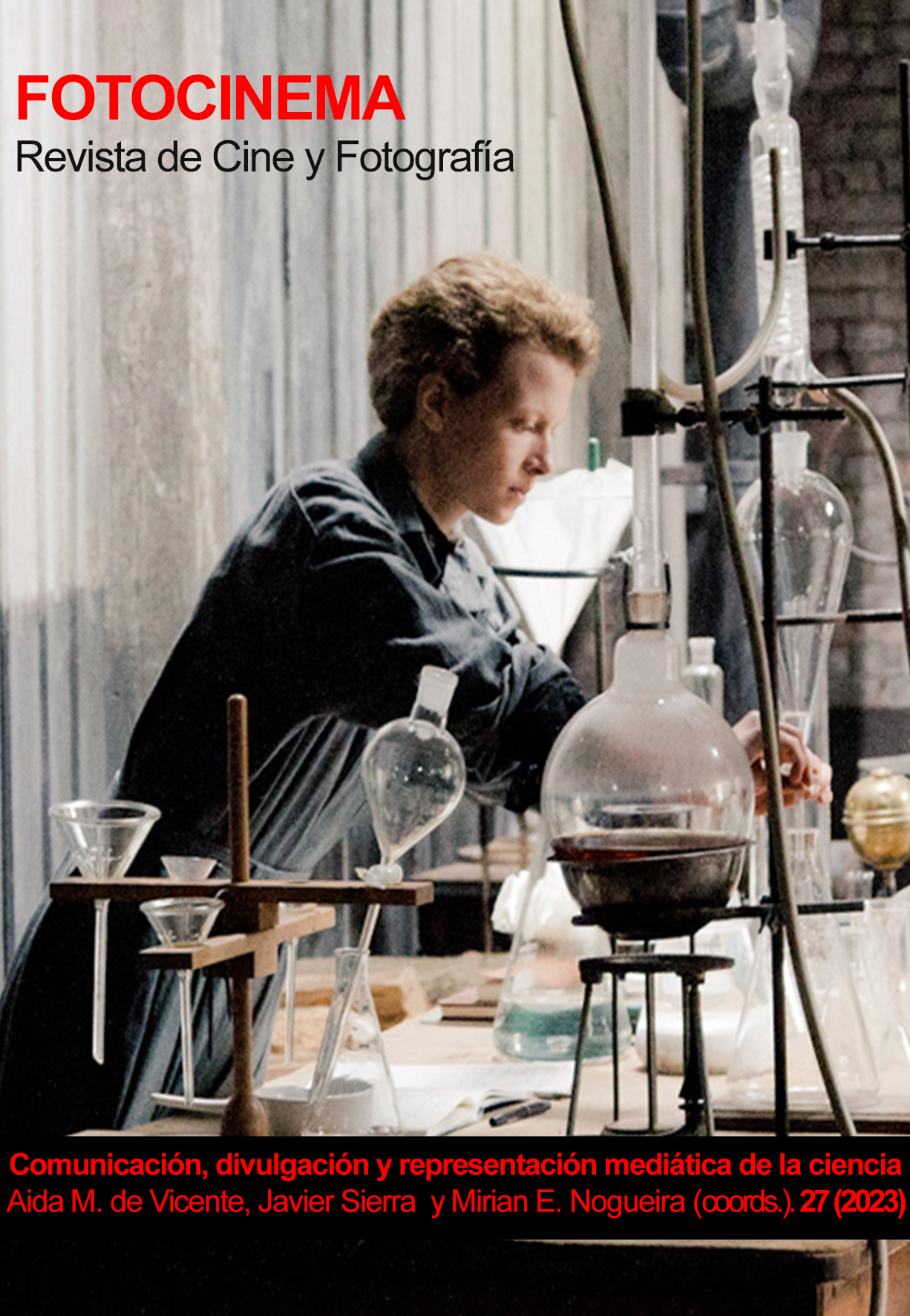
Science in feminine. The construction of the role of the female scientist in film discourse
DOI:
https://doi.org/10.24310/Fotocinema.2023.vi27.16527Keywords:
Science, women, cinema, audiovisual, representation, genderAbstract
Throughout history, women scientists have been invisibilised and overshadowed in academia and science. Due to socio-cultural and political issues, women's late access to science systems has led to a significant gender gap today. In this sense, the media and the visual arts - such as the film genre - have perpetuated themselves as strong vehicles of representation that perpetuate or combat current imaginaries of inequality. Given this situation, the aim of this article is to analyse the representation and, consequently, the construction of the public image of women scientists through cinematographic narrative. To this end, we confront works from different periods and film genres - from biographies to science fiction - in which the role of the female scientist is analysed: Madame Curie (1943), Gorillas in the Mist (1988), Contact (1997), A Dangerous Method (2011) and Radioactive (2019). The results of the research deduce the importance of an unbiased look at the construction of female roles in science and how the current reality of the female scientist does not adapt to the classic archetypes traditionally represented in the film genre
Downloads
References
Downloads
Published
Dimensions
Citations




Issue
Section
License
All contents published in Fotocinema Revista científica de cine y fotografía are protected under the Creative Commons Attribution-NonCommercial-ShareAlike 4.0 International (CC BY-NC-SA 4.0) license. All about this license is available in the following link: <http://creativecommons.org/licenses/by-nc-sa/4.0>
Users can copy, use, redistribute, share and exhibit publicly as long as:
- The original source and authorship of the material are cited (Journal, Publisher and URL of the work).
- It is not used for comercial purposes.
- The existence of the license and its especifications are mentioned.
There are two sets of authors’ rights: moral and property rights. Moral rights are perpetual prerogatives, unrenounceable, not-transferable, unalienable, imprescriptible and inembargable. According to authors’ rights legislation, Fotocinema. Revista científica de cine y fotografía recognizes and respects authors moral rights, as well as the ownership of property rights, which will be transferred to University of Malaga in open access. The property rights are referred to the benefits that are gained by the use or the dissemination of works. Fotocinema. Revista científica de cine y fotografía is published in an open access form and it is exclusively licenced by any means for doing or authorising distribution, dissemination, reproduction, , adaptation, translation or arrangement of works.
Authors are responsable for obtaining the necessary permission to use copyrighted images.





13.png)