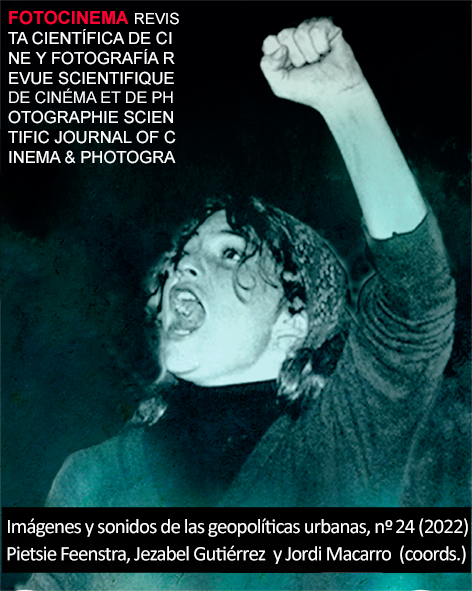
Cries In The City! Urban Modernity, Serial Killing, Female Liberation, in the Spanish Horror Film in Franco’s Dictatorship (1963-1975)
DOI:
https://doi.org/10.24310/Fotocinema.2022.vi24.13429Keywords:
Spanish horror film, Franco's dictatorship, Serial Killer, City and Film, ModernityAbstract
The article focuses on the urban representation in the horror films of the second Franco regime as a scenario of fear in the face of the profound transformations of the period. The city in Spanish horror was constructed as a degenerate space and container of vices that facilitated the rupture with traditional roles.
Through four films (Ella y el miedo, El espectro del terror, Una libélula para cada muerto and El sádico de Notre Dame), the urban serial killer embodies a monstrosity born of two fundamental discourses. First, the anxieties about the dangers of modernity associated with dehumanization and fear of strangers that had constructed the serial killer in other cinematographies. On the other hand, the strong conservative component of the Spanish version created an antagonist derived from the deformation of national Catholic and patriarchal values. Thus, the urban monster also symbolized youth insecurity in the face of the persistence of a repression that hardened its measures during the last years of the dictatorship.
Downloads
References
Downloads
Published
Dimensions
Citations




Issue
Section
License
All contents published in Fotocinema Revista científica de cine y fotografía are protected under the Creative Commons Attribution-NonCommercial-ShareAlike 4.0 International (CC BY-NC-SA 4.0) license. All about this license is available in the following link: <http://creativecommons.org/licenses/by-nc-sa/4.0>
Users can copy, use, redistribute, share and exhibit publicly as long as:
- The original source and authorship of the material are cited (Journal, Publisher and URL of the work).
- It is not used for comercial purposes.
- The existence of the license and its especifications are mentioned.
There are two sets of authors’ rights: moral and property rights. Moral rights are perpetual prerogatives, unrenounceable, not-transferable, unalienable, imprescriptible and inembargable. According to authors’ rights legislation, Fotocinema. Revista científica de cine y fotografía recognizes and respects authors moral rights, as well as the ownership of property rights, which will be transferred to University of Malaga in open access. The property rights are referred to the benefits that are gained by the use or the dissemination of works. Fotocinema. Revista científica de cine y fotografía is published in an open access form and it is exclusively licenced by any means for doing or authorising distribution, dissemination, reproduction, , adaptation, translation or arrangement of works.
Authors are responsable for obtaining the necessary permission to use copyrighted images.





13.png)