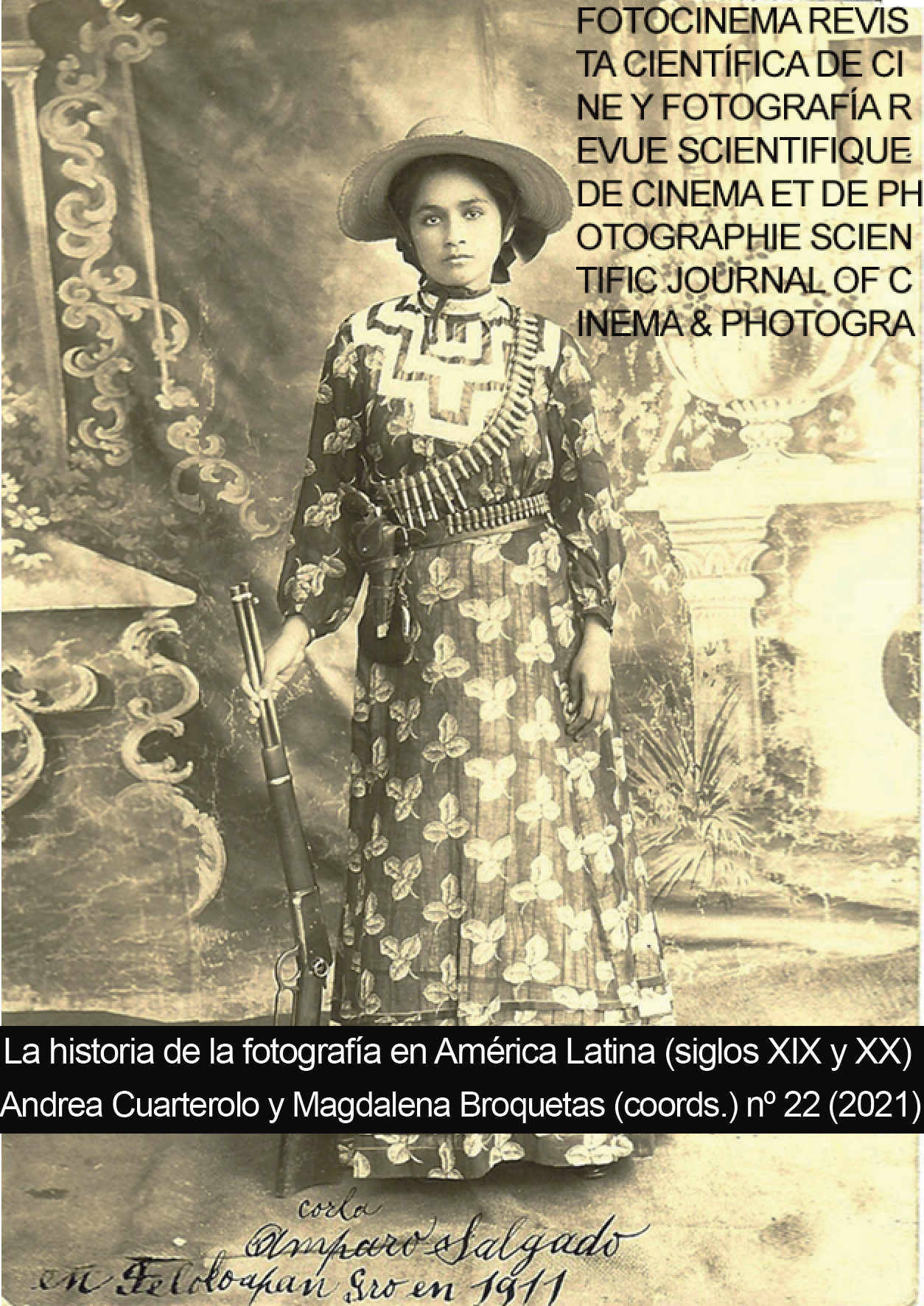
Sara Castrejón: photographing revolution, representing women
DOI:
https://doi.org/10.24310/Fotocinema.2021.vi22.11694Keywords:
Mexican Revolution, revolutionary photography, studio photography, postcards, vernacular photography, women photographersAbstract
In this article an analysis is presented of Sara Castrejón’s photography of the Mexican Revolution, with the development of Mexican women photographers. This is carried out through a photohistory that employs an historical methodology in which photographs serve as primary sources. Hence, the process is that of history, which is discovering primary sources, among them interviews and, moreover, incorporating secondary sources to contextualize the study. Inquiry is made into how Castrejón made a living in the midst of the civil war, and her political position as compared to that of other studio photographers. Moreover, a feminist perspective is incorporated by examining what opportunities existed for women in this period and how the choices Castrejón made differed from traditional patterns. The particularities of Castrejón’s photography that derived from her gender are examined. Castrejón’s imagery can be considered an example of “vernacular” photography, which is produced outside artistic canons (Batchen, 2000). In this sense, the study could be considered as being inspired by Postmodern photographic theory, which displaces art photography from its discursive dominance.
Downloads
References
Downloads
Published
Dimensions
Citations




Issue
Section
License
All contents published in Fotocinema Revista científica de cine y fotografía are protected under the Creative Commons Attribution-NonCommercial-ShareAlike 4.0 International (CC BY-NC-SA 4.0) license. All about this license is available in the following link: <http://creativecommons.org/licenses/by-nc-sa/4.0>
Users can copy, use, redistribute, share and exhibit publicly as long as:
- The original source and authorship of the material are cited (Journal, Publisher and URL of the work).
- It is not used for comercial purposes.
- The existence of the license and its especifications are mentioned.
There are two sets of authors’ rights: moral and property rights. Moral rights are perpetual prerogatives, unrenounceable, not-transferable, unalienable, imprescriptible and inembargable. According to authors’ rights legislation, Fotocinema. Revista científica de cine y fotografía recognizes and respects authors moral rights, as well as the ownership of property rights, which will be transferred to University of Malaga in open access. The property rights are referred to the benefits that are gained by the use or the dissemination of works. Fotocinema. Revista científica de cine y fotografía is published in an open access form and it is exclusively licenced by any means for doing or authorising distribution, dissemination, reproduction, , adaptation, translation or arrangement of works.
Authors are responsable for obtaining the necessary permission to use copyrighted images.





13.png)