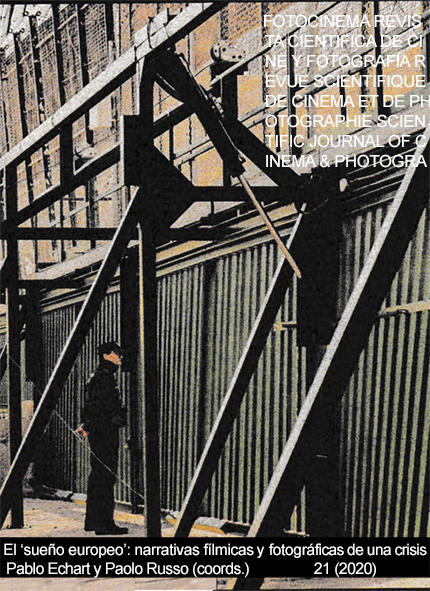
Europe and the European Dream in the film arts. An analysis of the impact of the European cinema within its own territory
DOI:
https://doi.org/10.24310/Fotocinema.2020.vi21.10001Keywords:
Europe, European Films, European Dream, Representation Studies, UNICAbstract
This paper investigates the impact of European film productions within their own territory. To this end, the representations of the idea of ??Europe and of the European Dream in the most watched films in Europe have been examined. Also analysed are representations of exclusively national realities within Europe, as well as those outside the European space but still consumed within the European film market.
The main research goal aims at finding out whether the optimistic coordinates pointed out by Rifkin in 2004 on the strength of the European Dream have had, more than a decade later, an impact on the cinema that is consumed within Europe. The investigation triangulates between quantitative content analysis of the annual reports of the International Union of Cinemas (UNIC) from 2015 to 2019; and narrative analysis, which seeks to shed qualitative light on the titles studied, especially those that address European national realities, the notion of Europe itself, or the idea of the European Dream.
The results ratify the main hypothesis, confirming that the representations of Europe and of the European Dream are barely represented in the films that Europeans watch the most.
Downloads
References
Downloads
Published
Dimensions
Citations




Issue
Section
License
All contents published in Fotocinema Revista científica de cine y fotografía are protected under the Creative Commons Attribution-NonCommercial-ShareAlike 4.0 International (CC BY-NC-SA 4.0) license. All about this license is available in the following link: <http://creativecommons.org/licenses/by-nc-sa/4.0>
Users can copy, use, redistribute, share and exhibit publicly as long as:
- The original source and authorship of the material are cited (Journal, Publisher and URL of the work).
- It is not used for comercial purposes.
- The existence of the license and its especifications are mentioned.
There are two sets of authors’ rights: moral and property rights. Moral rights are perpetual prerogatives, unrenounceable, not-transferable, unalienable, imprescriptible and inembargable. According to authors’ rights legislation, Fotocinema. Revista científica de cine y fotografía recognizes and respects authors moral rights, as well as the ownership of property rights, which will be transferred to University of Malaga in open access. The property rights are referred to the benefits that are gained by the use or the dissemination of works. Fotocinema. Revista científica de cine y fotografía is published in an open access form and it is exclusively licenced by any means for doing or authorising distribution, dissemination, reproduction, , adaptation, translation or arrangement of works.
Authors are responsable for obtaining the necessary permission to use copyrighted images.





13.png)