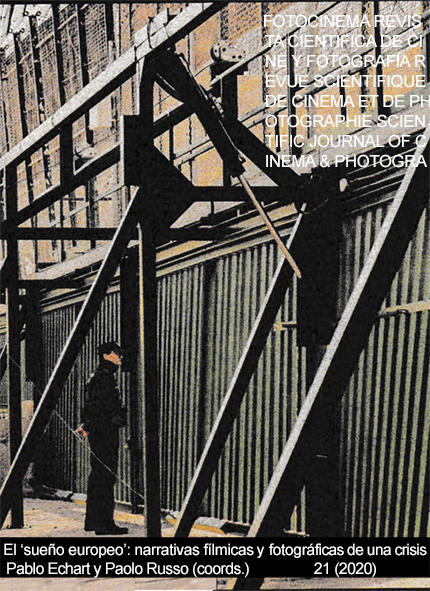
La crisis constructiva del sueño europeo en Metrópolis, de Fritz Lang. Un estudio contextual comparado de los mitos de Prometeo y Atlas
DOI:
https://doi.org/10.24310/Fotocinema.2020.vi21.10000Keywords:
Mythology, Cinema, Metropolis, Rockefeller Center, Aesthetic ideology, Open work of artAbstract
Almost one hundred years after its premiere, Fritz Lang's Metropolis remains a film of enormous complexity whose possible ideological interpretations continue to provoke controversy. This article studies Metropolis in parallel with other ideological interpretations of the same classic Greek myths explored, such as those of Prometheus and Atlas. In particular, a comparison is made with the iconographic project of the Rockefeller Center in New York, which follows a similar aesthetic and also makes an ideological use of the same myths. However, while Metropolis supposes a certain dystopian and preventive premonition of the crisis of the European dream (as seen in the totalitarian use of the same mythology by both Nazi Germany and the USSR), the Rockefeller Center symbolizes the most utopian project of the American capitalist dream. The comparative study between the distinct applications of these myths in different ideologies results in a renewed reading of the open meanings contained in Fritz Lang's film, which today more than ever—having overcome the methodological prejudices inherited from the Cold War— reveals themselves as universal and timeless.
Downloads
References
Downloads
Published
Dimensions
Citations




Issue
Section
License
All contents published in Fotocinema Revista científica de cine y fotografía are protected under the Creative Commons Attribution-NonCommercial-ShareAlike 4.0 International (CC BY-NC-SA 4.0) license. All about this license is available in the following link: <http://creativecommons.org/licenses/by-nc-sa/4.0>
Users can copy, use, redistribute, share and exhibit publicly as long as:
- The original source and authorship of the material are cited (Journal, Publisher and URL of the work).
- It is not used for comercial purposes.
- The existence of the license and its especifications are mentioned.
There are two sets of authors’ rights: moral and property rights. Moral rights are perpetual prerogatives, unrenounceable, not-transferable, unalienable, imprescriptible and inembargable. According to authors’ rights legislation, Fotocinema. Revista científica de cine y fotografía recognizes and respects authors moral rights, as well as the ownership of property rights, which will be transferred to University of Malaga in open access. The property rights are referred to the benefits that are gained by the use or the dissemination of works. Fotocinema. Revista científica de cine y fotografía is published in an open access form and it is exclusively licenced by any means for doing or authorising distribution, dissemination, reproduction, , adaptation, translation or arrangement of works.
Authors are responsable for obtaining the necessary permission to use copyrighted images.





13.png)