
On Nietzsche and the «Homeric Question»
DOI:
https://doi.org/10.24310/EstudiosNIETen.vi18.10874Keywords:
the Young Friedrich Nietzsche, the Homeric Question, Classic Scholarship (History of) Contest of Homer and Hesiod, Agonal SpiritAbstract
After a brief introduction on the often difficult and troubled relationship Friedrich Nietzsche had with his profession as a Classical philologist and with many of its representatives, our paper focuses on his three most significant contributions to Homeric studies: 1) his opening lecture at the chair in Basel, Homer and Classical Philology (1869); 2) his study of the Florentine manuscript on the «Contest of Homer and Hesiod», published in two instalments (1870 and 1873) in the Rheinisches Museum für Philologie, and 3) his brilliant 1872 essay on «The agôn in Homer». The central part of the first of these texts is extensively analyzed with the purpose of obtaining an in-depth understanding of certain widely-discussed passages. Additionally, several points of continuity between Nietzche’s early works and the subsequent development of his thought are underlined.
Downloads
References
Acampora, Ch. D. (2003), «The Contest between Nietzsche and Homer: Revaluing the Homeric Question», en N. Martin (ed.), Nietzsche and the German Tradition, Oxford/New York: Lang, 83-109.
Acampora, Ch. D. (2013), Contesting Nietzsche, Chicago/London: The University of Chicago Press.
Cataldi Madonna, L. (1983), Il razionalismo di Nietzsche. Filologia e teoria della conoscenza negli scritti giovanili, Napoli: Edizioni Scientifiche Italiane.
Foucault, M. (2001), «Qu’est-ce qu’un auteur?», en Dits et écrits I (1954-1975), Paris: Quarto-Gallimard, 817-849.
Gossman, L. (2000), Basel in the Age of Burckhardt. A Study in Unseasonable Ideas, Chicago/London: The University of Chicago Press.
Grafton, A. (1981), «Prolegomena to Friedrich August Wolf»: Journal of the Warburg and Courtault Institutes XLIV: 101-129.
Gutiérrez Girardot, R. (2000), Nietzsche y la filología clásica. La poesía de Nietzsche, Bogotà, Panamericana (1.ª ed. Buenos Aires: Eudeba, 1996).
Lloyd-Jones, H. (1982), «Nietzsche», en Blood for the Ghosts. Classical Influences in the Nineteenth and Twentieth Centuries, London: Duckworth, 165-181 (1.ª ed. en O’Flaherty et alii 1976: 1-15).
Nietzsche, F. (1967-), Nietzsche Werke. Kritische Gesamtausgabe, ed. de G. Colli y M. Montinari, Berlin/New York: Walter de Gruyter.
Nietzsche, F. (1982), Philologische Schriften 1867-1876. Zweite Abteilung bearbeitet von F. Borman und M. Carpitella, Berlin/New York: Walter de Gruyter.
Nietzsche, F. (1993), Appunti filosofici (1867-1869). Omero e la Filologia Classica, ed. de G. Campioni y F. Gerratana, Milano: Adelphi.
Nietzsche, F. (2005), Nosotros los filólogos, introd., trad. y notas de J. L. Puertas, Madrid: Biblioteca Nueva.
Nietzsche, F., Obras Completas, I-IV (OC ). Director ed. Diego Sánchez Meca. Madrid: Tecnos, 2011-2016
Nietzsche, F., Correspondencia I-VI. (CO). Director ed. Luis E. de Santiago Guervós. Madrid : Trotta, 2005- 2012.
Nietzsche, F., Fragmentos Póstumos I-IV (FP). Director ed. Diego Sánchez Meca. Madrid: Tecnos, 2006-2010.
O’Flaherty, J. C., Sellner, T. F. y Helm, R. M. (eds.) (1976), Studies in Nietzsche and the Classical Tradition, Chapel Hill: The University of North Carolina Press.
Porter, J. I. (2000), Nietzsche and the Philology of the Future, Stanford UP.
Porter, J. I. (2004), «Nietzsche, Homer, and the Classical Tradition», en P. Bishop (ed.), Nietzsche and Antiquity. His Reaction and Response to the Classical Tradition, Rochester, NY: Camden House/Boydell & Brewer, 7-26.
Pòrtulas, J. (2008), Introducció a la Ilíada. Homer entre la història i la llegenda, Barcelona: FBM.
Van Groningen, B. A. (1966), Theognis. Le Premier livre, ed. y comentario, Amsterdam: Noord-Hollandsche Uitgevers Maatschappij.
Vogt, E. (1962), «Nietzsche und der Wettkampf Homers»: Antike und Abendland XI, 103-113.
Wolf, Fr. A. (1985), Prolegomena to Homer [1795], trad., introd. y notas de A. Grafton, G. W. Most y J. E. G. Zetzel, Princeton, NJ: Princeton UP.
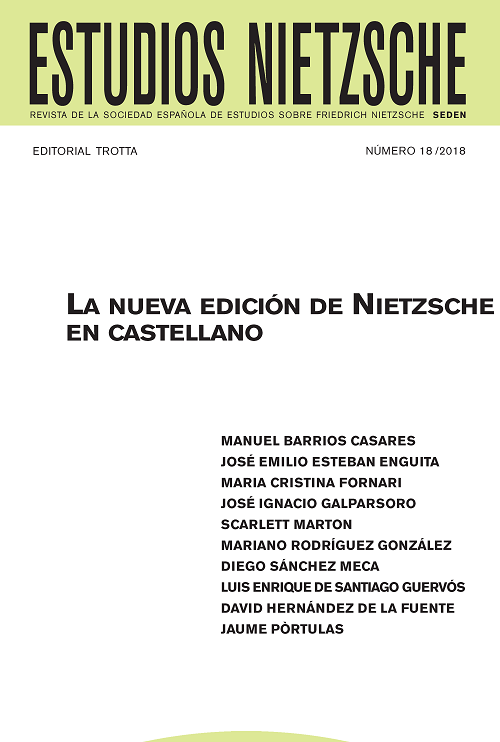
Downloads
Dimensions
Citations




Issue
Section
License
As of issue 21 (2021) this journal is published only in open access (diamond route).
From that number 21, like the previous numbers published in NIETZSCHE STUDIES, they are subject to the Creative Commons Acknowledgment-NoComercia-ShareIgual 4.0 license, the full text of which can be consulted at <http://creativecommons.org/licenses/by-nc-sa/4.0 >
It is the responsibility of the authors to obtain the necessary permissions of the images that are subject to copyright.
This work is licensed under a Creative Commons Attribution-NonCommercial-ShareAlike 4.0 International License.
Copyright generates two different rights: moral rights and patrimonial rights that EJFB recognizes and respects. Moral rights are those relating to the recognition of the authorship. They are rights of a personal nature that are perpetual, inalienable, unseizable and imprescriptible as consequence of the indivisible union of the author and his/her work.
Patrimonial rights are those that can be derived from the reproduction, distribution, adaptation or communication of the work, among others.

11.png)
