
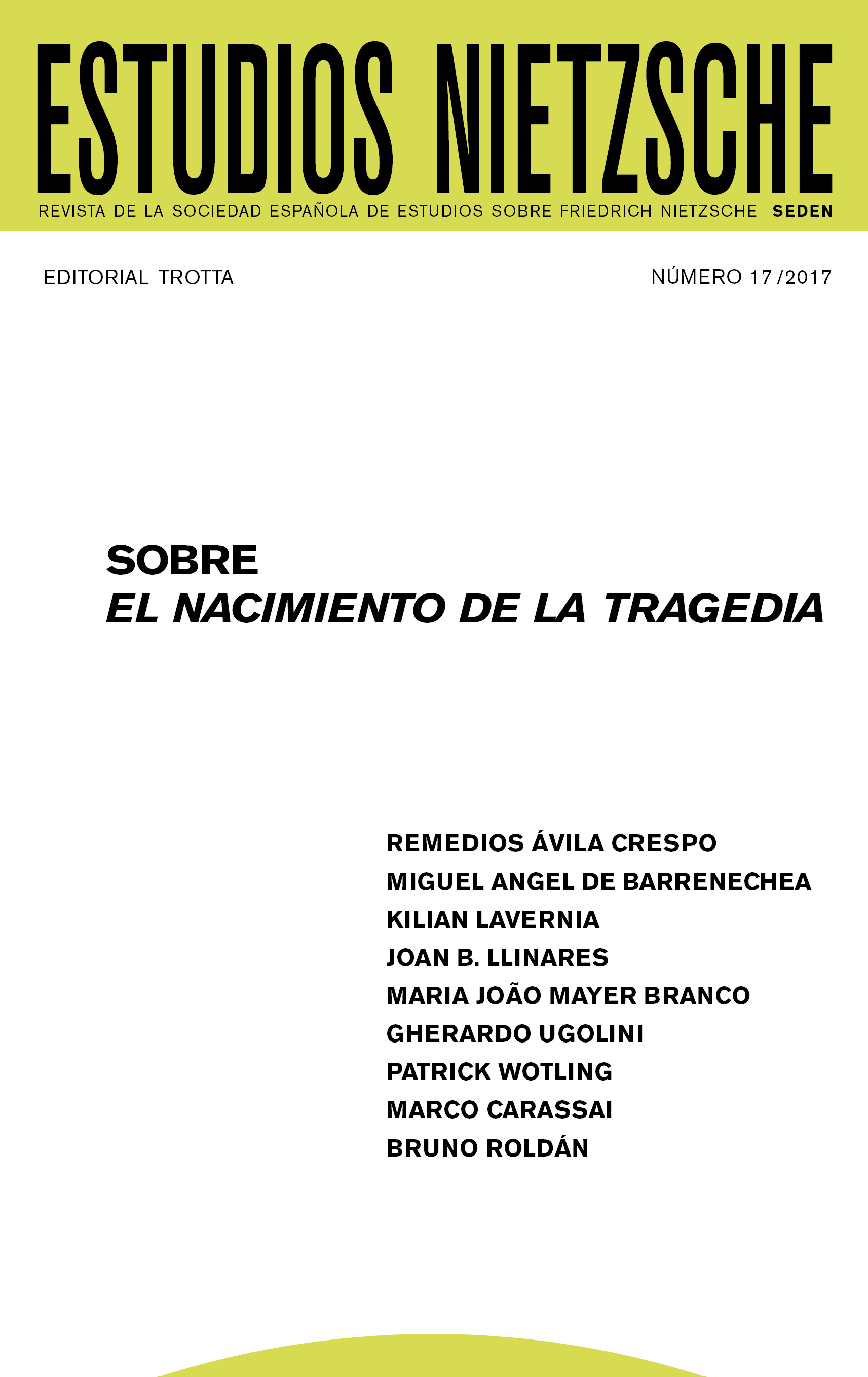
The enigma of the Dionysian and the intention in The Birth of Tragedy
DOI:
https://doi.org/10.24310/EstudiosNIETen.vi17.10845Keywords:
dyonisian, apollinian, tragedy, realityAbstract
This paper investigates the status and difficulties of the «dionysian» in The Birth of Tragedy, as well as the nature of the link between the apollinian and the dionysian drives. Although they are originally introduced in keeping with a dualistic perspective, important clues point to the possibility that they might in fact be asymmetrical, and suggest that the dionysian is to be considered the basis underlying the apollinian process. At the same time, however, it appears that the dionysian can only be thought of and reached by means of the apollinian process. What, then, does Nietzsche exactly aim at when developing the complicated logic of The Birth of Tragedy? Is it not, first and foremost, to reveal the peculiarity of our relationship to reality?
Downloads
References
Blanqui, Louis-Auguste La eternidad a través de los astros, México: Siglo XXI, 2000.
Boscovich, R. J., A Theory of Natural Philosophy, Chicago-Londres: Open Court Publishing Company, 1922.
Conill-Sancho, Jesús y Diego Sánchez Meca, Guía Comares de Nietzsche, Granada: Comares, 2014.
Deleuze, Gilles, Conversaciones, Valencia: Pre-Textos, 2014, p. 280.
Emerson, Ralph Waldo, Die Führung des Lebens, Leipzig: Steinacker, 1862.
Gerhardt, Volker, Friedrich Nietzsche. Also sprach Zarathustra, Berlín: Akademie Verlag, 2012.
Janz, C. P., Friedrich Nietzsche 3. Los diez años del filósofo errante, Madrid: Alianza, 1985.
Montinari, Mazzino, Lo que dijo Nietzsche, Barcelona: Salamandra, 2003.
Nietzsche, F., Obras Completas, I-IV (OC ). Director ed. Diego Sánchez Meca. Madrid: Tecnos, 2011-2016
Nietzsche, F., Correspondencia I-VI. (CO). Director ed. Luis E. de Santiago Guervós. Madrid : Trotta, 2005- 2012.
Nietzsche, F., Fragmentos Póstumos I-IV (FP). Director ed. Diego Sánchez Meca. Madrid: Tecnos, 2006-2010.
Schirnhofer, Resa von, «Vom Menschen Nietzsche»: Zeitschrift für philosophische Forschung 22/2 (abr. - jun., 1968).
Vogt, Johanes Gustav, Die Kraft. Eine real-monistische Weltanschauung, Leipzig: Haupt & Tischler, 1878.
Weber, Max, La ética protestante y el espíritu del capitalismo, Madrid: Akal, 1998.
Downloads
Dimensions
Citations




Issue
Section
License
As of issue 21 (2021) this journal is published only in open access (diamond route).
From that number 21, like the previous numbers published in NIETZSCHE STUDIES, they are subject to the Creative Commons Acknowledgment-NoComercia-ShareIgual 4.0 license, the full text of which can be consulted at <http://creativecommons.org/licenses/by-nc-sa/4.0 >
It is the responsibility of the authors to obtain the necessary permissions of the images that are subject to copyright.
This work is licensed under a Creative Commons Attribution-NonCommercial-ShareAlike 4.0 International License.
Copyright generates two different rights: moral rights and patrimonial rights that EJFB recognizes and respects. Moral rights are those relating to the recognition of the authorship. They are rights of a personal nature that are perpetual, inalienable, unseizable and imprescriptible as consequence of the indivisible union of the author and his/her work.
Patrimonial rights are those that can be derived from the reproduction, distribution, adaptation or communication of the work, among others.

11.png)
