
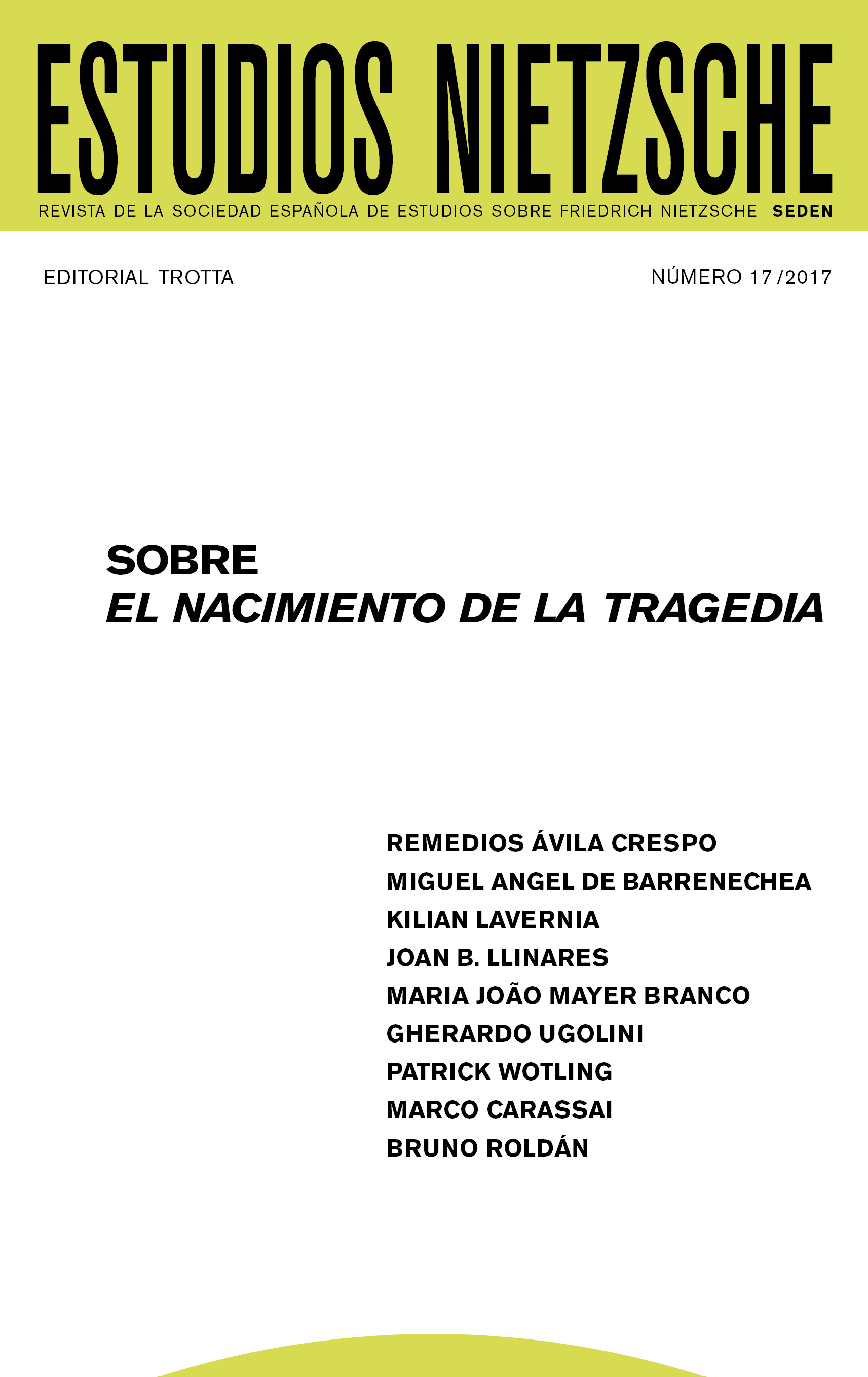
«Only chorus and nothing but chorus». The Role of the Tragic Chorus in The Birth of Tragedy
DOI:
https://doi.org/10.24310/EstudiosNIETen.vi17.10844Keywords:
tragic chorus, dionysiac, tragedyAbstract
In his Birth of Tragedy Friedrich Nietzsche famously developed a «dionysiac» theory of the tragic chorus. Nietzsche’s is a theoretical model that touches on aesthetic, philosophical and even philological concerns, while explicitly reacting against the most prevalent nineteenth-century theories on the subject, such as August Wilhelm Schlegel’s theory of the chorus as «ideal spectator» and Friedrich Schiller’s one, which sees the chorus as a «living wall». A correct approach and understanding of this problem cannot be achieved
only by looking at Nietzsche’s Birth of Tragedy, but should be include other fundamental works such as The Greek Music Drama and his Basel lectures. In particular my analysis concentrates here on three aspects, which have a crucial meaning in Nietzsche’s conception: the chorus’s original centrality in the tragic performance, its relationship with the cult of Dionysus, and the chorus’s own specifically «dionysiac» function in the tragic performance.
Downloads
References
Borchmeyer, D., Das Theater Richard Wagners. Idee - Dichtung - Wirkung, Stuttgart 1982.
Calder III, W. M., - R. Schlesier R. Schlesier, Zwischen Rationalismus und Romantik. Karl Otfried Müller und die antike Kultur. Darmstadt 1998.
Decher, F., Nietzsches Metaphysik in der «Geburt der Tragödie» im Verhältnis zur Philosophie Schopenhauers, «Nietzsche-Studien» 14, 1985, pp. 110-125,
Dowerg, R., Friedrich Nietzsches «Geburt der Tragödie» in ihren Beziehungen zur Philosophie Schopenhauers, Leipzig 1902.
Else, G. F., The Origin and Early Greek Form of Greek Tragedy, Cambridge Mass. 1965.
Gentili, B., Il coro tragico nella teoria degli antichi, «Dioniso» 55, 1984/1984, pp. 17-35.
Grande, C. del, TRAGODIA. Essenza e genesi della tragedia, Napoli 1952.
Ieranò, G., Il ditirambo di Dioniso. Le testimonianze antiche, Pisa-Roma 1997.
Isler-Kerényi, C., Civilizing Violence. Satyr on 6th Century Greek Vases, Göttingen 2004.
Leonhardt, J., Phalloslied und Dithyrambos. Aristoteles über den Ursprung des griechischen Dramas, Heidelberg 1991.
Lessing, G. E., Hamburgische Dramaturgie, in Werke, Bd. IV, Dramaturgische Schriften, hrsg. von K. Eibl, München 1973 [1767-1769], 59. Stück, p. 504).
Müller, K. O., Geschichte der griechischen Literatur bis auf das Zeitalter Alexanders, Breslau 1857 [1841].
Nietzsche, F., Obras Completas, I-IV (OC ). Director ed. Diego Sánchez Meca. Madrid: Tecnos, 2011-2016
Nietzsche, F., Correspondencia I-VI. (CO). Director ed. Luis E. de Santiago Guervós. Madrid : Trotta, 2005- 2012.
Nietzsche, F., Fragmentos Póstumos I-IV (FP). Director ed. Diego Sánchez Meca. Madrid: Tecnos, 2006-2010.
Patzer, A. H., Die Anfänge der Tragödie, Wiesbaden 1962.
Reibnitz, B. von, Ein Kommentar zu Friedrich Nietzsche, «Die Geburt der Tragödie aus dem Geiste der Musik» (Kap. 1?12), Stuttgart/Weimar 1992.
Schadewaldt, W., Hellas und Hesperien. Gesammelte Schriften zur Antike und zur neueren Literatur, Zürich 19702 [1960].
Schiller, F., Ueber den Gebrauch des Chors in der Tragödie, in Schillers Werke, Bd. X, hrsg. von S. Seidl, Weimar 1980 [1803].
Schlegel, A. W., Über dramatische Kunst und Literatur. Vorlesungen, Heidelberg 1809-1811.
Schmidt, J., Kommentar zu Nietzsches «Die Geburt der Tragödie», Berlín-New York, De Gruyter, 2012.
Ugolini, G., Sofocle e Atene. Vita politica e attività teatrale nella Grecia classica, Roma 2000.
Wagner, R., Beethoven, Leipzig 1870.
Zimmermann, B., Dithyrabus. Geschichte einer Gattung, Göttingen 1992
Downloads
Dimensions
Citations




Issue
Section
License
As of issue 21 (2021) this journal is published only in open access (diamond route).
From that number 21, like the previous numbers published in NIETZSCHE STUDIES, they are subject to the Creative Commons Acknowledgment-NoComercia-ShareIgual 4.0 license, the full text of which can be consulted at <http://creativecommons.org/licenses/by-nc-sa/4.0 >
It is the responsibility of the authors to obtain the necessary permissions of the images that are subject to copyright.
This work is licensed under a Creative Commons Attribution-NonCommercial-ShareAlike 4.0 International License.
Copyright generates two different rights: moral rights and patrimonial rights that EJFB recognizes and respects. Moral rights are those relating to the recognition of the authorship. They are rights of a personal nature that are perpetual, inalienable, unseizable and imprescriptible as consequence of the indivisible union of the author and his/her work.
Patrimonial rights are those that can be derived from the reproduction, distribution, adaptation or communication of the work, among others.

11.png)