
«Despite fear and compassion...».The value of katharsis in The Birth of Tragedy
DOI:
https://doi.org/10.24310/EstudiosNIETen.vi17.10843Keywords:
katharsis, tragedy, AristotleAbstract
The paper focus on the role of the concept of katharsis in The Birth of Tragedy. After briefly describing the interpretative context of the Greek term inherited by Nietzsche and clarifying his position towards this same context, it claims, first, that Nietzsche does not understand katharsis as the suppression of the affects of fear and pity; secondly, that these affects are at the core of the effect of tragedy such as Nietzsche understood it. In order to present these claims, the paper re-examines Bernays’ interpretation of Aristotle’s understanding of katharsis and elucidates its influence upon the «purely aesthetic» interpretation of the effects of tragedy that Nietzsche puts forward on his first published work.
Downloads
References
Bailly, J. C., Le champ mimétique, Paris : Éditions du Seuil, 2005.
Balaudé, J.-F. et Wotling, P., “L’art de bien lire”. Nietzsche et la philologie, Paris, Vrin, 2012.
Billings, J. / Leonard, M. Tragedy and the Idea of Modernity, Oxford: Oxford University Press, 2015.
Billings, J. / M. Leonard, Tragedy and the Idea of Modernity, Oxford: Oxford University Press, 2015.
Borsche. T. / F. Gerratana / A. Venturelli « Centauren-Geburten ». Wissenschaft, Kunst und Philosophie beim jungen Nietzsche, Berlin / New York: Walter de Gruyter, 1994.
Denat, C. / Wotling, P. (éds.), Nietzsche. Les premiers textes sur les Grecs, Reims: Éditions et presses universitaires de Reims, 2016.
Krell, D.F., The Tragic Absolute. German Idealism and the Languish of God, Bloomington and Indianopolis: Indiana University Press. 2005.
Loraux, Nicole, La voix endeuillée. Essai sur la tragédie grecque, Paris: Gallimard, 1999.
Müller, E., «“Aesthetische Lust” und “dionysische Weisheit”. Nietzsches Deutung der griechischen Tragödie » en Nietzsche-Studien, Bd. 31, Berlin / New York: Walter de Gruyter, 2002.
Nietzsche, F., Obras Completas, I-IV (OC ). Director ed. Diego Sánchez Meca. Madrid: Tecnos, 2011-2016
Nietzsche, F., Correspondencia I-VI. (CO). Director ed. Luis E. de Santiago Guervós. Madrid : Trotta, 2005- 2012.
Nietzsche, F., Fragmentos Póstumos I-IV (FP). Director ed. Diego Sánchez Meca. Madrid: Tecnos, 2006-2010.
Porter, James, I. , Nietzsche, Tragedy, and the Theory of Catharsis en Skenè. Journal of Theatre and Drama
Studies, 2:1 2016 (p. 202).
Porter, James, I., Nietzsche, Tragedy, and the Theory of Catharsis, en: SKENÈ Journal of Theatre and Drama Studies, 2:1 (2016), pp. 201-228.
Silk , M.S., / J. P. Stern, Nietzsche on Tragedy, Cambridge: Cambridge University Press, 1981.
Ugolini, G., Guida alla lettura della Nascita della Tragedia di Nietzsche, Roma-Bari: Editori Laterza, 2007.
Vöhler. M. / D. Linck (hg.) Grenzen der Catharsis in den moderne Kufstein. Transformationen des aristotelischen Modells seit Bernays, Nietzsche und Freud, Berlin / New York: Walter de Gruyter, 2009.
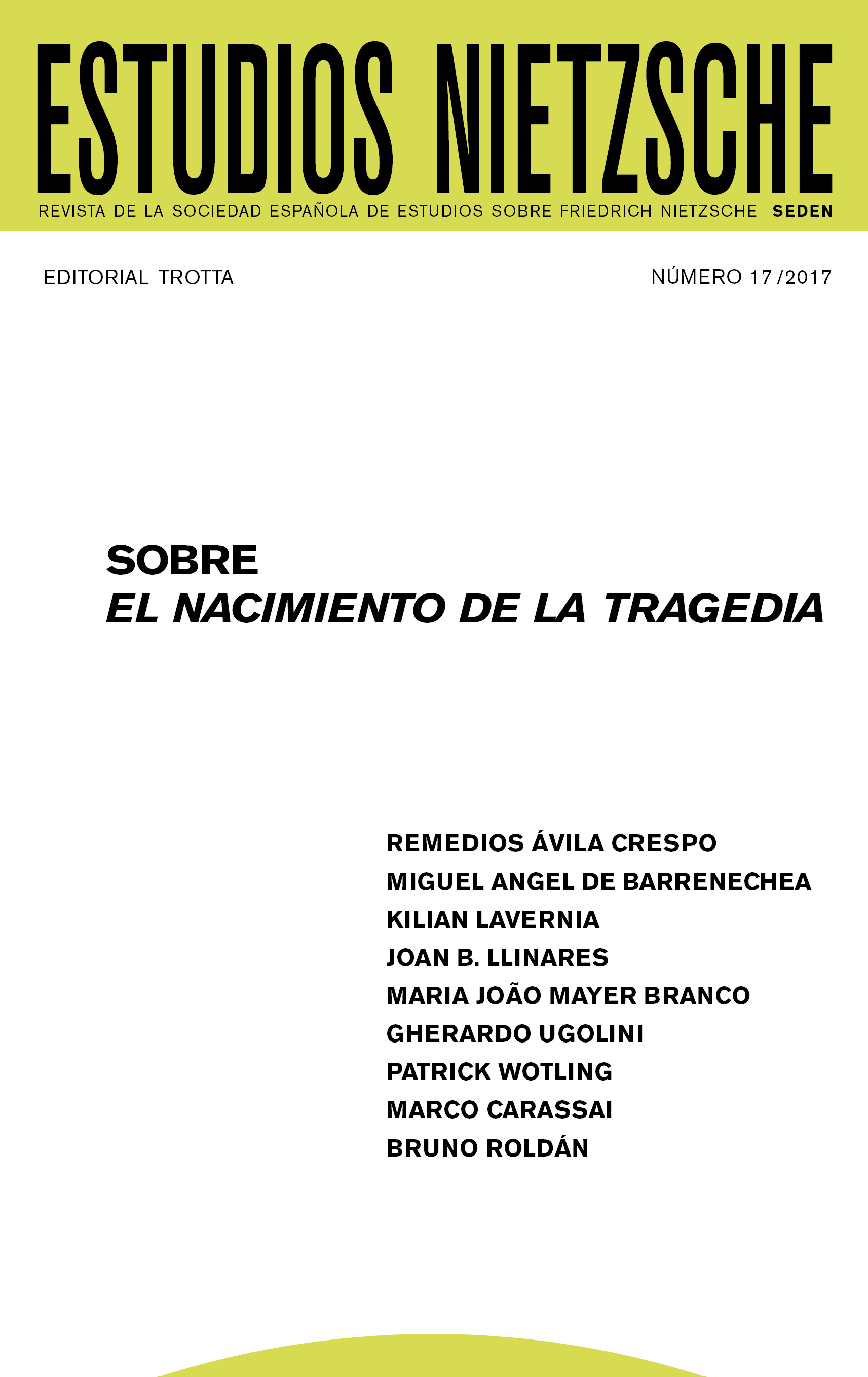
Downloads
Dimensions
Citations




Issue
Section
License
As of issue 21 (2021) this journal is published only in open access (diamond route).
From that number 21, like the previous numbers published in NIETZSCHE STUDIES, they are subject to the Creative Commons Acknowledgment-NoComercia-ShareIgual 4.0 license, the full text of which can be consulted at <http://creativecommons.org/licenses/by-nc-sa/4.0 >
It is the responsibility of the authors to obtain the necessary permissions of the images that are subject to copyright.
This work is licensed under a Creative Commons Attribution-NonCommercial-ShareAlike 4.0 International License.
Copyright generates two different rights: moral rights and patrimonial rights that EJFB recognizes and respects. Moral rights are those relating to the recognition of the authorship. They are rights of a personal nature that are perpetual, inalienable, unseizable and imprescriptible as consequence of the indivisible union of the author and his/her work.
Patrimonial rights are those that can be derived from the reproduction, distribution, adaptation or communication of the work, among others.

11.png)
